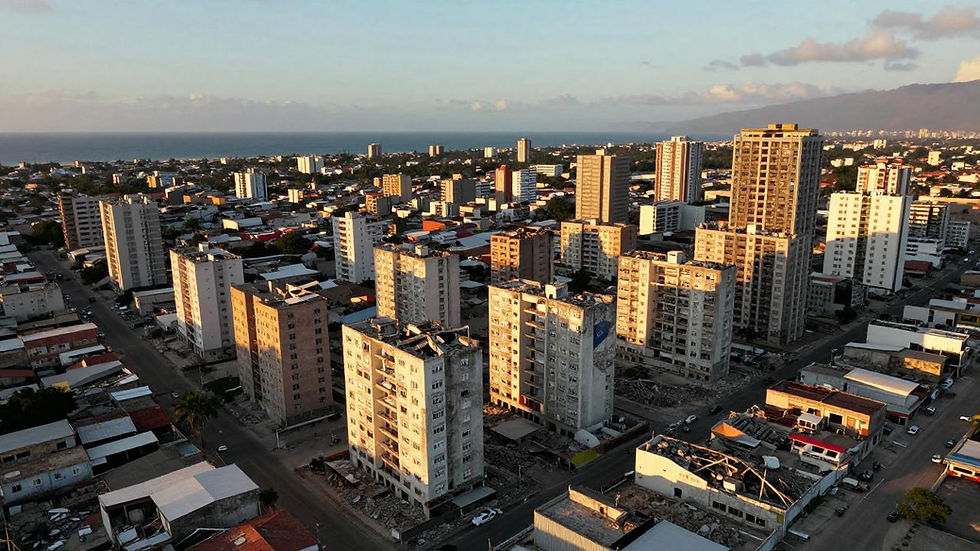
Guyana–US Defense Partnership Signed at the Pentagon Ahead of ICJ Ruling

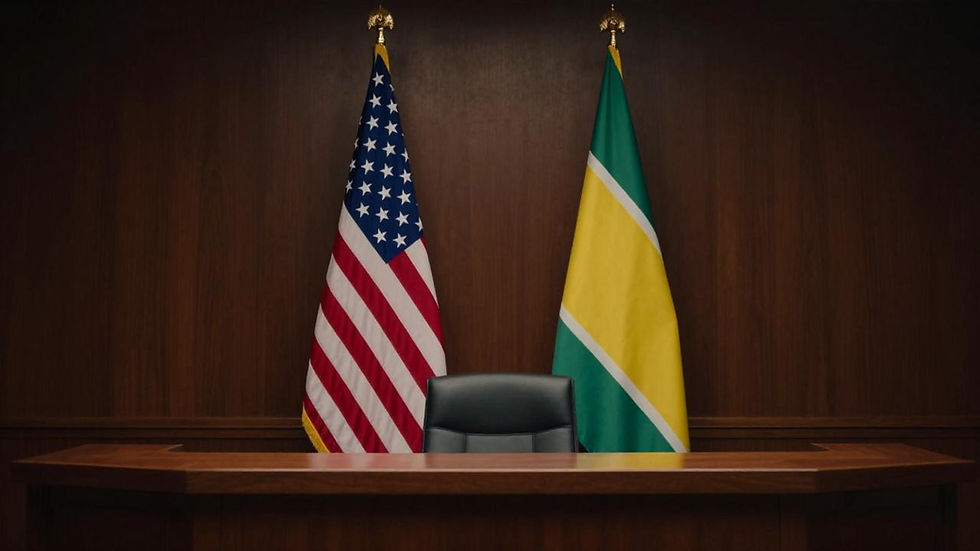
CES DAILY SIGNAL — October 26, 2026
On 21 October 2026, President Irfaan Ali and Secretary of War Pete Hegseth signed a Joint Declaration for an Enhanced Defense Partnership at the Pentagon, committing Washington to sustained defense expertise, multidomain training and combined exercises with the Guyana Defence Force, alongside strengthened air-domain awareness (DPI Guyana, 21 October 2026). Two days later, Ali told CNN that Georgetown would abide by whatever the International Court of Justice decides on the Essequibo claim — and that a judgment was now expected early in 2027 (Suriname Nieuws Centrale, 23 October 2026). The signature therefore lands in the interval between a claim filed and a verdict delivered, an interval Georgetown has chosen to occupy with a foreign military architecture rather than simply endure.
The Guyana–US defense partnership is an insurance policy bought before the verdict, not a reaction to it: Washington now holds a forward position in the disputed littoral whose value survives whichever way The Hague rules.
TRAJECTORY
Over the coming quarter the declaration migrates from text to footprint. Training rotations begin, air-domain awareness feeds are stood up, and the Guyana Defence Force starts acquiring the rudiments of maritime and aerial interdiction it has never possessed. Caracas answers in the register it has used for three years: declarations of sovereignty, militia and naval signalling along the Atlantic littoral, appeals to bodies that cannot bind Washington. When the ruling arrives it will not reset the board; it will be read against a military reality that has already hardened. The diplomatic track survives formally and atrophies practically — talks continue because neither capital can afford to be seen walking out, while the substance moves to the operational file. What matters is the speed at which American presence becomes visible enough to function as a tripwire, ahead of whatever the judgment brings.
SECOND-ORDER EFFECTS
Brasília loses its monopoly on mediation. With Lula returned for a fourth term, Brazil resumes the arbiter's chair it occupied after the 2023 San Vicente talks — but it now arbitrates between a party that has acquired a guarantor. Likely that its leverage narrows to procedural management: convening, sequencing, keeping channels nominally open.
CARICOM's legal solidarity separates from its security integration. Smaller Caribbean states that have defended Guyana's territorial integrity on principle now watch the same government embed itself in a counter-narcotics architecture many of them consider legally contestable. Realistic possibility of abstention rather than endorsement in regional fora.
Beijing's equity becomes politically awkward. China's share of the offshore consortium now sits under a security umbrella it cannot influence and would not want tested. Likely that Chinese commentary treats the arrangement as commercially tolerable while Chinese diplomacy declines to legitimise it.
ANALYSIS
Why the Guyana–US Defense Partnership Was Signed Before the Verdict
The timing is the argument. The ICJ merits phase is under way, and Venezuela has never consented to the proceedings — a position it defends by invoking Article 53 of the Court's Statute, which permits judgment even in the absence of a party (El Nacional, 22 October 2026). Ali's own framing, delivered to CNN and reported on 23 October, is that Georgetown will respect the outcome whatever it is, with a decision expected early in 2027 (Suriname Nieuws Centrale, 23 October 2026). That leaves a window of roughly one to two quarters between signature and verdict.
Into that window Washington has inserted a commitment that takes sixty to ninety days to become tangible. Highly likely that the sequencing was deliberate: a favourable ruling then lands on prepared ground, while an unfavourable one encounters a presence already difficult to reverse without cost. Hegseth's language at the signing — invoking "President Donald J. Trump's corollary to the Monroe Doctrine" and pushing back on "military influence from outside the Western Hemisphere" — reframes a bilateral territorial quarrel as hemispheric containment (U.S. Department of War, 21 October 2026). Likely that Caracas reads the doctrinal vocabulary, not the training schedule, as the operative signal.
The Guarantee Contains No Automatic Clause
What the text commits is precise but bounded: sustained defense expertise, multidomain training, combined exercises and improved air-domain awareness (DPI Guyana, 21 October 2026). What it does not contain is a mutual-defence trigger. Highly unlikely that the declaration obliges American forces to respond to a Venezuelan incursion as a matter of treaty; the language stays on capacity-building; collective defence would require a treaty this document never claims to be.
The industrial layer is thinner still. Hegseth described Guyana's pursuit of a memorandum of understanding on critical minerals as "crucial to the nations' collective security" and a bolster to a "shared defense industrial base" (U.S. Department of War, 21 October 2026). Reporting establishes the intention, not the instrument: no terms, no identified projects, no funding line. Realistic possibility that a signed minerals text emerges before the judgment, converting aspiration into procurement; unlikely that it specifies volumes or offtake within the same period (see our Critical Minerals 2026 Geopolitical Risk Assessment).
Washington's own diplomats have moved to soften the asymmetry. Ambassador Nicole Theriot insists the relationship is "50/50 absolutely," with "no dominance" (CANANews, 25 October 2026). The reassurance is itself informative: the question of imbalance is now salient enough in Georgetown to require an answer.
The Oilfield Does Not Wait for the Court
The commercial file is where the declaration earns its keep. The Stabroek Block, roughly 120 miles offshore, holds an estimated 11 billion barrels of recoverable oil, operated by ExxonMobil at 45% with Chevron at 30% and CNOOC at 25%; Guyana's oil revenues have passed $8 billion and real GDP has grown at an average of 47% a year since 2022 (CFR, 11 February 2026). Output reached 926,550 barrels a day by 28 February 2026, with the $12.7 billion Uaru facility due online later in the year and capacity projected to approach 1.7 million barrels a day by 2030 (OilPrice, 31 March 2026). Roughly a third of exports already move to the United States.
Part of that acreage lies off the disputed coast, which is why a security guarantee functions as a political-risk instrument. Likely that the declaration compresses the perceived premium attached to the next development sanction, because operators price the probability of administrative disruption, not the probability of invasion. Unlikely that it alters the physical schedule of Uaru or the four projects behind it (see our Guyana 2026 Geopolitical Risk Assessment).

The Arbiter Returns, Recentred
Lula's fourth term, secured with 51.75% against Flávio Bolsonaro's 48.25% (Al Jazeera, 26 October 2026), restores to Brasília the regional standing it used to slow the 2023 escalation. Ali's congratulatory message pledged closer cooperation on trade, investment and regional integration (News Room Guyana, 26 October 2026). Likely that Brazil prioritises procedural continuity over substantive settlement: hosting, sequencing and keeping both capitals at the table while the military file advances outside its reach.
The sharper complication is Guyana's own record. Georgetown demands that Caracas submit to international law over the disputed territory while continuing to hold the Tigri border area claimed by Suriname since 1969 — a dispute it manages bilaterally rather than judicially (Suriname Nieuws Centrale, 23 October 2026). That inconsistency hands Caracas a rhetorical instrument and gives Suriname a reason to stay silent rather than endorse. Realistic possibility that the selectivity is raised formally by a third state before the judgment (see our Venezuela 2026 State Collapse assessment).
SIGNALS TO WATCH
Named combined exercise published before 31 December 2026. If the Guyana Defence Force and U.S. Southern Command announce a dated, titled drill, the declaration has crossed from text to footprint.
Air-domain awareness node transferred to Guyanese custody before the ruling. A functioning radar or maritime-surveillance feed in national hands ahead of the verdict indicates Washington intends the capability to pre-date the judgment.
Sustained Venezuelan naval or militia presence within 50 nautical miles of the disputed littoral. A single patrol is signalling; rotation is positioning, and the reading above weakens if rotation begins.
Terms of the critical minerals memorandum published before the judgment. Identified projects and volumes would convert industrial-base rhetoric into a procurement reality.
---
Want deeper analysis?
Confidential advisory programs scoped to your organization — continuous monitoring, dedicated analysis, board-level support. Engagements are annual.
---
DISCLAIMER — This analysis is provided for informational and strategic planning purposes only. It is not investment advice, financial advice, or legal advice, and it should not be treated as such. Probability assessments reflect the analyst's calibrated judgment based on available open-source intelligence as of the date of publication, and are subject to revision as new information emerges. Some quantitative estimates and reported events are based on regional sourcing that may evolve as additional confirmation becomes available.