Guyana 2026: The Compounding Asset

Updated: Sep 29

Contents
The Verdict Without a Bailiff: A Border Case and the November Clock
The Compounding Machine: Six Years from Zero to 900,000 Barrels
The Transactional Frontier: Sindicatos, Gold, and Borrowed Gravity
Deterrence by Alignment: Radar, Liaison Officers, and the American Blanket
The Dragon Next Door: Post-Intervention Caracas and the New Caribbean Energy Map
Key Takeaways
January's decapitation did not settle the Essequibo question — it nationalised it. The 3 January capture of Nicolás Maduro removed the man, not the claim. Across the Venezuelan political spectrum, from Chavista apparatus to opposition, Essequibo remains a rare point of consensus. The acting president who replaced him travelled personally to The Hague to defend the claim while simultaneously rejecting the court's authority. This is now a structural feature, not a personality trait.
The court's verdict is the single highest-stakes date on the file. Oral hearings closed on 11 May 2026. Based on the court's historical deliberation timelines, a binding judgment is expected between November 2026 and January 2027. One party has pledged to comply whichever way it rules; the other has pre-declared non-compliance. The gap between those two positions is where every physical and financial risk in this file now concentrates.
The asset compounds faster than the threat accumulates. Production crossed 900,000 barrels per day in November 2025, set a record above 918,000 in February 2026, and holds seven sanctioned projects worth more than $60 billion in committed capital, targeting 1.7 million barrels per day by 2030. The government's per-barrel share has risen to 39.8 percent. For boards, the exposure question is no longer whether the prize is real — it is whether the security envelope around it is priced correctly.
Fiscal durability is deteriorating beneath record growth. A 16.2 percent projected GDP expansion in 2026, the world's fastest, coexists with the first year-on-year decline in sovereign fund withdrawals, a record $7.47 billion budget, and a deficit widening to 7.7 percent of GDP. The wealth mechanism is functioning; the buffer is thinning relative to the spending base it underwrites.
The frontier is not contested by armies — it is taxed by armed groups. Attacks on Guyanese security forces at Eteringbang, sindicato checkpoints on the Cuyuní River, and at least 26 armed groups operating in the adjacent Venezuelan mining arc constitute a slow, deniable erosion of effective sovereignty. This is the mechanism most likely to generate the incident that converts legal dispute into armed exchange — not a decision made in Caracas.
Portfolio-level: Guyana remains investable at the asset level and under-hedged at the jurisdictional level over a 6-12 month horizon. The November-January ICJ window is the designated repricing event; operators and lenders should complete exposure sequencing, contingency planning and political-risk stress tests before Q4 2026, not after the judgment lands. Energy-sector counterparties carry concentrated upside; anything touching the Essequibo interior carries concentrated physical risk.
1. The Decapitation Dividend: What January Did Not Change
The operation that removed Nicolás Maduro was not a settlement. It was a custody transfer.
In the early hours of 3 January 2026, more than 200 US special operations forces swept through Caracas in Operation Absolute Resolve, seizing the Venezuelan leader and his wife from the Fuerte Tiuna military complex while strikes suppressed air defences across northern Venezuela. An estimated 75 to 80 people were killed, including 32 Cuban special forces, according to CSIS satellite imagery analysis of the strike aftermath (CSIS, 10 January 2026). The raid exposed in a single night what years of sanctions had not: the Bolivarian armed forces could not protect the head of state inside its own largest fortress (Al Jazeera, 10 January 2026).
The analytical temptation after 3 January was to close the Essequibo file. Analysts told CNBC the intervention would put Venezuela's territorial claims "on ice" — to the audible relief of energy majors offshore (CNBC, 16 January 2026). The relief lasted roughly three months — too short to hold. This Guyana 2026 geopolitical risk assessment examines what the decapitation dividend did, and did not, change.
Two facts dismantle it. First, the claim is not Maduro's property. "Despite ongoing changes within the Venezuelan political landscape, the country's position on the Essequibo territory remains a rare point of consensus across both the Maduro-aligned government and the opposition" (IMUNA ICJ briefing, 19 January 2026). The claim survived the man who industrialised it. Second, his successor escalated its symbolism: Acting President Delcy Rodríguez, installed after the US operation, made her first overseas visits to Grenada and Barbados in April 2026 wearing a pin shaped like the Essequibo — prompting a formal protest from Georgetown to the CARICOM chairman as a "calculated and provocative assertion" of Venezuela's claim (AP, 28 April 2026).
The custodial state that emerged from January, as assessed in our Venezuela 2026 State Collapse report, monetises instability rather than resolving it — and its principal creditor is a territorial claim that now functions as compensation for everything Caracas lost. A state stripped of its oil prize through intervention retains, in Essequibo, the one nationalist asset no American raid can airlift to New York. It is therefore highly likely that over the next twelve months Caracas will continue to cultivate the claim rhetorically and administratively — maps, pins, decrees — even while lacking the capacity, and arguably the motive, to enforce it kinetically.
For organisations with Venezuela-adjacent exposure: assume the claim is a permanent feature of the operating environment, not a residual risk decaying after regime change; baseline any 24-month regional plan on continued low-intensity pressure, with fewer than 90 days between provocation cycles.
2. The Verdict Without a Bailiff: A Border Case and the November Clock
The International Court of Justice is not deciding a border. It is deciding whether one side owns a sentence it has already refused to read.
The oral hearings opened on 4 May 2026 in the Great Hall of Justice at The Hague, with Foreign Minister Hugh Hilton Todd telling judges that 70 percent of a sovereign state's territory was at stake — "a blight on our existence as a sovereign state from the very beginning" (AP, 4 May 2026). The plaintiff asked the court to declare the 1899 arbitral award, drawn by arbitrators from Britain, Russia and the United States, legally valid and binding. Venezuela spent its allocation of the room differently.
On the final day of hearings, Acting President Rodríguez — who had travelled to the Netherlands in person — defended her country's position by arguing that "political negotiations — not a judicial ruling — will resolve the century-old territorial dispute" (CNN, 12 May 2026). Her government had already stated in August 2025 that it would ignore the ICJ's final ruling, and she repeated before the court that the matter belonged to the 1966 Geneva Agreement's diplomatic machinery, not judicial determination (Breaking Belize News, 13 May 2026). Georgetown's attorney general countered by pressing for a judgment that was "clear, explicit and unambiguous", warning that any ambiguity would permit continued challenges to sovereignty (News Room Guyana, 8 May 2026).
The asymmetry is the analysis. One litigant has bound itself in advance to compliance regardless of outcome — a position consistent with a state whose position rests on legal title. The other has pre-committed to rejection, consistent with a state whose claim rests on will. The judgment's enforceability is therefore asymmetric by construction: it binds the party that volunteered for it and misses the party that did not. What the judgment can do, however, is decisive legal work: a ruling affirming the 1899 boundary would strip every future Venezuelan action — decree, election, pin — of any colourable legal foundation, converting persistence into naked aggression under international law.
The clock matters more than the ruling's content. The smaller litigant's government assesses, based on the court's historical six-to-eight-month deliberation pattern, that the judgment lands between November 2026 and January 2027 (Caribbean National Weekly, 15 September 2026). Given that Venezuela's rejoinder was filed in August 2025 and that the court has twice affirmed jurisdiction — in 2020 and 2023 — and granted provisional measures as recently as 2025 blocking elections in the disputed territory, it is highly likely that a judgment is delivered within this window. It is equally the case, on the evidence of Rodríguez's conduct, that non-compliance by Caracas is a near-certainty; the operative question is not whether Venezuela rejects the ruling but what form its rejection takes — administrative theatre, armed provocation, or delegation to criminal proxies.
For organisations with Essequibo-adjacent or maritime exposure: fix Q4 2026 as your hard planning deadline; baseline a 6-8 month runway from judgment to observable enforcement behaviour, and pre-position decision triggers on three signals — the judgment's publication date, Caracas's formal response within 72 hours of it, and any movement of naval assets toward the Stabroek perimeter.
3. The Compounding Machine: Six Years from Zero to 900,000 Barrels
The Stabroek Block is not a conventional oil province. It is a compounding instrument with a coastline.
First oil flowed in December 2019. By November 2025, production had reached 900,000 barrels per day following the ramp-up of the Yellowtail development to full capacity — the fourth mega-project to start up in five years (ExxonMobil, 12 November 2025). February 2026 set a record above 918,000 barrels per day, the highest monthly output since production began (Energy Magazine, 20 April 2026). By late February the country was lifting 926,550 barrels per day, securing its place as South America's second-largest producer, behind Brazil and ahead of Venezuela (OilPrice.com, 31 March 2026). Output averaged 914,000 in the first quarter, settling at 903,000 in April — a plateau, not a decline, with optimization work at Yellowtail expected to push that project alone toward 290,000 barrels per day (OilNOW, 2 June 2026).
The consortium is ExxonMobil (45 percent operator), Chevron (30 percent, via its 2025 acquisition of Hess) and CNOOC (25 percent), with more than $60 billion committed across seven sanctioned projects (ExxonMobil, 22 September 2025). Uaru, the fifth development, adds roughly 250,000 barrels per day on startup late in 2026; Whiptail follows in 2027; Hammerhead, sanctioned for 2029, adds a further 150,000, taking installed capacity past 1.5 million and the corporate trajectory toward 1.7 million by 2030. The block holds an estimated 11 billion barrels of oil equivalent in discovered resources. Nothing in the production numbers flinched during the January intervention, the March Hormuz shock, or the May hearings.
The pipeline behind the pipeline keeps extending: in March 2026, SBM Offshore was awarded front-end engineering and design contracts for an eighth development, Longtail, with a standardised Fast4Ward hull allocated ahead of government approval and final investment decision (World Oil, 24 March 2026). Eight FPSOs across eleven billion barrels is no longer a programme; it is a production system.
The compounding extends to the state's share. Georgetown's entitlement per barrel has risen to 39.8 percent of production — ExxonMobil recovered its investment roughly two years ahead of projection, shifting the split decisively toward profit oil (592Hub, August 2026). Budget documents project $2.4 billion in profit oil and $375 million in royalties for 2026 (Caribbean Council, 13 February 2026), with total oil revenues forecast near $4.3 billion — a 67 percent year-on-year increase driven partly by prices (Energy News Beat, 31 May 2026).
The macro-geopolitical tailwind deserves equal weight. The 2026 Iran war and the March closure of the Strait of Hormuz — the IEA has called it the largest supply disruption in the history of the global oil market — sent Brent past $118 at its March peak, with the EIA projecting an $87 average for the year (Al Jazeera, 12 August 2026; IEA Oil Market Report, March 2026). Reuters headlined the consequence plainly: a tiny Atlantic-coast state "poised for big Iran oil gains" (Reuters, 30 May 2026). The mechanics of that exposure — and why supply-side windfalls now carry their own geopolitical pricing — are examined in our Hormuz capex analysis. Because the offshore architecture sits squarely inside the disputed maritime envelope, it is likely that any post-judgment escalation path will begin at sea, not on land — coastguard incursions and harassment of FPSO support traffic being the cheapest instruments available to Caracas, as CSIS documented during the January 2026 naval incursion into the EEZ (CSIS, 8 September 2026).
For organisations with energy-sector exposure: treat the Stabroek production curve as the most reliable variable in the entire file — four FPSOs, ~911,000 bpd year-to-date average, +250,000 onstream by year-end — and stress-test counterparty and logistics assumptions against maritime harassment rather than force majeure; baseline disruption scenarios at 4-8 weeks of partial throughput interference, not full-field shutdown.
4. The Windfall Paradox: A Record Budget on a Shrinking Buffer
Georgetown's sovereign wealth fund is not a savings vehicle. At present trajectory, it is a pass-through account with a flag.
The Natural Resource Fund held approximately $4.35 billion at the end of July 2026 (Bank of Guyana, via 592Hub, 25 August 2026). Since deposits began in 2020 it has absorbed roughly $9.3-10.5 billion in inflows — and transferred out more than $6.7 billion to finance successive budgets. The 2026 approved withdrawal is $2.37 billion, down from $2.46 billion — the first year-on-year decline since deposits began, a function of softer 2025 prices rather than fiscal discipline (Rio Times Online, 3 July 2026). The fund's balance did nonetheless surpass $4 billion for the first time in April 2026, and is forecast to reach $11.7 billion by 2029 (592Hub NRF tracker; Caribbean Council, 13 February 2026).
The budget it feeds is the largest in the country's history: GY$1.558 trillion — about $7.47 billion — tabled by Finance Minister Ashni Singh, 12.7 percent larger than its predecessor and themed, without apparent irony, "Putting People First" (Caribbean Council, 13 February 2026). It finances the $100,000 cash grant, regional hospitals, schools and the Diamond Jubilee programme. It also widens the deficit sharply: projected revenue of GY$514.1 billion against current expenditure of GY$705.1 billion and capital expenditure of GY$779.6 billion produces a GY$448.9 billion shortfall — 7.7 percent of GDP (Stabroek News, 31 January 2026).
The paradox is structural, not cyclical. Real GDP grew 19.3 percent in 2025, and the IMF projects 16.2 percent for 2026 — the fastest expansion on earth (World Bank data via Hope Research Group; IMF). But the non-oil fiscal balance tells the disarming truth: deficits relative to non-oil GDP ran at -21 percent in 2024 and -13.2 percent in 2025 (Coface country file, 2026). Opposition-aligned fiscal analysts argue the classification of NRF withdrawals as current revenue "distorts fiscal reporting and masks the underlying dependence of the Budget on oil-financed transfers" (Stabroek News, 31 January 2026). A state budget quadrupled in five years to $6.7 billion by 2025 rests on a withdrawal mechanism calibrated to prior-year prices — meaning a sustained price decline transmits directly into the spending base with a twelve-month lag.
Meanwhile the demographic base absorbs the distribution. Roughly 196,000 voters withheld their ballots from Irfaan Ali in the September 2025 election even as his PPP/C won re-election with 36 of 65 seats, and the new WIN formation "shaken the pillars of the political establishment" (Guyana Chronicle, 21 December 2025; AS/COA, 9 September 2025). Distribution expectations compound like the oil does.
The labour-market offset is genuine but narrow. Non-oil growth ran at 14.3 percent in 2025 — real diversification momentum — yet the sector employs roughly 7,000 Guyanese nationals directly, across a 1,200-company local-content register (Ministry of Natural Resources, February 2026). ExxonMobil and its contractors have spent more than GY$600 billion with local businesses since 2015, including GY$87 billion with 1,800 vendors in the first half of 2025 alone, and over $3.6 billion in procurement since 2019 (ExxonMobil, August 2025; Routledge, August 2026). In June 2026 the Local Content Secretariat approved 2026 plans for more than forty oil-sector companies. The distribution question is thus not whether the windfall circulates — it is whether 7,000 direct jobs and a vendor register can anchor social legitimacy for a $7.5 billion state in which cash transfers, not payrolls, remain the primary transmission channel.
The demographic pressure arrives from both directions. Venezuelan migrants — Venezuelans are now the fastest-growing foreign nationality in the prison system, the home affairs minister has noted — strain social amenities and compete for informal employment, generating the xenophobic frictions documented across the region, while research consistently finds no causal link between migration and aggregate crime (Migration Brief; InSight Crime; OSAC country report). Perception outruns statistic; the political economy of grievance does not wait for the data.
Given the first-year withdrawal decline, softer price assumptions in the 2027 budget cycle, and an electorate now habituated to cash transfers, it is a realistic possibility that by end-2027 the government faces visible fiscal strain sufficient to force either a renegotiated withdrawal rule or a politically costly austerity gesture. The Norway-advised stewardship experiment (COP30 commitments, sovereign-wealth consultation) is real but thin against the arithmetic.
For organisations with fiscal-linked exposure: model the NRF withdrawal ceiling — not the fund balance — as your binding constraint; baseline 2027 budget assumptions on Brent at $70-75, a withdrawal below $2.4 billion, and capital-project slippage of 10-15 percent on the gas-to-energy and infrastructure programmes.
5. The Transactional Frontier: Sindicatos, Gold, and Borrowed Gravity
The Essequibo border is not garrisoned. It is metered.
In the dense jungle along the Cuyuní River, soldiers of the Guyana Defence Force came under gunfire while navigating a remote waterway near Eteringbang, deep inside the disputed territory (Miami Herald, 12 June 2025). The attackers were members of Venezuelan criminal syndicates — sindicatos — who had set up checkpoints along the river, charging miners and traders for passage. A Guyanese mining activist reported that "a number of miners have been robbed along the roadway coming out with their production and killed" and that mining camps had been ambushed by armed groups (InSight Crime investigation, June 2025). Crucially, InSight Crime's fieldwork concluded that the criminal interest in Essequibo "overlaps with the Venezuelan state's political ambitions" — deniability layered atop compellence.
This is the frontier's real operating system. The sindicato economy connects directly into the Venezuelan mining arc: at least 26 armed groups — gangs, mining syndicates, ELN guerrillas and FARC dissidents — operate in the border-state mining areas, according to an SOSOrinoco report, and Venezuelan armed forces launched a major operation in Bolívar state in June 2026 against illegal miners (Mongabay, 15 September 2026; Venezuelanalysis, 16 June 2026). Gold remains the connective tissue: illegally mined Venezuelan gold is reportedly smuggled eastward and laundered through trading hubs inside the territory, while criminal bosses like "Jhon 40" — a FARC dissident commander controlling the Acacío/Esequibo-area systems — tax mines, transport routes and the sex trade in near-slavery conditions (Crisis Group report 53, "A Curse of Gold"; Miami Herald, 10 April 2026).
R. Evan Ellis, Latin America research professor at the US Army War College's Strategic Studies Institute, frames the state-level logic precisely: "Venezuela's options today have narrowed even more than in the past, because where once it could count on the United States and some regional support, it is today isolated and weaker economically and politically than at any time in recent history. The Venezuelan sense of urgency today is palpable" (Inter-American Dialogue, 2026). A weakened state with an urgent claim and an armed, deniable non-state frontier is the compellence architecture CSIS diagnosed in Maduro's strategy — and the architecture, unlike Maduro, remains in place (CSIS, "The Essequibo Pressure Cooker").
Against this, the host state's coercive capacity is skeletal: a military of fewer than 5,000 troops for a country of some 800,000-830,000 people (AP, 5 February 2024), spread across a territory the size of Florida with few all-weather roads. The national homicide rate rose to 15.6 per 100,000 in 2025, with 130 killings — driven, the government insists, by disputes, not organised crime (InSight Crime, 31 March 2026). That statistical reassurance is beside the point; the security problem is not aggregate crime but the territorial denial system operating in a specific 61,600-square-mile envelope, where security-force presence is thin enough that "perpetrators are rarely investigated or prosecuted" (InSight Crime, 5 January 2026). The criminal geography mirrors the mineral geography traced in our critical minerals assessment, and the counter-narcotic architecture relevant to the wider corridor is assessed in our Colombia 2026 report. Absent a change in Caracas's cost-benefit calculus, it is likely that sindicato incursions and extortion activity in the territory will intensify through 2027, because the post-intervention vacuum in the Venezuelan border states has worsened, not improved — critics note the illegal mining crisis "has only worsened" since the US intervention (Mongabay, 15 September 2026).
For organisations with interior-operations or artisanal-mining exposure: treat the Cuyuní corridor from Eteringbang south as a denied area with checkpoint taxation, not a soft border; baseline duty-of-care posture on evacuation-by-river contingencies and per-site security cost uplifts of 15-25 percent on 2025 baselines.
6. Deterrence by Alignment: Radar, Liaison Officers, and the American Blanket
Georgetown does not defend its territory. It rents the appearance that someone else might.
The geography is unforgiving: the only road from Venezuela into the country runs through Brazil, and Brasília stated early that it would tolerate no military traffic on it (Reuters, 6 February 2024). With under 5,000 troops, the deterrent cannot be indigenous. So it is borrowed — and in 2026 the borrowing industrialised.
What the borrowed deterrent must cover has meanwhile thickened. CSIS satellite imagery tracked the deployment of Iranian-origin Zolfaghar missiles and a Págalo patrol vessel to Punta Barima — a secondary coastguard station on the Essequibo's doorstep — alongside the enlargement of the Anacoco Island base occupied since 1966 (CSIS, May 2025). By late 2025, reporting placed roughly 15,000 Venezuelan troops surged to the border against a Guyana Defence Force of some 5,000 total (The Antagonist Magazine, 5 January 2026). The American response layer is tangible: aircraft, helicopters, military drones and radar technology committed in 2024, followed by joint surveillance flights and adviser deployments (Guardian, 9 February 2024; AP, 5 February 2024). The market has already priced the gap: Lloyd's Joint War Committee added the country's waters to its listed risk areas in December 2023, and after the 2025 naval incursion, ExxonMobil Guyana faced the prospect of materially higher war-risk premiums on its offshore positions (Bloomberg, 18 December 2023; Demerara Waves, 3 June 2025).
The US relationship now spans hardware, doctrine and institutional plumbing. USSOUTHCOM and the GDF Coast Guard run a joint coastal-radar programme focused on maritime domain awareness (Stabroek News, 7 December 2025). In August 2026, the GDF and the US Department of State signed a memorandum of agreement formalising the assignment of liaison officers — the connective tissue that makes joint operations executable rather than rhetorical (Guyana Chronicle, 13 August 2026). SOUTHCOM commander Admiral Alvin Holsey visited Georgetown in May 2026 for meetings with the prime minister and Chief of Defence Staff Brigadier Omar Khan (Caribbean National Weekly, 16 May 2026). Secretary of State Marco Rubio, visiting in March 2025, set the deterrent line in plain language: it would be "a very bad day for the Venezuelan regime if it attacked Guyana or ExxonMobil" (International Crisis Group, 10 April 2025).
The partnership has been placed inside a hemispheric architecture. At the inaugural Shield of the Americas Summit at Trump National Doral on 7 March 2026 — the first multilateral meeting of Latin American heads of state convened by the second Trump administration — Energy Secretary Chris Wright met President Ali and described the country as "a huge part of this strategy, a very well-governed country with great energy resources", with Georgetown joining the new Americas Counter-Cartel Coalition (The Peninsula Foundation, 30 June 2026; CSIS, 9 September 2026). Below the US layer sits a lattice of secondary alignments: a July 2024 military cooperation agreement with France, including land and maritime radar systems offered and accepted (AFCEA Signal, 1 March 2026); an August 2025 aerial-surveillance MOU with Colombia (The Defense Post, 27 August 2025); Indian-donated aircraft and patrol-boat talks; Brazilian training; and CARICOM's Regional Security System (Geopolitical Monitor, 8 January 2026).
Brazil is the quiet load-bearing wall. Brasília condemned the 3 January operation and the capture of Maduro outright — President Lula reaffirmed the position after an emergency meeting of the foreign ministry (Agência Brasil, 3 January 2026) — yet the Brazilian defence ministry simultaneously confirmed the border with both neighbours remained "calm and open", and the deeper posture, mapped in our Brazil 2026 assessment, is cross-partisan refusal of any military solution: Roraima reinforced, transit denied to all belligerents (RUSI). Brazil will not fight for Georgetown, and it will not permit the fight either — an odd but effective inertial deterrent, since the only land route for invasion passes through it.
The vulnerability in this architecture is attention, not capability. As documented in our Venezuela 2026 report, Washington's security bandwidth in the hemisphere is inversely indexed to the Hormuz strike tempo — and 2026 has consumed that bandwidth at historic rates. The asymmetric economics of the challenge — cheap drones and swarms against expensive platforms, per our inverted strike-surface analysis — mean that a hostile actor need not defeat the American blanket to degrade it. It is therefore likely, not merely possible, that the effective deterrent threshold over the offshore perimeter weakens measurably within 18 months if Middle East commitments persist, since the liaison-radar-training lattice requires sustained American presence that history shows is the first casualty of competing theatres.
The insurance channel deserves separate emphasis because it is the file's most sensitive transmission mechanism. Marine war-risk cover in the region operates on a repricing trigger, not a loss trigger: a single listed-area reclassification can multiply hull premiums overnight, and industry assessments of the Venezuela crisis warn of sudden war-risk repricing and accumulation problems across Caribbean marine books (Insurance Business, 2026). Analysts judged that the January intervention reduced regional risk premiums (Hellenic Shipping News, January 2026) — which means those premiums now sit on a false floor that a single post-judgment incident would remove. It is likely that the repricing mechanism, not the military balance, becomes the first measurable economic casualty of any Scenario B trajectory.
For organisations with personnel or fixed assets in-country: index your duty-of-care posture to two published indicators — CENTCOM deployment tempo and SOUTHCOM engagement frequency in the Caribbean basin; baseline a degradation of overflight surveillance coverage and response-time within 6-12 months of any sustained Gulf escalation cycle.
7. The Dragon Next Door: Post-Intervention Caracas and the New Caribbean Energy Map
The intervention did not just change who governs Caracas. It changed what the Caribbean is for.
In February 2026, Washington issued Trinidad and Tobago two general licences providing "a clear and structured legal framework" for oil and gas activities in Venezuela and along the shared maritime border — restarting, under tiered conditions, the Dragon field project that April 2025 revocations had frozen (Jamaica Observer, 13 February 2026). Dragon holds roughly four trillion cubic feet of gas; Shell has aimed to begin production and export to Trinidad's Atlantic LNG-linked infrastructure, potentially as early as 2026 (Reuters, 20 March 2025). Shell and BP are meanwhile seeking licences for the Loran-Manatee field, holding some ten trillion cubic feet straddling the boundary (Reuters, 28 January 2026). The post-intervention thaw has effectively re-drawn a cross-border energy corridor that had been sanctions-frozen for a decade.
The consequence for Georgetown is double-edged. On one hand, the prospecting frontier around the country attracts breadth: TotalEnergies, QatarEnergy and Petronas indicate broadening interest beyond the Stabroek consortium (The Peninsula Foundation, 30 June 2026). The offshore pipeline — the 300 MW Wales gas-to-energy plant, first fire expected around 4 December 2026 and 57 MW on the grid by year-end — converts associated gas into domestic industrial capacity, doubling generation and targeting a 50 percent tariff cut (Rio Times Online, 12 September 2026; Guyana Chronicle, 9 May 2026). On the other hand, a licenced Caracas gas industry reintroduces Venezuelan hydrocarbons into the same maritime neighbourhood the court case is about — and an acting president styling herself as a technocrat "opening the country to investors", as CRS describes Rodríguez's post-sanctions pivot (Congressional Research Service, 13 August 2026), needs revenue far more than she needs a war.
The reputational substratum is thickening beneath the commercial map. In August 2026, the Inter-American Commission on Human Rights called for robust environmental and social assessment guarantees, public information access, and consultation with Indigenous communities around extractive projects in the region (IACHR statement, August 2026); critics assess that Venezuela's illegal mining crisis has worsened since the intervention, with at least 26 armed groups still operating across the Arco Minero (Mongabay, 15 September 2026; SOSOrinoco). For any operator whose supply chains touch the Guyanese-Venezuelan frontier — gold, timber, riverine logistics — the compliance exposure is no longer confined to sanctions screening; it now spans human-rights due diligence under the IACHR's sharpened scrutiny. Boards should read the commission's August statement as a leading indicator of litigation and exclusion-list risk, not as commentary.
Beijing completes the triangle. CNOOC holds 25 percent of Stabroek; bilateral trade reached an all-time high of about $1.4 billion in 2024; Foreign Minister Hugh Todd, visiting Beijing three years running, welcomed further Chinese investment ("Chinese companies have played a pivotal role in supporting our development goals") and the country was the first English-speaking Caribbean state to recognise the PRC, in 1972 (CNW Network, 13 May 2025; People's Map of Global China). Washington's instinct — a CSIS pre-summit paper framed the entire Shield of the Americas project around countering Chinese influence in the hemisphere (CSIS, 9 September 2026) — collides with the reality that one-fifth of the national oil consortium is Chinese. The playbook in Georgetown is to be what R. Evan Ellis's work at the Army War College keeps describing: the venue where both powers' commercial presence is welcomed and neither is allowed exclusivity.
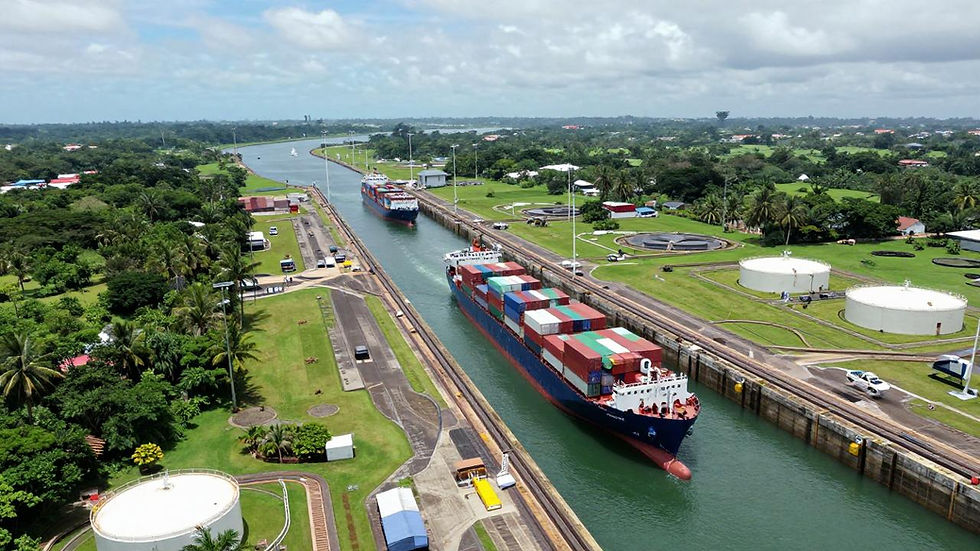
The structural risk in this section is jurisdictional contagion, not kinetic. The eviction of CK Hutchison from the Panama Canal terminals — executed by judicial fiat and transferred to Western operators, as assessed in our Panama Canal 2026 report — established a precedent that great-power competition can retroactively annul commercial concessions. Every Chinese-linked position inside a contested jurisdiction, including CNOOC's Stabroek stake, now carries that tail-risk premium. Given CNOOC's 25 percent interest, renewed US-China deterioration, and the demonstrated willingness in Caracas and Panama City to subordinate commercial paper to strategic alignment, it is a realistic possibility that within 24 months US policymakers explicitly scrutinise CNOOC's participation in the consortium — not to force divestment, but to attach compliance conditions that raise the transaction costs of that participation.
For organisations with cross-border Caribbean energy exposure: separate your licence-dependent from your licence-independent value chains; anything contingent on the Dragon/Loran-Manatee framework should be modelled on six-month licence renewal cycles, while Stabroek-anchored exposure should be stress-tested against CNOOC-related compliance friction rather than against sovereign expropriation.
8. Guyana 2026 Geopolitical Risk Assessment: Three Scenarios
Scenario A — The Adjudicated Equilibrium: Legal Settlement Without Physical Resolution (Probability: ~45–50%).
The ICJ delivers its judgment within the expected November 2026–January 2027 window, affirming the 1899 award and the existing boundary. Caracas rejects the ruling formally but confines its response to the administrative-theatrical register it has already rehearsed: decrees, map displays, ceremonies in the fictional Guayana Esequiba state. Production continues compounding through the Uaru startup; oil revenues land near forecast; the NRF balance passes $5 billion; budget execution proceeds with slippage but no rupture. The frontier criminal economy persists at current intensity — harassment, checkpoints, episodic violence — without a state-directed escalation. Deterrence holds because nobody tests it.
This scenario is elevated by the acting government's demonstrated preference for monetising the status quo over risking it, by Washington's demonstrated appetite for Caribbean stability at minimum bandwidth cost, and by Caracas's economic dependence on licences whose continuation is contingent on good behaviour. It is reduced only by two factors: the pre-committed non-recognition of the court removes the settlement's finality and leaves the dispute alive indefinitely, and the criminal frontier's autonomy from Caracas means escalation there requires no presidential order. The scenario holds unless a judgment more ambiguous than expected leaves both sides room to claim victory and thereby dissolves the clarity Scenario A presumes.
Scenario B — The Provocation Cycle: Verdict Rejection Weaponised (Probability: ~25–30%).
The judgment lands; Caracas rejects it; and this time the rejection acquires a kinetic edge. A coastguard incursion into the EEZ near the FPSO perimeter, a staged incident at Eteringbang attributed to sindicatos, a military parade in the claimed territory with missile deployments at Punta Barima — the documented toolkit remains available and now operates under a government that needs nationalist compensation for its humiliation. War-risk premia reprice discontinuously rather than gradually — the listed-area mechanism means a single incident reclassifies the theatre, multiplying hull and liability costs across every operator in the basin. FPSO support-traffic schedules are disrupted for weeks; the US responds with carrier presence and sanctions extensions, but stops short of a second intervention — bandwidth again. Freight and offshore logistics costs rise regionally; the market prices a persistent harassment discount rather than a war.
This scenario is elevated by the acting government's legitimacy deficit — Essequibo is the one cause that "unites all Venezuelan citizens", in her own words — and by the demonstrated availability of deniable instruments. It is reduced only by the FANB's exposed incapacity after Fuerte Tiuna, by Caracas's licence-linked revenue dependence, and by the Brazilian lock on the land route. The scenario holds unless the US signals — through pre-positioned naval assets or an explicit guarantee — that harassment triggers direct response, raising the cost above what the compensation is worth.
Scenario C — Reconstitution Rupture: The Claim Goes Hot (Probability: ~15–20%).
A fragmenting Venezuelan transition — an intra-apparatus succession fight, a collapsed concession architecture, or a US-China incident that unfreezes every frozen file — produces a faction that invigorates the claim as its legitimacy currency and executes a physical move: occupation of the Essequibo interior at Anacoco-style points, or a direct challenge to offshore operations. The US responds; Brazil seals Roraima; the region splits between intervention-condemners and security-freeloaders. Offshore production suffers material interference for the first time in the file's history; force majeure language activates; the entire regional energy corridor — Dragon, Trinidad LNG, the Suriname-Guyana basin — reprices.
This scenario is elevated by the sheer velocity of 2026's precedent: two events conventionally priced at near-zero — a US seizure of a sitting president and a closure of Hormuz — both occurred within a single quarter. It is reduced only by every actor's cost-benefit math: no faction in Caracas can win the fight, Washington cannot afford a third theatre, Brasília will not permit the road, and Beijing would lose a 25-percent stake in the prize. The scenario holds unless one of those four constraints breaks — an uncontrollable Caracas succession, a bandwidth collapse in Washington, a Brazilian political reversal, or a superpower rupture that makes the Caribbean a score-settling board.
9. Implications
Energy and commodities. Sequence licence-derived value ahead of judgment-dependent value: complete non-judgment-contingent investments before Q4 2026 and defer incremental commitments scheduled to close inside the November-January window. Stress-test every offshore logistics contract against 4-8 weeks of partial interference at a 3-5 nautical mile perimeter, not against full-field shutdown. Price political-risk cover now — post-judgment, if Scenario A prevails, that cover will be repriced upward on legality grounds, not downward.
Operations and security. Rebuild the country risk register around the Essequibo interior as a distinct jurisdiction inside the state — separate threat baselines, separate evacuation protocols, separate vetting standards for riverine contractors. Fix three early-warning indicators at defined thresholds: GDF incident reports from the Cuyuní corridor (any month-over-month doubling), FANB deployment announcements in Bolívar/Delta Amacuro (movement above garrison norms), and SOUTHCOM engagement frequency (any quarter with fewer than two senior visits). Budget security cost uplifts of 15-25 percent on interior operations for FY2027.
Cyber (structural exposure, inferred). No Guyana-specific incident is on the public record — a monitoring gap, not a safety statement. The structural exposure, however, follows from the file's own logic: the production system runs on remotely operated, IT/OT-converged offshore platforms whose global attack class is escalating (industrial ransomware up 64 percent year-on-year, Dragos 2026; an April 2026 joint US advisory documented an Iran-linked APT disrupting PLCs at energy-sector sites). In a file where asymmetric cost-advantage already favours the challenger, it is reasonable to treat the offshore control layer as an unpriced attack surface and to require OT segmentation audits of FPSO operators and shore-base contractors as a standing counterparty condition.
Finance and treasury. Treat the NRF withdrawal rule, not the fund balance, as the fiscal signal: model 2027 on a sub-$2.4 billion withdrawal and Brent at $70-75, and flag any supplementary budget request in H1 2027 as evidence of the pass-through problem maturing. For lenders, the relevant covenant exposure is not sovereign default — public debt remains among the region's lowest ratios — but execution risk on capital programmes financed by withdrawals that depend on prior-year prices.
Governance and reputational. CNOOC's 25 percent consortium position now carries a compliance-friction premium that grew when judicial annulment of foreign concessions became an accepted hemispheric instrument; audit counterparty chains accordingly and pre-position a position paper on consortium continuity under US-China deterioration. The vendor register is meanwhile a reputational asset class of its own — 1,200+ certified companies, $3.6 billion in procurement — and EMGL is actively seeking local insurers for the Longtail programme (Local Content Register RFI, August 2026); partner-selection and joint-venture due diligence should treat certification status and register history as material terms. Boards with Venezuela-linked interests should sequence, not straddle: value accruing under current licences before value dependent on their renewal, and continuous monitoring of the two genuine repricing triggers — the judgment's publication and Caracas's 72-hour response to it.
10. Core Analytical Judgment
Guyana's defining condition in 2026 is not prosperity, and it is not dispute. It is that the variables governing its security, its fiscal trajectory and its legal existence are coupled — and none of them is governed from Georgetown.
The judgment clock couples the country's sovereignty to a docket in The Hague. The deterrent that protects its offshore assets couples to a strike schedule in the Gulf. The fiscal buffer underwriting its record budget couples to a price set by a war it did not join, fought around a strait it has never seen. The criminal pressure on its interior couples to a mining economy inside a neighbour whose governing authority was installed by helicopter. And the consortium that produces the wealth couples a quarter of its capital to the one power whose presence in the hemisphere Washington has declared itself organised to counter. Every variable is coupled; the system oscillates between legal settlement and armed provocation; there is no stable equilibrium — only a compounding asset held in an account whose conditions are written elsewhere.
This Guyana 2026 geopolitical risk assessment reduces the country's position to a single architecture: the world's fastest-growing economy, built on a border it cannot defend, funded by a fund it is draining, awaiting a verdict it cannot enforce, under a security blanket it does not own. The house always compounds the bettor's stake — the question, in this file, is only who the house is.
---
If your organisation operates in or has exposure to offshore energy assets in the Stabroek Block, Essequibo interior operations, Caribbean maritime logistics, Venezuelan-adjacent supply chains, or sovereign-fund-linked fiscal instruments, CES Intelligence maintains 24/7 situational awareness and can provide bespoke risk assessments, crisis stress-testing, and board-level briefings.
Want more analysis like this?
Bespoke advisory available on request.
Thierry Marquez — Founder & Principal Advisor, CES Intelligence
+33 (0)9 55 16 54 98 →
DISCLAIMER
This analysis is provided for informational and strategic planning purposes only. It is not investment advice, financial advice, or legal advice, and it should not be treated as such. Probability assessments reflect the analyst's calibrated judgment based on available open-source intelligence as of the date of publication and are subject to revision as new information emerges. Some quantitative estimates and reported events are based on regional sourcing that may evolve as additional confirmation becomes available.