Venezuela Political Transition Risk: Machado's Return Starts the Clock Nobody Set

CES DAILY SIGNAL — October 27, 2026
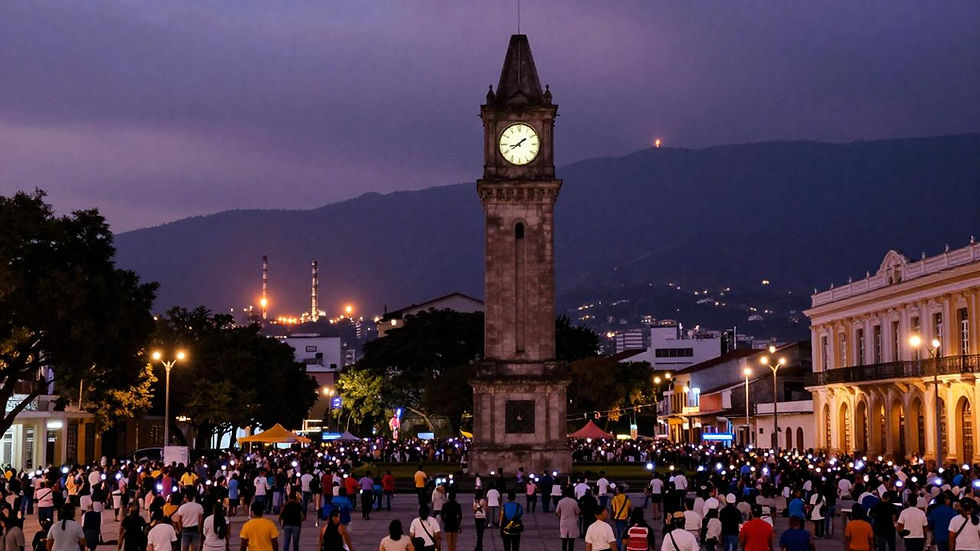
On Sunday afternoon, 25 October, two words on social media ended ten months of forced absence: "I am here. With you." María Corina Machado surfaced first at a church in Barquisimeto, 220 miles west of Caracas, then travelled through the night to the capital in a caravan of supporters — her first appearance in her country since slipping out by speedboat in December 2025 to collect the Nobel Peace Prize in Oslo (AP News, 25 October 2026). Weeks after she left, US forces captured Nicolás Maduro, who has been jailed in New York since, and his former deputy Delcy Rodríguez now governs from Caracas without a term limit anyone can name.
Machado's homecoming forces the deferred contest between popular legitimacy, Washington's sequenced transition and the Rodríguez interim — and for energy exposures the binding variable is not the return itself but an electoral calendar that still does not exist.
TRAJECTORY
Machado converts presence into pressure. Over the next three months she tests the streets, the state and the State Department in sequence: rallies first, then demands for a published timetable, then friction with the interim she refused to endorse. Washington manages the collision by accelerating the institutional checklist — new Supreme Court by year-end, new electoral council soon after — while keeping oil terms untouched. Rodríguez declares the presidency vacant only when the sequencing leaves her no rent in delay. A firm election date emerges late in the window at best; the pressure never resolves inside it.
SECOND-ORDER EFFECTS
US Gulf Coast refiners absorb blendstock volatility: the contract price of Venezuelan crude excludes the diluents extra-heavy grades require, meaning realised import economics swing on natural gasoline and condensate spreads rather than headline barrels — a likely margin-variance headache through the winter slate.
Colombian border authorities face renewed flow management: sustained street mobilisation without a calendar raises the odds of opportunistic outward movement toward Cúcuta — a realistic possibility if the timetable slips again.
Marine insurers reprice Lake Maracaibo-area exposure: planned vessel mobilisation jumping from roughly 100 to 900 in Zulia outruns any visible security upgrade to terminals and channels — war-risk premiums likely widen ahead of capacity (see our The Waterline, 2026).
ANALYSIS
The Venezuela Political Transition Risk Nobody Scheduled
The return was permitted, not arranged in her favour. Machado's movement counts seven failed re-entry attempts over recent months, from the United States, Panama and Curaçao, each blocked by Venezuelan authorities (Euronews, 25 October 2026). Secretary of State Marco Rubio disclosed on Monday that the interim government had been told "weeks and weeks ago" that she could land without interference — a framing that converts the arrival from defiance into choreography (AP News, 26 October 2026). In our reading, the sequencing is best understood as managed accommodation: Washington eased the door open days before the US midterms, when the political cost of appearing to muzzle a Nobel laureate peaked, while ensuring she re-enters a transition architecture built without her. Rodríguez, meanwhile, now leads an interim that has outlasted the authorisation it was originally given, with no election scheduled and no visible mechanism forcing one (AP News, 25 October 2026). Frictions between Machado's camp and the Trump administration over publishing a timetable are likely to mount across the next quarter — her stated election deadline is July 2027, an implied accusation against everyone slower than that (Reuters, 23 October 2026).
Two Clocks Running at Different Speeds
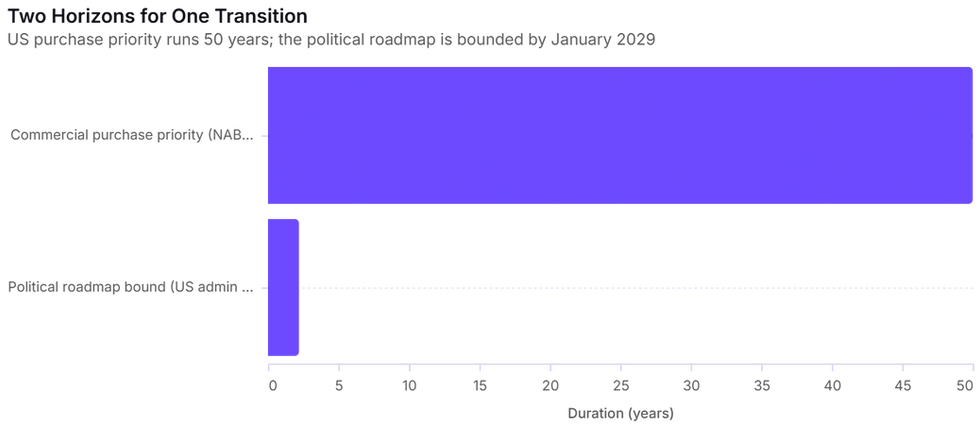
The structuring fact for energy exposures is a horizon mismatch. Washington's political roadmap runs on months: a renewed Supreme Court before end-2026, a new National Electoral Council shortly after, then — only then — a declaration of permanent vacancy that opens a six-month constitutional window for a presidential vote, with the whole process nominally bounded by January 2029, when this administration leaves office (per a senior State Department official, EFE, 26 October 2026; Axios, 27 October 2026). The commercial architecture runs on decades: seventeen field agreements targeting 65 million barrels, a US right to buy 20 percent of production at 30 dollars per barrel, purchase priority running 50 years, and a 35 percent US government stake in the operator's parent company (ProPublica, 21 October 2026; EFE, 26 October 2026). Expected investment of roughly 76 billion dollars across 61 bilateral agreements hangs on the second clock, not the first (EFE via El Tiempo, 26 October 2026). Maritime mobilisation in Zulia is slated to rise from roughly 100 to 900 vessels under the same framework, according to state media (telesur, 23 October 2026). This decoupling is the core Venezuela political transition risk for energy exposures: as long as the political clock can be wound forward indefinitely, the interim retains its usefulness to the commercial one — and the realistic possibility that a firm presidential date is actually fixed in the next three months coexists with the near-certainty that the oil terms survive whichever way it resolves.
The Majority Without a Seat
The excluded party is the polling leader. Talks promoted by Washington proceed between the interim and an opposition bloc headed by Dinorah Figuera, a track Vente has declined to join; Figuera has floated personally — no agreement exists — a vote in late 2027 or early 2028, well beyond Machado's July deadline (El Nacional, 24 October 2026). Against that sits the legitimacy arithmetic: a Meganalisis survey fielded 23–30 September puts Machado at roughly six respondents in ten, with no rival reaching double digits (Meganalisis, September 2026), a commanding lead corroborated in order of magnitude as negotiations resumed (Bloomberg, 14 October 2026). Her movement is already building the apparatus an election would require — a voter-registration application for the diaspora, developed over 18 months, launching Saturday, intended to feed a reformed electoral roll (Reuters, 23 October 2026). The gap between that organisational readiness and her absence from the table where the referee is being chosen is the load-bearing contradiction of the transition (see our Venezuela State Collapse, 2026). A pressure campaign outside the negotiation channel is highly likely to be her opening move.
SIGNALS TO WATCH
This sequencing holds only if the renewed Supreme Court bench is installed before year-end; slippage past mid-January 2027 pushes the earliest credible vote beyond July 2027.
Machado escalates to open-ended street mobilisation if the dialogue round scheduled for 11–15 November closes without a published electoral timetable.
Washington–Vente relations fray visibly if her movement is still excluded from the negotiating table when the new National Electoral Council is constituted.
War-risk premiums on Maracaibo-area hulls and cargo widen if Zulia vessel mobilisation scales toward the announced 900-figure without corresponding security and channel upgrades.
---
Want deeper analysis?
Confidential advisory programs scoped to your organization — continuous monitoring, dedicated analysis, board-level support. Engagements are annual.
---
DISCLAIMER — This analysis is provided for informational and strategic planning purposes only. It is not investment advice, financial advice, or legal advice, and it should not be treated as such. Probability assessments reflect the analyst's calibrated judgment based on available open-source intelligence as of the date of publication, and are subject to revision as new information emerges. Some quantitative estimates and reported events are based on regional sourcing that may evolve as additional confirmation becomes available.