
Mexico's Senate Makes the American Presence Routine

CES DAILY SIGNAL — October 30, 2026
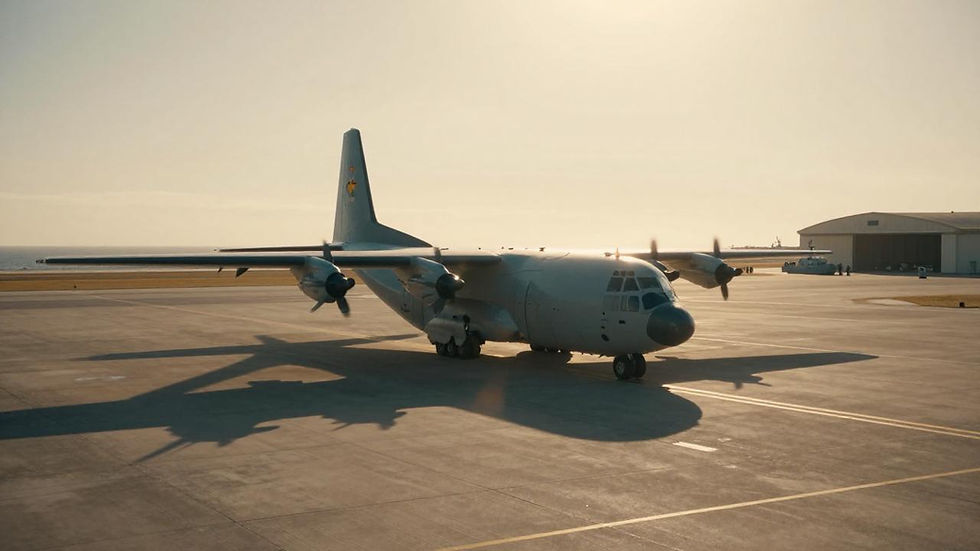
A US Air Force C-130 landed at La Paz, Baja California Sur, on 29 October carrying 28 operators of SEAL Team 4, cleared into Mexico with weapons, ammunition and tactical equipment (El Financiero, 28 October 2026). Their five-and-a-half-month engagement had been authorised the evening before: the Senate cleared the authorisation 87 votes to five, a tally that absorbed four additional votes cast after the initial count of 80 (El Financiero, 28 October 2026; Milenio, 28 October 2026).
Ratification by repetition is replacing negotiation: each Senate vote lowers the political cost of the next American footprint on Mexican soil.
TRAJECTORY
The engagement runs to 15 April 2027 and absorbs the winter pause without incident. A further US entry request reaches the Senate's Naval Commission before the end of February 2027, and it passes with a wider margin than the last. The training perimeter holds — no US operator joins a Mexican operational tasking — but the boundary between instruction and embedding narrows with each rotation. Washington treats the vote's lopsidedness as political inventory and spends it in the trade negotiation, while Sheinbaum defends the procedure in sovereignty language and quietly renews it. By spring, the Senate authorisation reads as a budget line.
SECOND-ORDER EFFECTS
For the White House, the margin lands as a verifiable cooperation deliverable days before the midterms, and likely reduces near-term appetite for unilateral measures against Mexico City — sequencing replaces ultimatum.
For Mexican exporters and capex planners, the Senate vote becomes collateral in a different bargain — the sectors absorbing the outcome of the security-for-tariffs exchange are those with the least margin left to absorb it.
For US nationals and corporate footprints in Mexico, greater visibility of American security presence cuts both ways; it is unlikely that cartels redirect targeting toward US interests within the window, but the incentive grows with each publicised deployment.
ANALYSIS
The procedure is the policy
Speed carried the story. The presidential request reached the Naval Commission on 26 October, transmitted through the Secretaría de Gobernación — the interior ministry that manages political crises — and the full chamber cleared it two days later (Milenio, 28 October 2026). The operators were on the ground the following morning. According to the official record, the engagement is designated Evento SOF 19, "joint land and maritime training" conducted at the Navy's advanced training centre in Donato Guerra, Estado de México, and at naval installations in Baja California Sur (Gaceta del Senado, October 2026). This is normalisation by accumulation, not by treaty: each authorisation expires on a fixed date, but the rhythm persists. The timing is not innocent. Days before the US midterm vote, the Trump administration had delivered a memo proposing a path for US security personnel to accompany counter-cartel operations inside Mexico (The New York Times, 24 October 2026). There is a realistic possibility that a further, wider request reaches the chamber within ninety days — carried by the precedent it just ratified rather than by any negotiated framework.
The accumulation ledger of US military presence in Mexico
The detached view that matters is longitudinal. This is the fourth authorisation of US military presence in Mexico approved by the Senate in under twelve months, after SEAL Team 2 in February, SEAL Team 8 and Marine elements in April, and 139 paratroopers of the 101st Airborne in September (Latin Times, 29 October 2026). The lineage runs further back: a Green Beret detachment authorised in September 2025 for work in Estado de México and Veracruz (Milenio, 28 October 2026). On the receiving end, per the approved documentation, 87 Mexican naval commandos drawn from four specialised units — special forces, parachute riflemen, amphibious commandos and naval intelligence — will rotate through SOF 19's six phases (El Financiero, 28 October 2026). The vocabulary throughout is adiestramiento, and that word performs real protective work, keeping the legal status short of anything operational. Individually, every entry is deniable as routine cooperation; collectively, the pattern builds what no single vote would authorise (see our Mexico 2026 Geopolitical Risk Assessment). It is highly likely that this cadence continues regardless of how the bilateral trade negotiation resolves — the entries are cheap, popular enough in a chamber that keeps approving them, and structurally useful to both capitals.
Three variables set the slope
The first variable sits in Washington, and it is dual-track. If the administration reads the midterms as vindication, pressure for a visible escalation — embedded advisers, not visiting instructors — will mount on the precedent now banked (see our US Midterms 2026 Geopolitical Risk Assessment); if it reads them as rebuke, the incentive is to pocket the cooperation narrative and stall. Either way, the arithmetic feeds the tariff file: a framework trade deal before 3 November would pair a Senate-ratified security deliverable with commercial relief, converting the vote's margin into negotiating capital (Reuters, 28 October 2026), while the July agreement holding tariffs at 25 rather than 30 percent showed the two files already trade against each other. The toll is already visible on the investment ledger: greenfield commitments fell 13.4 percent year-on-year in the first half of 2026, per Economy Ministry figures (Latin Times, 29 October 2026). Washington, for its part, is banking the security account publicly — the US Embassy in Mexico City claimed "historic results" in cooperation the very day of the vote (US Embassy Mexico City, 29 October 2026), even as the State Department advisory for Mexico held at Level 2 for terrorism, crime and kidnapping (US State Department, October 2026). The second variable sits in Mexico City. The five dissenting senators mark the visible floor of resistance, but the more telling signal came earlier in October, when Sheinbaum herself publicly questioned a binational police training academy in Querétaro — evidence that the presidential ceiling on US security presence is real, not rhetorical (Mexico News Daily, 5 October 2026). The third is calendar-bound: the December–January pause in SOF 19, and the phase rotation to Donato Guerra, offer natural checkpoints where scope could quietly widen or contract. Within ninety days, the drift from training toward embedded advising retains a realistic possibility — carried by procedure, aided by Washington's midterm arithmetic, constrained mainly by the president's own instinct for the appearance of sovereignty.
SIGNALS TO WATCH
This reading holds unless a further US entry request reaches the Naval Commission with a scope designation outside "adiestramiento" — watch the Senate gazette through February 2027.
Escalation becomes probable if US personnel are attached to any Mexican operational tasking outside the designated training installations before 15 April 2027.
The coupling thesis strengthens if a trade framework announced before 3 November is presented jointly with security-cooperation achievements; it weakens if the tariff pause lapses without a deal.
Deceleration shows first in the calendar: if the December–January pause extends past mid-January, the six-phase schedule slips and the cadence breaks.
---
Want deeper analysis?
Confidential advisory programs scoped to your organization — continuous monitoring, dedicated analysis, board-level support. Engagements are annual.
---
DISCLAIMER — This analysis is provided for informational and strategic planning purposes only. It is not investment advice, financial advice, or legal advice, and it should not be treated as such. Probability assessments reflect the analyst's calibrated judgment based on available open-source intelligence as of the date of publication, and are subject to revision as new information emerges. Some quantitative estimates and reported events are based on regional sourcing that may evolve as additional confirmation becomes available.


