EU Law Seals Nord Stream's Fate Beyond the Ukraine War


CES DAILY SIGNAL — October 29, 2026
On Wednesday afternoon, at the European Commission's daily briefing, chief spokesperson Paula Pinho faced the question her office had until then deflected: could the pipeline that once carried a third of Europe's Russian gas ever flow again once the guns fall silent in Ukraine? "We know far too well the hidden costs of being dependent on Russia for the purchase of fossil fuels," she replied, recalling that Moscow had weaponised supplies and that Europe had paid the price (Euronews, 28 October 2026). Minutes later, pressed again, the Commission anchored its answer in law rather than politics — and closed a door Washington and Moscow have spent a month trying to prise open.
Brussels has just converted a wartime position into permanent statute — and drawn, on the Baltic seabed, the legal border of the transatlantic divorce.
TRAJECTORY
The Commission's line holds through the winter and beyond the 2027 statutory deadline. The phase-out proceeds on a legislative track deliberately insulated from the sanctions regime, so battlefield dynamics and ceasefire diplomacy cannot touch it. Washington and Moscow keep probing — through envoys, would-be investors and leaked proposals — but find no European counterpart with the legal authority to say yes. The friction arrives in the second and third quarters of 2027, when pipeline-contract expiry collides with a structurally tight LNG market and the storage-triggered extension clause becomes the arena where member states price the political cost of coherence. Expect the derogation debate to surface well before the last deadline bites.
SECOND-ORDER EFFECTS
Ukraine loses a bargaining chip it never held on paper. Washington's reported framing — resumed transit through the Ukrainian network as a peace dividend — assumed Kyiv's pipeline geography could be monetised in a settlement. It is highly likely that Kyiv's leverage now concentrates on the military and diplomatic tracks, where it is thinner.
Central European utilities inherit a contract-frustration problem. Austria's OMV holds a Gazprom contract running to 2040, Hungary's MVM to 2036, Slovakia's SPP to 2028 (Bruegel, 2024) — but the statute terminates pipeline deliveries in September 2027 regardless of remaining term. Renegotiation, arbitration exposure and replacement-supply premia now sit on the balance sheets of buyers who cannot hedge their way out. A likely consequence is renewed Vienna-Budapest-Bratislava friction with Brussels over transition costs.
US and Qatari suppliers lock in a durable premium. With the eastern option foreclosed in law, European demand floors the Atlantic LNG franchise for years — a likely structural transfer from European industrial consumers to non-Russian producers.
ANALYSIS
A statute built to outlive the war
The mechanics of Wednesday's refusal matter more than its tone. The Commission did not invoke sanctions; it invoked Regulation (EU) 2026/261, adopted on 26 January 2026 after the Council-Parliament deal of December 2025. The stepwise prohibitions are dated and cumulative: short-term pipeline contracts ended 17 June 2026; long-term LNG contracts end 1 January 2027; long-term pipeline contracts — the Baltic system's category — end 30 September 2027, extendable to 1 November only if member states are off-track on their storage-filling targets under the gas storage regulation (Council of the EU, December 2025; Dentons, February 2026). Two design choices harden the wall. First, transition relief covers only contracts signed before 17 June 2025 and not subsequently amended — so nothing new can be grandfathered in (Dentons, February 2026). Second, the instrument is a regulation, not a sanctions package: it passed the ordinary legislative procedure, outside the unanimity that lets a single member state hold hostage any Russia-file sanction. "The legislation in force is not tied to sanctions or any geopolitical events either," energy spokesperson Anna-Kaisa Itkonen stressed (Euronews, 28 October 2026). This is a legal closure, not a negotiating posture — which is why Moscow finds no purchase on it, and why the position is likely to hold for exactly as long as the conflict endures (see our Energy Front — European Energy Security, 2026).
The transatlantic fight over Nord Stream runs under the Baltic
The reason Wednesday's briefing happened at all is a push that is no longer speculative. Reuters reported on 7 October that top Russian and US officials, including special envoy Jared Kushner and Kremlin investment envoy Kirill Dmitriev, discussed bringing a US investor into the pipeline system alongside renewed Russian gas sales to Europe. Per reporting by The Economist on 22 October, Washington went further — proposing restored Russian supplies to Europe as an economic sweetener for Moscow in peace talks, described as the latest prospective concession to Putin. A New York Times account of 17 October had envoys floating resumed flows through Ukraine's network; the White House denied the Baltic conduits were part of recent negotiations. At an Istanbul forum, Dmitriev called resumption "economically inevitable" (RIA Novosti, 22 October 2026). Arrayed against this convergence sits a firmer wall than either Washington or Moscow anticipated: the German government confirmed in a written Bundestag answer published 19 October that commissioning Nord Stream 2 is "not on the agenda" and its certification remains suspended, calling Russia an unreliable energy partner (RBC-Ukraine, 27 October 2026). The joint push over Europe's heads has produced the inverse of its intent — it welded Berlin and Brussels together (see our European Sovereignty Arithmetic, 2026). A widening rift with Washington is likely; a German reversal before a durable ceasefire is unlikely.
The buyers who cannot say goodbye
The statute's sharpest edges fall on actors who appear nowhere in Wednesday's exchanges. In the assessment of the EU Agency for the Cooperation of Energy Regulators, authorised Russian contracts still cover 45-55 bcm per year of capacity, with pipeline contracts of 16-26 bcm concentrated in Hungary, Slovakia and Greece — roughly 12 per cent of EU gas demand through May 2026 (ACER, 2026). That flow travels almost entirely through TurkStream, which has moved over 62 bcm since 2021, worth some €22 billion to the Kremlin (CREA/CSD, May 2025). Implementation, not intent, is the vulnerability: as reported by Forbes on 15 October, the EU is on course to miss even its January 2027 LNG milestone as Russian LNG imports rise rather than fall. There is a realistic possibility that Budapest and Bratislava convert that enforcement gap into a demand for flexibility at the September 2027 deadline — their energy ministers have been laying the rhetorical groundwork for a year.
The premium Europe pays for coherence
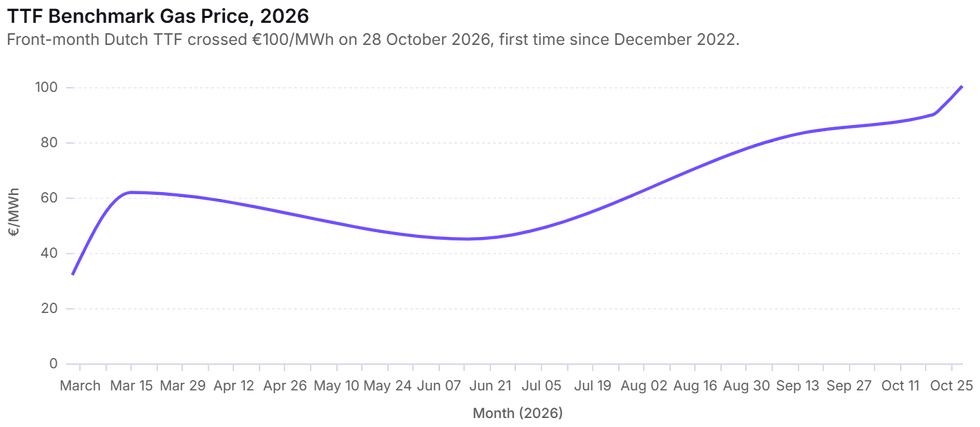
The declaration lands on an already distressed market. Front-month TTF crossed €100 per megawatt-hour on Wednesday for the first time since December 2022, up 4.1 per cent on the day and more than triple its level before the Iran war began — a conflict that has already added over €100 billion to Europe's fossil fuel import bill (Bloomberg, 28 October 2026). Storage stands at 75 per cent, the lowest for the date since 2011, after a refill costing an estimated €27 billion (ACER, 27 October 2026). In the assessment of the IEEFA, the EU may need to cut winter demand by 7 per cent year on year to balance the season (IEEFA, October 2026). Asian competition compounds the squeeze — the Platts JKM index topped $30/MMBtu, meaning Europe must outbid Asia for cargoes it can no longer legally replace from the east (UEEX, 26 October 2026). The clause is small; its existence is the story.
SIGNALS TO WATCH
The December European Council conclusions. If they open the door to "flexibility" on the 2027 phase-out beyond the existing 1 November extension, treat it as the first crack in the wall.
Winter 2026-27 storage trajectories against the filling targets. A shortfall that activates the 1 November extension clause converts a safety valve into precedent — watch the Commission's storage reports from February onward.
A verdict in the Hamburg sabotage trial, running since mid-October. If the court attributes responsibility to Ukrainian actors, the political temperature around the pipeline file in Berlin changes overnight — and pressure on the coalition becomes two-sided.
Any formal Hungarian or Slovak request for transition relief citing the rising-Russian-LNG enforcement gap. Preceded by diplomatic note, it signals Vienna and Bratislava have decided to force the derogation debate early.
---
Want deeper analysis?
Confidential advisory programs scoped to your organization — continuous monitoring, dedicated analysis, board-level support. Engagements are annual.
---
DISCLAIMER — This analysis is provided for informational and strategic planning purposes only. It is not investment advice, financial advice, or legal advice, and it should not be treated as such. Probability assessments reflect the analyst's calibrated judgment based on available open-source intelligence as of the date of publication, and are subject to revision as new information emerges. Some quantitative estimates and reported events are based on regional sourcing that may evolve as additional confirmation becomes available.