DR Congo's Ebola Epidemic Outruns the Response Built for It


CES DAILY SIGNAL — October 29, 2026
At close of business on Tuesday, Congo's National Public Health Institute put the epidemic past its threshold: 10,060 confirmed Ebola cases and 4,887 deaths across 66 health zones and eight provinces, a case fatality rate of 48.6 per cent (Reuters, 27 October 2026). The count crossed the line three days after a nurse responding to an alert in Bafwasende was killed by residents who blamed responders for poisoning local wells (AP, 26 October 2026). Together, the two facts define the problem: the virus is now outrunning the social contract that any containment strategy requires.
The 10,000-case threshold converts a Congolese epidemic into a continental stress test that Africa's containment architecture — and its empty shelf of licensed countermeasures — was never built for.
TRAJECTORY
Transmission holds near current intensity through the quarter. The national count passes 15,000 by late January, with Ituri and Nord-Kivu still carrying the load and Tshopo emerging as the hinge province. At least one additional African state records an imported case; none sustains uncontrolled community transmission outside the Great Lakes corridor. No Bundibugyo-specific vaccine or therapeutic reaches licensure or scaled deployment inside the horizon. The decisive variable is not viral but behavioural: whether contact tracing reconstitutes faster than insecurity dismantles it.
SECOND-ORDER EFFECTS
Landlocked trade. Corridor economies between Mombasa and the Great Lakes absorb the friction — driver screening, checkpoint delays, insurance premia — compounding through the first quarter and raising delivered costs for Uganda, Rwanda, Burundi and South Sudan before any formal closure decision. A lasting freight premium is likely even with the corridor nominally open.
Tourism season. East African operators enter the December–March peak carrying a messaging burden. Screening-led reassurance holds bookings likely only while imported cases stay clustered; a single locally acquired case in Kenya or Tanzania converts advisories into cancellations — a realistic possibility within the horizon.
Regulatory states. The absence of licensed tools pushes regulators into ad hoc trial frameworks; emergency-use pathways, not market authorisations, become the operative industrial policy for filovirus countermeasures — and the reputational bet lands on whichever regulator moves first. Consolidation around two or three candidate platforms is likely by January.
ANALYSIS
The DR Congo Ebola response is losing to its own arithmetic
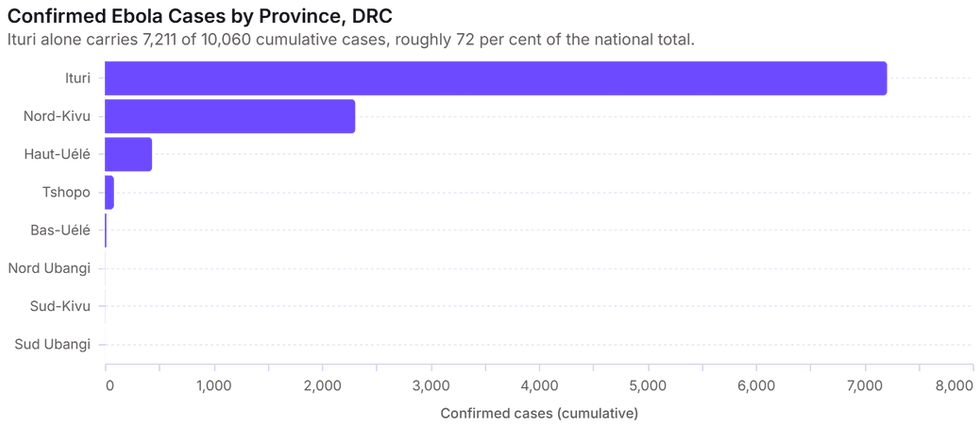
The Ministry's Tuesday report makes the mechanical case plainly. Roughly 80 per cent of new cases are being detected outside the chains of transmission that response teams monitor (Al Jazeera, 27 October 2026); per the standard Africa CDC applies, an outbreak approaches control only when at least 95 per cent of cases arise from known contacts. The last epidemic of this order — West Africa, 2014-2016 — needed two years to reach 28,600 cases and more than 11,000 deaths; Congo has logged over a third of that toll in five months (Reuters, 27 October 2026). That fifteen-point contact gap is the epidemic's true growth rate, and it compounds. Since May, 269 frontline responders have themselves been infected, 180 of them in Ituri (WHO, 23 October 2026); for operators in-country, that figure reads as a duty-of-care ledger — infection among response personnel is the leading indicator of the exposures confronting expatriate rotations, site clinics and medevac chains. The Bafwasende killing was the sharpest expression of a recurring pattern of attacks and work stoppages (UN News, 26 October 2026), and contact follow-up stood at 76.9 per cent in mid-October, down from 81 per cent a week earlier (WHO, 23 October 2026) — the wrong direction, five months in. Concentration persists nonetheless: Ituri alone accounts for 7,211 cumulative cases (ECDC, 27 October 2026), in a handful of zones the response already knows by name — terrain mapped in our theatre work (see our DR Congo Geopolitical Risk Assessment, 2026). This is a logistics-and-trust failure, not a virological novelty; nothing in the current data suggests reversal inside the window, and sustained suppression below the current plateau is unlikely before the second quarter of 2027.
A shelf built for the wrong virus
What separates this crisis from every comparable episode since 2014 is pharmaceutical, not epidemiological. Bundibugyo is the rarest of the ebolavirus species; no vaccine or therapeutic is licensed against it anywhere (WHO, 23 October 2026). The tool that ended past Congo epidemics — the Ervebo ring-vaccination platform — is Zaire-specific, and WHO restricts its use here to research protocols precisely because human protection against this strain is unproven (WHO, 9 September 2026). Regulators have converged on a triage of candidates: an rVSV-Bundibugyo construct, Oxford's ChAdOx1 vaccine and an mRNA candidate in prevention; remdesivir and the antibodies MBP-134 and maftivimab in treatment; obeldesivir for post-exposure prophylaxis (EMA, October 2026). All are early: the leading preventive candidate was assessed at seven to nine months from trial-readiness as of June (Nature Reviews Drug Discovery, 4 June 2026), and the first preventive trials opened only in July and August (The Lancet Infectious Diseases, October 2026). A licensed Bundibugyo countermeasure within 90 days is highly unlikely — containment rests entirely on behavioural measures for the rest of the quarter. The deeper dependency is industrial: surge manufacturing for rare strains was never built, a structural blind spot we treat elsewhere (see our Pharmaceutical Supply Chain Security: the Precursor Problem, 2026).
One fire brigade, three fires
WHO's own framing — an outbreak spanning the east, west and centre of the continent (AFP, 27 October 2026) — is a staffing problem stated as geography. The confirmed spillover map remains thin: nine cases and two deaths in Kenya, all tied to a single traveller who transited Uganda; one imported case in Abuja, likewise Uganda-routed (ECDC, 27 October 2026). The routing tells the story: Entebbe functioned as the unnoticed hub between the Congolese cluster and two coastlines. Uganda has answered with the sharpest instrument it has — a 21-day, self-funded quarantine for citizens returning from Congo (AP, 25 October 2026) — a measure whose burden lands squarely on traders and transport workers, the exact population the corridor depends on. That corridor moves roughly 75,000 tonnes of cargo a day from Mombasa into Uganda, Rwanda, Burundi, South Sudan and eastern DRC, and Ebola-related screening frictions are already slowing clearances and inflating transport costs at peak season (Reuters, 23 October 2026).
The economic geography sharpens the corporate exposure. The epidemic map and the gold map overlap almost exactly: Ituri's artisanal and industrial gold economy and Haut-Uélé — 436 confirmed cases (ECDC, 27 October 2026) — host large-scale mining operations dependent on fly-in fly-out staffing, site clinics and medevac agreements. For boards, a confirmed case within a mine's labour catchment is likely to trigger suspension and evacuation protocols before any government order does — and the compounding read-across to the minerals complex is mapped in our portfolio work (see our Critical Minerals 2026 assessment, 2026). One counting caution belongs on the record: the ministry's Tuesday count stopped at 10,060 (data to 25 October) while WHO relayed 10,141 as of Monday (UN News, 28 October 2026) — consecutive updates differing by several hundred cases are a reminder that even the headline curve carries reporting noise. Diffusion, not amplification, is the quarter's swing variable: a further imported case in an additional country is a realistic possibility before January; simultaneous sustained community transmission in three states outside Congo remains unlikely.
SIGNALS TO WATCH
This reading holds unless the next WHO Disease Outbreak News update — the cadence runs roughly fortnightly, placing the next edition in early November — reports community transmission beyond known contact clusters in Kenya or Nigeria.
Diffusion accelerates if Ituri's share of cumulative cases falls below 70 per cent across consecutive national situation reports while weekly cases remain above 500 — the signature of a spreading rather than deepening fire.
The countermeasure timeline compresses if interim ChAdOx1-BDBV Phase 1 safety and immunogenicity data land before year-end; if the Ervebo crossover protocol enrolls its full cohort in November, first protection signals become readable by January.
Corporate exposure materialises if any industrial operator in Ituri or Haut-Uélé announces a rotation freeze, staff evacuation or suspension of operations — a disclosure that pre-empts government signalling and prices the corridor premium.
---
Want deeper analysis?
Confidential advisory programs scoped to your organization — continuous monitoring, dedicated analysis, board-level support. Engagements are annual.
---
DISCLAIMER — This analysis is provided for informational and strategic planning purposes only. It is not investment advice, financial advice, or legal advice, and it should not be treated as such. Probability assessments reflect the analyst's calibrated judgment based on available open-source intelligence as of the date of publication, and are subject to revision as new information emerges. Some quantitative estimates and reported events are based on regional sourcing that may evolve as additional confirmation becomes available.