
Tanzania 2026 Geopolitical Risk Assessment: The Quiet Corridor


Contents
Key Takeaways
The corridor is the country. Tanzania's geopolitical value does not reside in its territory, population or polity — it resides in what crosses its territory: Gulf-bound container flows, Great Lakes mineral freight, regional electrons, and an Indian Ocean coastline that every serious maritime power now courts. It is highly likely that Dar es Salaam's diversification play — DP World, MSC, Sinosure, Orion CMC, the EU's Global Gateway — will deepen through 2027, because the state has discovered that calibrated non-alignment is worth more than any single alliance.
Stability is priced; legitimacy is not. Markets and creditors are underwriting a 6 per cent growth economy on the assumption that the October 2025 election shock — 518 confirmed dead, an officially vindicated contest won at 98 per cent, opposition leaders now facing the death penalty — was an anomaly rather than a system description. The governance premium embedded in Tanzanian assets is thin, and it is likely to remain unpriced only until a second trigger event forces its repricing.
The infrastructure wave is real, financed, and dual-tracked. The Standard Gauge Railway is backed by $2.33 billion of fresh Euro-creditor syndication layered atop Chinese Sinosure cover; Bagamoyo's first berths broke ground in January 2026 under a European operator; the Julius Nyerere Hydropower Plant lifted installed capacity to 4,646 MW against 2,271 MW of peak demand; and the $42 billion Lindi LNG development — the largest single investment ever contemplated in the country — has cleared commercial negotiation and sits in final legal drafting. This is not announced ambition; it is committed capital — which is precisely why its political substrate matters.
The southern flank is the unpriced tail. Islamic State Mozambique's intensification in Cabo Delgado — security incidents up 28 per cent quarter-on-quarter into Q3 2026, with insurgent logistics networks documented on the Tanzanian side of the Ruvuma — sits directly adjacent to the Mtwara corridor and the coastal anchor of the country's gas and port economy. A sustained cross-border escalation is a realistic possibility over the next twelve months, and no published valuation we are aware of carries it.
Portfolio-level. Tanzania is an investable corridor but not yet an investable governance proposition: the differentiation belongs at the asset level — ports, rail-linked mines, offtake-tied power contracts — where contracted revenues survive political shock, rather than at sovereign-equity or unstructured greenfield level. The relevant horizon is 24 months to the Kabanga final investment decision, the Bagamoyo first-berth commissioning, the Lindi LNG signature, and the treason-trial verdicts; allocation made before those gates closes differently than allocation made after them.
1. The Silenced Bell: October 2025, the 98 Per Cent Presidency, and the Debt of Quiet
Tanzania 2026 is not a stable state. It is a quieted one. The distinction matters more than any macro indicator in this report, because everything that follows — the port capital, the rail billions, the mineral rush, the power surplus, the gas that waits — is being built on a political settlement whose actual mechanics were disclosed, brutally, on 29 October 2025.
That day, Tanzanians went to the polls in an election without a contest. The main opposition party CHADEMA had been deregistered and excluded from the ballot after months of escalating restrictions, and its presidential ambitions collapsed into a straight coronation: President Samia Suluhu Hassan won re-election with 98 per cent of the vote according to official tallies (Africanews, 22 October 2026). Citizens attempted instead to demonstrate against a ballot universally understood to be predetermined. This Tanzania 2026 geopolitical risk assessment maps that election as what it has quietly become: the founding condition of the country's entire investment case. What followed was a five-day security crackdown of a scale the country had not recorded since independence: the Presidential Commission chaired by retired Chief Justice Mohamed Chande Othman identified at least 518 people killed — 490 men and 28 women, most from gunshot wounds — while treating 2,390 injured across public and private health facilities (The Chanzo, 21 October 2026; Pan African Visions, 22 October 2026). The commission itself cautioned the figure was neither final nor conclusive, and opposition and rights groups continue to put the true toll nearer 2,000 (Africanews, 22 October 2026).
The analytical error would be to read this as an African election that went wrong. The commission's April 2026 report found the violence was planned and coordinated, and identified political, economic and social grievances — youth unemployment, coastal alienation, the monotony of a sixty-year single-party dominance — as its substrate. None of its twelve short-term recommendations, including a proposed national day of mourning for the dead, had been implemented as of the first anniversary (The Chanzo, 21 October 2026). Instead, the state escalated downward: treason charges carrying the death penalty now stand against two opposition figures, with CHADEMA's Tundu Lissu awaiting verdict and a second charge filed weeks before the anniversary (Africanews, 22 October 2026; The Chanzo, 22 October 2026).
Samia's trajectory gives the repression its analytical signature. She inherited the presidency in March 2021 on Magufuli's death and was internationally praised for reopening space — reconciliation, media liberalisation, the restoration of IMF and World Bank relations (BBC News Swahili, 21 October 2026). Her 4Rs formula — reconciliation, resilience, reform, rebuilding — was read as the antidote to Magufulism. The same office-holder then presided over both the silencing of the opposition and the deadliest election violence in national history. It is highly likely that this reflects not a personal reversal but a structural calculation: the governing party concluded that a competitive political market was no longer affordable, and priced the repression into its relationship with the outside world. That bet — that capital cares less about ballots than the previous decade assumed — is the load-bearing assumption of the country's entire 2026 position.
For organisations with governance-linked, ESG-mandated or reputational exposure: treat the October 2025 crisis as a permanent fixture of the operating environment, not a closed chapter. Baseline: an official death toll of 518 with acknowledged incompleteness; opposition counts near 2,000; two treason prosecutions with capital exposure; zero implemented commission recommendations at the one-year mark; and a 98 per cent election result that converts every future electoral date into a question of crowd management rather than competition. Model policy continuity as high, political legitimacy as contested, and external reaction as lagging.
2. The Growth Nobody Is Pricing: A Six Per Cent Economy With an Unpriced Governance Premium
The macroeconomy is doing exactly what the headlines say. That is the problem. Real GDP growth reached 5.9 per cent in calendar 2025 and is projected at 6.0 per cent for 2026 and 5.9 per cent in 2027 — against a sub-Saharan average of 4.5 per cent and Kenya's 4.5 per cent — in the IMF's October 2026 World Economic Outlook (IMF WEO, 13 October 2026). Headline inflation ran at just 4.0 per cent year-on-year in June 2026, the lowest in the East African Community and less than half the regional average (IMF, Country Report 2026). The current account deficit is manageable at 2.7–2.9 per cent of GDP, cushioned by gold exports at prices the Gulf war has kept elevated (IMF, 12 May 2026).
The multilateral anchor is unusually firm. The IMF Executive Board completed the final reviews of both the Extended Credit Facility and the Resilience and Sustainability Facility in 2026, releasing SDR 326.49 million — roughly $443.9 million — and closing out a program the Fund assesses as having delivered "robust growth and macro-financial stability" (IMF, 2026). The Bank of Tanzania's high-frequency indicators tracked 6.2 per cent growth in the first quarter of 2026 and 6.1 per cent in the second (Bank of Tanzania, Monthly Economic Review, June 2026). The World Bank's macroeconomic outlook projects acceleration to 6.1 per cent in 2026 and 6.5 per cent over the medium term, driven by infrastructure rollout, a rebound in real export growth to 6.8 per cent on commodity demand, and the Second Blueprint for Investment Climate Reform (World Bank MPO, 2026). Total investment commitments reached $10.95 billion across 915 registered projects in 2025 — more than triple the 2021 count — with mining the central driver (Mining Weekly, 10 April 2026).
The fiscal picture underneath is stronger than the corridor narrative requires. Gross public debt is on a declining path — 50.3 per cent of GDP in 2024/25 falling to a projected 47.4 per cent by 2026/27 — with external debt standing at $29.61 billion at end-June 2026, some 70.4 per cent of it owed to multilateral creditors and 56.2 per cent of the total on concessional terms (IMF Country Report, July 2026; Ministry of Finance Quarterly Debt Report, June 2026). The present value of public debt sits at 39.6 per cent of GDP against a 55 per cent sustainability threshold, per the finance ministry's own assessment (Khamis Mussa Omar, June 2026). The export base doing the earning is also now documented with precision: gold generated $5.5 billion in the year ending June 2026, travel $4.4 billion, and transportation $3.2 billion, with total service receipts up 14.4 per cent on transit-cargo growth through the corridors themselves (Bank of Tanzania, Monthly Economic Review, August 2026). Tourism earned $4.41 billion in 2025 on 2,294,495 arrivals — a 13 per cent earnings gain on just 7.1 per cent arrival growth, driven by average nightly spend jumping 19 per cent to $289, with Zanzibar alone taking $1.19 billion — evidence of a deliberate yield strategy rather than a volume accident (Bank of Tanzania, 2025 International Visitors' Exit Survey, 13 July 2026). The country earns its hard currency exactly where its strategic value sits: in the ground, on the coast, and through the corridor.
The vulnerabilities are equally legible, and they all run through the same chokepoint: the Gulf war's spillovers. The Fund flagged rising fuel prices as the emerging pressure point even as inflation stayed anchored (IMF, 2026), and its May 2026 staff assessment projected inflation ticking up to 4.7 per cent with the current account widening to 2.9 per cent of GDP specifically because of Middle East spillovers — oil, fertiliser, aviation disruption — weighing on agriculture, tourism and transport (IMF, 12 May 2026). A country whose growth model is ports, tourism and diesel-dependent logistics is structurally long the very commodity whose price a Hormuz escalation moves. It is likely that the 2026 growth print lands within a quarter-point of projection, and materially less likely that the external account survives a sustained oil shock without a fiscal response, because the buffers are being consumed building the corridor itself.
The deeper issue is what the growth conceals. A meaningful share of 2025 momentum came from election-cycle government consumption — consumption the World Bank explicitly identifies as a transitory impulse that will unwind (World Bank MPO, 2026) — while employment-rate series sit at roughly 75.8 per cent of working-age population with little projected movement. Six per cent growth that does not absorb the young men who took to the streets on 29 October 2025 is a macroeconomy solving the wrong equation. There is a realistic possibility that by 2028 the binding constraint on Tanzanian assets is not debt, drought or the deficit — it is the deferred invoice from a legitimacy the growth figures are quietly financing.
For organisations with sovereign, banking or investment-cycle exposure: underwrite the corridor, not the country report. Baseline: 6.0 per cent growth 2026, 5.9–6.3 per cent 2027–medium term; inflation 4.0–4.7 per cent within the 3–5 per cent band; current account deficit 2.7–2.9 per cent of GDP with gold-price offset; gross public debt 50.3→47.4 per cent of GDP trajectory with present value at 39.6 per cent against a 55 per cent threshold; IMF program concluded cleanly with a successor arrangement likely under negotiation; FX earners year to June 2026 — gold $5.5bn, travel $4.4bn, transport $3.2bn; $10.95 billion of 2025 investment commitments skewed to extraction and logistics. Stress-test everything against a $110-plus oil scenario transmitted through fuel, fertiliser and tourism channels.
3. Harbours and Hydrocarbons: DP World, Bagamoyo, and the Waiting Gas
In October 2023, Tanzania signed the most contested commercial agreement of the Samia era: a 30-year concession placing four of the twelve berths of Dar es Salaam port — berths four to seven, Terminal 1 — under DP World operation, under a Host Government Agreement and leases signed in the president's presence (Reuters, 22 October 2023). The deal provoked months of street protest, dozens of arrests, and a constitutional challenge in Mbeya that the High Court dismissed, clearing the way for what opponents called a surrender of sovereignty over the country's dominant trade gateway (BBC, 23 October 2023). The government's arithmetic was cold: Dar es Salaam handles roughly 90 per cent of national cargo and serves Uganda, Rwanda, Burundi and copper-exporting Zambia, and the port had become a byword for dwell-time failure against Kenyan competition at Mombasa (AP, 23 October 2023; gbc1.net, 30 January 2026). The concession sits inside a wider Gulf acquisition logic — the same state-linked operator now holds positions at Mombasa and Lamu — as examined in our UAE 2026 assessment of Emirati port strategy, and inside the broader Indian Ocean contest mapped in our Indian Ocean strategic dilemma analysis.
Two and a half years in, the scoreboard is genuinely mixed. DP World committed an initial $250 million, expandable toward $1 billion across the concession, with the operator now describing a $500 million modernisation programme for Terminal 1 (Reuters, 22 October 2023; DP World concession disclosures). Vessel-clearance ambitions were framed at moving from a 12-hour average to 60 minutes (BBC, 23 October 2023). Yet the official opposition's infrastructure bench documents average ship turnaround deteriorating from 3.8 days in 2021 to 9.6 days, with container vessels averaging 12.7 days at berth in 2024 — against a service benchmark of three days (The Guardian Tanzania, 31 August 2026). A contested new tariff schedule, originally set for 8 March 2026, was suspended amid public backlash over DP World's role in the planned infrastructure levies (The Citizen, 11 March 2026). The concession is working too slowly to be vindicated and too strategically to be abandoned — which is precisely why a second port was needed.
Bagamoyo is that second port, and its 2026 resurrection is the single most consequential logistics event in East Africa this decade. First agreed in 2013 with China Merchants and Oman's sovereign fund at $10 billion, killed by Magufuli in 2019 as "exploitative and predatory," revived by Samia in 2021 as a national priority (Port Strategy, 12 March 2026), the project finally broke ground in January 2026 under an entirely different patron: Africa Global Logistics, the French-headquartered subsidiary of MSC, the world's largest container line, selected under a December 2025 memorandum of understanding covering the design, construction and operation of the first berths (The Citizen, 8 December 2025; Reuters, 24 November 2025). The flagship vision remains 28 berths at 20 metres depth able to take 25,000-TEU ultra-large container vessels inside a 9,800-hectare special economic zone; the January 2026 reality is construction starting on an initial three berths (The Citizen, 8 December 2025; gbc1.net, 30 January 2026). A temporary jetty has been completed to receive construction machinery, and at the St Petersburg forum in June 2026 the president marketed the SEZ abroad as "our number one project" (The Citizen, 15 October 2026).
The analytical significance lies in the ownership structure rather than the tonnage: the corridor was deliberately diversified away from the original Chinese-led configuration toward a European operator away from the original Chinese-led configuration toward a European operator, without ejecting Chinese capital from the country — a renegotiation the state conducted "with its own interests in mind," as regional analysis has framed it (The Diplomat, 11 June 2026).
The same logic governs the offshore estate, and here the stakes dwarf the ports. The $42 billion liquefied natural gas development at Lindi — operated jointly by Equinor and Shell, with ExxonMobil, Pavilion Energy, Medco Energi and the state's TPDC as partners — is designed to commercialise 47.13 trillion cubic feet of offshore gas and place the country among Africa's top six reserve holders, behind Nigeria, Algeria, Senegal, Mozambique and Egypt (Reuters, 26 January 2026; Africanews, 15 October 2026). Twelve years in gestation and repeatedly stalled on fiscal and legal terms, the project entered its final legal phase in September 2026: commercial, fiscal and revenue-sharing negotiations are complete, leaving legal teams in Arusha to close the Host Government Agreements within the 2026/27 financial year (Mussa Makame, TPDC Managing Director, 21 September 2026, via bne IntelliNews). What changed the arithmetic is the Gulf war: with Hormuz closed and Qatari liquefaction capacity damaged, Equinor's head of international operations assessed the case had plainly improved — "you don't want to wait too long to put new LNG volumes on the market" (Philippe Mathieu, August 2026, via Newsbase). First exports are projected roughly eight years post-signature, near 2034, with Ugandan crude crossing Tanga port from early 2027 as the corridor's first hydrocarbon flow (Reuters, 13 October 2026). The gas play is thus a twin of the minerals play, as assessed in our Bab al-Mandeb blockade analysis: the more the Gulf war tightens global LNG supply, the more patient the state can afford to be — and the more its multi-patronism pays.
For organisations with logistics, supply-chain or landlocked-hinterland exposure: model the Dar es Salaam–Bagamoyo complex as a staged capability, not a switch. Baseline: 12 berths at Dar es Salaam with four under DP World concession and turnaround times still three to four times benchmark; Bagamoyo at three berths under construction since January 2026 against a 28-berth masterplan; SEZ land assembly of 9,800 hectares with compensation ongoing; no credible commissioning window for meaningful Bagamoyo capacity before 2028–2029. On the gas side, treat the $42 billion Lindi project as a 2034 revenue event, not a 2027 catalyst: HGA signature expected within FY2026/27, first exports roughly eight years thereafter, 47.13 trillion cubic feet of reserves. Price inland corridors on current port performance, not on renderings.
4. The Dual-Creditor Railroad: Standard Gauge, Sinosure, and the Arithmetic of Alignment
The Standard Gauge Railway is where Tanzania's alignment strategy becomes visible in balance-sheet form — and it is a more sophisticated structure than the debt-trap narratives allow. In April 2026, Standard Chartered arranged a $2.33 billion syndicated facility for the 1,219-kilometre Dar es Salaam–Mwanza backbone, funding two stretches to be built by Turkey's Yapi Merkezi and China's CCECC (Reuters, 28 April 2026). The decomposition is the story: Lots 3 and 4 — the Makutupora–Isaka sections — carry $1.32 billion of European export-credit cover from SACE of Italy, EKN and SEK of Sweden, and KUKE of Poland, plus $462 million of commercial and development-institution finance; Lot 5, Isaka–Mwanza, rides a $559 million Sinosure-covered Chinese facility delivered by CCECC (Standard Chartered, 28 April 2026; International Railway Journal, 1 May 2026). Earlier, Lots 1 and 2 had already absorbed $1.46 billion in ECA-led lending, with passenger service between Dar es Salaam and Dodoma running since July 2024 (International Railway Journal, 1 May 2026).
The railway is extending westward faster than most maps have registered. On 20 July 2026, the president laid the foundation stone for the Tabora–Uvinza–Kigoma Lot 6 — a $2.74 billion, 506-track-kilometre extension of the Central Corridor to the shores of Lake Tanganyika, being built by a Chinese joint venture, slated for service around 2030 and projected to cut Dar es Salaam–Kigoma freight journey times from over 20 hours to around 8 (TanzaniaInvest, 20 July 2026; Railway Gazette International, 5 August 2026). Beyond Kigoma, the African Development Bank has approved financing for a multinational Tanzania–Burundi–DRC standard-gauge extension whose Phase II documents are already in disbursement (AfDB project appraisal, November 2025). The railway is, at heart, a Great Lakes capture device aimed at the mineral trade of eastern DRC, with its station at Lake Tanganyika as the loading bay. Tanzania is the conduit, not the customer.

The strategic reading matters more than the engineering. Beijing's exposure here is real — Sinosure's underwriting of Lot 5 was signed in October 2024, and Dodoma publicly lobbied Beijing to extend Sinosure cover to the Kigoma lot, where roughly $1.1 billion of development-institution finance is expected alongside (The BizLens, 29 April 2025) — but the Chinese share of the corridor's capital stack is now a minority position inside a deliberately plural structure. The debt itself sits comfortably inside program parameters: the IMF completed its final reviews without covenant friction (IMF, 2026), and the appetite of European ECAs, whose risk committees are not sentimental, signals that the multilateral system has underwritten the corridor's fiscal maths.
For organisations with freight, mining-logistics or DRC-hinterland exposure: the corridor competition is between rail and trucking margins, and rail is winning on financing rather than on delivery. Baseline: 1,219 km Phase 1 (Dar es Salaam–Mwanza) fully financed with passenger service live to Dodoma; Lot 5 at 68 per cent completion by early 2026 with public-service readiness projected 2028 (Maritime Business Review, 31 August 2026); Lot 6 under construction toward 2030; multinational extensions to Burundi and DRC in AfDB-approved disbursement. No Great Lakes volume capture before 2028 at the earliest — competitive against Mombasa's northern corridor thereafter, as assessed in our DR Congo 2026 risk assessment.
5. The Kilowatt Pivot: JNHPP, the 2,375 Megawatt Question, and the Regional Grid Grab
The Julius Nyerere Hydropower Plant is not an electricity project. It is a foreign-exchange instrument that happens to generate power — and its commissioning on 22 August 2026 marks the moment the country stopped importing scarcity and started marketing abundance.
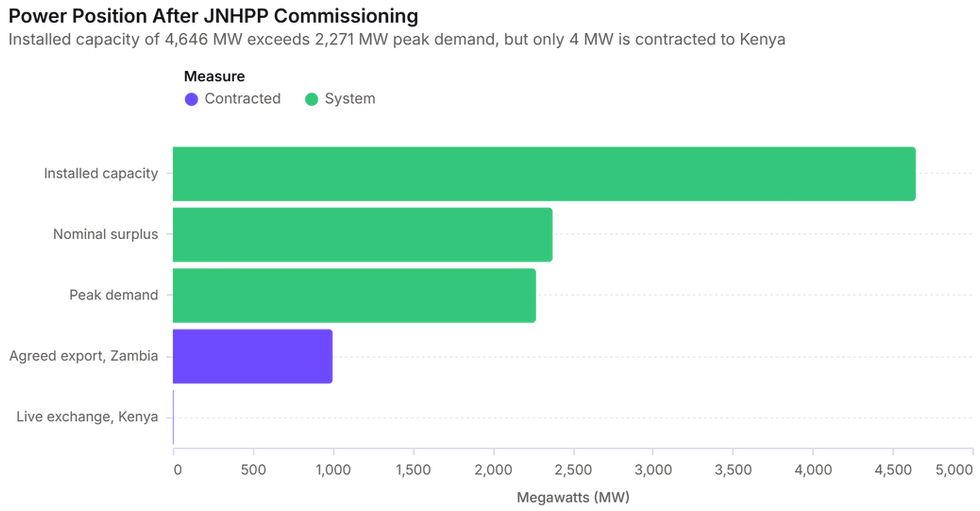
Built on the Rufiji River by an Egyptian consortium of Arab Contractors and Elsewedy Electric between June 2019 and March 2025, the 2,115 MW facility was inaugurated by President Samia Suluhu Hassan at a cost of roughly TZS 7.45 trillion — some $2.84 billion at Reuters' implied exchange rate, and $3.35 billion at the appreciation reflected in domestic reporting and stressing that it was financed entirely from national resources, without external borrowing (Reuters, 22 August 2026; TanzaniaInvest, 23 August 2026). The arithmetic that followed is the headline: installed generation capacity now stands at 4,646 MW against peak demand of 2,271 MW, leaving a nominal surplus of 2,375 MW, according to energy minister Deogratius Ndejembi (The Citizen, 25 August 2026).
Nominal is the operative word. In its March 2026 sub-sector regulatory update, the energy regulator EWURA recorded plant availability at 73.88 per cent and utilisation at 53.67 per cent — meaning the gap between paper capacity and dispatchable power is not a rounding error but a structural feature of the system (Ecofin Agency, 23 August 2026). Ndejembi conceded as much at the inauguration: "Adding generation capacity alone is not enough," he said, pointing to the network that must carry it (bne IntelliNews, 23 August 2026). The evidence for that constraint is granular and revealing. A newly completed 400 kV Chalinze–Dodoma transmission line lifted national peak demand by 150 MW within three days of going live (TanzaniaInvest, 23 August 2026), while Rukwa Region — site of the Malangali substation works — requires roughly 30 MW and receives about 16 MW, a shortfall the government itself acknowledges is throttling agricultural processing and mineral activity (Daily News, 16 October 2026).
The export architecture being assembled around this surplus is where the strategic content sits. The 400 kV Kenya–Tanzania interconnector was energised in December 2024 across a roughly 510-kilometre corridor, yet the regulator has so far approved only an initial 4 MW exchange arrangement — a rounding error against a 2,375 MW theoretical margin (bne IntelliNews, 23 August 2026). Against that, negotiations with Zambia have concluded for the sale of 1,000 MW, talks continue with the Democratic Republic of Congo and Uganda, and dual membership of both the Eastern Africa Power Pool and the Southern African Power Pool gives Dar es Salaam a bridge position no other East African state occupies (The Citizen, 25 August 2026; The Guardian Tanzania, 24 August 2026). The stated ambition is more than $1 billion in annual export earnings by 2030 and 8,000 MW of installed capacity by the same date (The Guardian Tanzania, 24 August 2026). The politics of the Kenyan leg belong to our Kenya 2026 assessment; the commercial logic is simpler — a country that was buying power from Zambia is now positioning to sell it, reversing the polarity of the region's southern grid.
Two cautions deserve to be priced. The first is hydrological: a 2,115 MW asset on a single river basin concentrates national supply risk in one catchment, and no transmission contract removes a rainfall variable. The second is that export earnings are a function of interconnection, not of surplus. It is likely that by 2028 electricity exports remain a single-digit share of the 2030 earnings target, because the cross-border lines capable of moving bulk volume are not yet built — and a realistic possibility exists that a dry year forces the country back into spot imports precisely as its export marketing matures.
For organisations with power-intensive industrial, mining or data-centre siting exposure: treat the surplus as a genuine siting advantage with a transmission caveat attached. Baseline: 4,646 MW installed against 2,271 MW peak demand; 73.88 per cent availability and 53.67 per cent utilisation per EWURA's March 2026 update; 1,000 MW agreed for Zambia, 4 MW live with Kenya; 8,000 MW and $1 billion in export earnings targeted for 2030; grid reinforcement adding 150 MW of usable demand per major line. Site where the line already reaches, not where the megawatt is advertised.
6. The Mineral Vault: Graphite, Kabanga, and Washington's Return Ticket
The vault is not underground. It is in the licensing queue, the processing park and the final investment decision — and on all three counts the country is further along than its reputation allows, and further from bankability than its press releases imply.
Start with the geology, because it is genuinely exceptional. Estimated graphite reserves of 18 million tonnes represent about six per cent of the global total, with the Lindi Jumbo mine in Ruangwa running a 40,000-tonne annual capacity on a 5.5-million-tonne reserve and a 24-year life; the Mahenge and Epanko projects are each configured above 60,000 tonnes annually, and national output is projected to exceed 300,000 tonnes a year within seven years (TanzaniaInvest mining review, 9 October 2026). Rare earths add 890,000 tonnes of estimated reserves, anchored by the Ngualla project's projected 37,000 tonnes of REE metals a year — a volume that would place the country among the top five global producers — alongside the Wigu Hill deposit in Kilosa (TanzaniaInvest, 9 October 2026). The licensing tempo confirms intent rather than aspiration: between July 2025 and March 2026, the Mining Commission issued 454 licences across graphite, nickel, cobalt, lithium, heavy mineral sands and rare earths, including 271 graphite and 136 nickel permits (Tanzania Insight, 25 June 2026).
Kabanga is the prize that converts this from a resource story into a supply-chain story. Lifezone Metals' feasibility work declared reserves of 52.2 million tonnes grading 1.98 per cent nickel, 0.27 per cent copper and 0.15 per cent cobalt — the first such declaration since the deposit's discovery nearly fifty years ago — with a post-tax net present value of about $1.58 billion at an 8 per cent discount rate, a 23.3 per cent internal rate of return and an all-in sustaining cost of $3.36 per pound of payable nickel (Mining Weekly, 15 May 2026). Construction is estimated at roughly $940 million for output of some 350,000 tonnes of nickel concentrate a year, and the company has recruited Société Générale to arrange debt (Mining Weekly, 5 August 2026).
What makes the project geopolitically legible is its shareholder trajectory. A US government-backed consortium, Orion CMC — established with sovereign backing from the US International Development Finance Corporation and Abu Dhabi's L'imad Holding, and initial funding of $1.8 billion — has been selected as the favoured investor, in what would be one of the vehicle's earliest deployments as an instrument of Washington's minerals push (Mining Weekly, 5 August 2026). The catch is procedural: final investment decision was targeted for early 2027, but negotiations with the host government have progressed more slowly than the company anticipated (Mining Weekly, 5 August 2026). It is likely that the FID slips beyond its window, and highly likely that the binding constraint on the sector's 2028–2030 profile is processing and value addition rather than extraction — the same bottleneck our critical minerals assessment identifies across competing jurisdictions.
The state is not waiting passively. A development agreement for the Panda Hill niobium project in Mbeya was signed on 24 March 2026, targeting roughly four per cent of global niobium supply, annual output near 100,000 tonnes, 1,600 direct jobs and what is billed as Africa's first ferroniobium plant (Tanzania Insight, 25 June 2026). The former Buzwagi gold mine at Kahama has been converted into a 1,333-hectare special economic zone dedicated to mineral processing, and the country pitched a 68-project, $30.1 billion pipeline at an EU roadshow in Finland, Italy, the Netherlands and Belgium, backed by a fresh EUR 156 million European package, ahead of an early-2027 forum in Dar es Salaam (TanzaniaInvest, 9 October 2026). The unresolved operational weakness is mundane: remote mining regions still lean on diesel-based power, an infrastructure deficit the sector's own analysts flag as a live constraint (Mining Weekly, 10 April 2026).
For organisations with battery, EV, defence-metals or alloy supply-chain exposure: qualify counterparties on processing capacity, not on reserve statements. Baseline: 18 million tonnes of graphite reserves at roughly 6 per cent of global supply; 890,000 tonnes of REE reserves with Ngualla at 37,000 tonnes a year; Kabanga at 52.2 million tonnes grading 1.98 per cent nickel with a $1.58 billion post-tax NPV and roughly $940 million of build cost; 454 licences issued in nine months; Panda Hill niobium at approximately 4 per cent of global supply. Assume first meaningful concentrate volumes from Kabanga no earlier than 2029.

7. The Southern Flank: Mtwara, Cabo Delgado, and the Insurgency Across the River
The Ruvuma is not a border. It is a membrane — and the pressure differential across it is rising on a schedule that no port prospectus has yet entered.
London's travel guidance now advises against all but essential travel to any area within 20 kilometres of the frontier with Mozambique's Cabo Delgado province, explicitly citing attacks by groups linked to Islamic extremism and naming the Mtwara area as the relevant jurisdiction (FCDO advisory, reported 20 October 2026). Washington has moved the same region into a stricter advisory tier on terrorism grounds, restricting official travel without special authorisation (US State Department advisory, October 2026). Both governments are reacting to evidence, not atmospherics. In its latest conflict monitoring, ACLED records Islamic State Mozambique intensifying civilian targeting across Mocímboa da Praia, Muidumbe and Macomia during August and September, and — critically for this assessment — assesses that the group's return to Nangade is intended to draw on support from the Tanzanian side of the border, a development the analysts expect to tighten security measures on both banks (APAnews, 19 October 2026; AIM, 19 October 2026).
The aggregate trendline is unambiguous. Humanitarian access reporting compiled by OCHA records security incidents climbing from 192 in the first quarter of 2026 to 213 in the second and 245 in the third — a 28 per cent rise — with nearly four in five third-quarter incidents involving violence against civilians and 379 people reportedly abducted (OCHA via ReliefWeb, 21 October 2026). In September, insecurity extended beyond Cabo Delgado altogether, with an attack recorded in Marrupa district of Niassa province (OCHA, 21 October 2026). Since October 2017, the conflict has produced an estimated 6,600 deaths and some 1.2 million displaced people according to international organisations, and Maputo's own president, Daniel Chapo, confirms that Tanzanian forces continue to guard the frontier under bilateral arrangements to prevent militant movement (Mozambican press reporting, 24 October 2026).
Capability is being built in parallel. US Marine Raiders and the Tanzania People's Defence Force's 93rd Special Forces Battalion concluded a joint combined exchange training in Tanga on 29 September 2026, covering combat casualty care, live-fire work and high-altitude movement on Kilimanjaro — training explicitly framed around the operational demands of countering violent extremist organisations active in the region (AFRICOM, 22 October 2026). The analytical weight of that programme lies less in its tactical content than in its signal: the southern flank is now a standing line item in the bilateral security relationship, not a contingency. It is a realistic possibility that sustained cross-border escalation materialises within twelve months, given documented insurgent logistics on the Tanzanian side and the seasonal expansion pattern into Niassa; it remains unlikely that the violence reaches Cabo Delgado's intensity on the northern bank, because the frontier is defended by a conventional force with airlift and external training rather than by provincial police alone. The exposure that matters commercially is adjacency: Mtwara anchors the coastal end of the gas and port economy, and the corridor's southern arm runs through the same districts the advisory maps now shade. Our Mozambique 2026 assessment and Horn of Africa assessment trace the wider arc this feeds.
For organisations with southern-corridor logistics, offshore gas or Mtwara-adjacent field operations: price a 20-kilometre exclusion band into site selection and insurance, and treat advisory-tier changes as leading indicators rather than compliance noise. Baseline: incidents up 28 per cent across 2026 quarters to 245 in Q3; 379 abductions in the same quarter; four in five incidents targeting civilians; conflict cumulative toll of roughly 6,600 dead and 1.2 million displaced since 2017; standing bilateral border commitment and a September 2026 joint special-forces training cycle. Require verified-incident force-majeure language for southern operations.

8. The Fragility Ledger: Treason Trials, a Widening Western Discount, and the Politics of Complicity
Accountability in 2026 runs in one direction only, and the ledger is now being written by prosecutors rather than by commissioners.
Weeks before the first anniversary of the election violence, a second opposition figure was charged with treason — a capital offence — joining CHADEMA's Tundu Lissu, whose verdict remains pending (Africanews, 22 October 2026; The Chanzo, 22 October 2026). The timing is not incidental. The first presidential inquiry, chaired by retired Chief Justice Mohamed Chande Othman, concluded that the unrest had been planned and coordinated and recorded at least 518 deaths — a finding CHADEMA and ACT-Wazalendo reject outright — while a subsequent six-member regional commission was given a 150-day mandate to examine planners, participants and financiers of the violence (The Chanzo, 22 October 2026). Of the original twelve short-term recommendations, including a proposed national day of mourning for the more than five hundred dead, most remained unimplemented at the anniversary (The Chanzo, 21 October 2026). The asymmetry is the finding: organisers of protest face capital charges, while the actors the commission identified as having planned the crackdown face a review process with no published conclusions.
The external response has settled into a recognisable pattern — rhetorical distancing, financial continuity. The European Union approved Sh462 billion for the country while redirecting support toward the private sector under its Global Gateway framework and the national Dira 2050 strategy, with accompanying documents citing deterioration in human rights, democracy and the rule of law alongside the post-electoral violence as reasons the partnership's character had shifted (The Chanzo, 20 October 2026). Germany faces comparable pressure, with the opposition publicly urging Berlin to fundamentally rethink its cooperation with Dar es Salaam (Table.Briefings, 23 October 2026). Read together, the Western adjustment is a reallocation rather than a rupture: money keeps flowing, but it now bypasses the state where it can and attaches to enterprises, infrastructure and programmes instead. It is likely that this transactional posture holds through 2027, because the corridor's strategic value — minerals, ports, energy, counter-terrorism cooperation on the southern flank — outweighs the reputational cost of proximity; it is highly unlikely that donor conditionality reverses the prosecutions or produces a public accounting for the deaths.
That leaves the country's own development architecture exposed to a subtler risk. Vision 2050 and the First National Development Plan for 2026/27–2030/31 prioritise manufacturing and value addition, with the Bagamoyo special economic zone cast as the flagship (The Citizen, 15 October 2026). Industrial policy of that ambition requires patient institutional credibility — courts that enforce contracts predictably, regulators insulated from political direction, and a workforce whose expectations of mobility are met. Each of those prerequisites is weakened by a governing settlement that answered its first serious legitimacy test with live ammunition and then prosecuted the survivors' representatives. The corridor can be built on this foundation. It cannot be financed cheaply on it forever.
For organisations with donor-funded programmes, NGO partnerships, ESG-mandated mandates or reputational exposure: expect the West's engagement to remain funded but increasingly private-sector-routed, and structure accordingly. Baseline: two capital treason prosecutions against opposition figures; 518 officially recorded deaths with opposition estimates near 2,000; zero of twelve commission recommendations implemented at the one-year mark; a 150-day accountability commission with unpublished findings; Sh462 billion of EU support redirected toward private-sector channels under Global Gateway and Dira 2050. Build reputational due diligence around the prosecutions calendar, not the election calendar.
9. Tanzania 2026 Geopolitical Risk Assessment — Three Scenarios
Source: CES Intelligence calibrated judgment, 25 October 2026 — triggers and bidirectional justification below.
Scenario A — The Quiet Compounding: A Corridor Built on Silence (Probability: ~35–40%)
The settlement of October 2025 holds as a system description rather than an anomaly. The treason trials conclude in sealed verdicts — conviction with commutation, or indefinite adjournment — without martyrdom events; the anniversary passes under managed calm; and the western archipelago of investment advances on staggered schedules: Bagamoyo's first berths take shape, the Lindi LNG Host Government Agreements are signed inside the financial year, the Kabanga final investment decision lands in late 2027 after negotiated fiscal terms, the Zambia power line moves toward financing close, and EU Global Gateway money continues arriving through private-sector channels rather than state ones. Growth prints at 5.9–6.2 per cent through 2027 with inflation inside the band, and the IMF successor arrangement is negotiated without drama.
The probability is elevated by the demonstrated indifference of capital to the 518 documented deaths — every major external financing decision of 2026 postdates the crackdown and none reversed; by the fragmentation of the opposition between exile, prosecution and deregistration; and by the sheer sunk-cost weight of the corridor itself, which now gives every external patron a stake in continuity rather than scrutiny. It is reduced only by the treason-calendar's capacity to manufacture a single uncontrollable moment — a verdict, a death in custody, an anniversary gathering that outgrows its containment — and by the southern flank, where insurgent escalation does not respond to fiscal policy.
This scenario holds unless: the Lissu verdict or the second treason trial produces a death-penalty outcome or a death in custody; the October 2027 local-government cycle reproduces the 2025 pattern at lower intensity but with higher lethality per incident; or ACLED-documented insurgent logistics on the Tanzanian bank convert into a mass-casualty cross-border incident that pairs with the insurgency's documented recruitment geography to force a securitisation of the Mtwara corridor. Each trigger is individually below 15 per cent annual probability; jointly they account for the scenario's full discount from majority likelihood.
Scenario B — Legitimacy Rupture: The Verdict and the Second Crack (Probability: ~30–35%)
One dated trigger fires — most plausibly a capital sentence against Tundu Lissu or the second defendant, a death in custody, or an anniversary commemoration met with the force metronome of October 2025 — and the quieted state discovers the difference between silence and consent. Urban protest returns at a scale the security architecture can suppress episodically but not cheaply; network shutdowns return as the default instrument, taxing commerce the way they taxed Pakistan's; western capitals reallocate rhetoric into instrument — aid channel closures, AGOA-type preference reviews, resolution language at the Human Rights Council — while Gulf, Turkish and Chinese counterparts fill the resulting gaps on purely commercial terms. The immediate economic damage is contained (the Fund buffers hold; gold exports cushion the account), but the corridor premium reprices: the Kabanga FID slips a year, the Lindi HGA signature stalls in legal limbo, Bagamoyo's SEZ absorption slows as the compensation and land-transfer process becomes politically radioactive, and the EU's redirection completes its migration from state to private channels at accelerated pace.
The probability is elevated by the state's own demonstrated escalation preference — treason charges are a crescendo instrument, not a stabilising one — and by the sheer density of dated triggers clustered in the Lissu verdict, the second trial, and the November 2027 local-government sequence. It is reduced only by the opposition's demonstrated incapacity to convert grievance into sustained mobilisation post-deregistration, by the diaspora's organisational fragmentation, and by the government's expanded toolkit of pre-emptive detention, which has proven effective at decapitating gatherings before they form.
This scenario holds unless: the verdicts deliver custodial sentences rather than death penalties, draining the trigger of its martyrdom charge; or the state pre-empts rupture with a controlled liberalisation gesture — an amnesty, a commission report published with named accountability — of which there is currently no evidence.
Scenario C — Compound Escalation: The Southern Flank Joins the Ledger (Probability: ~15–20%)
The Islamic State Mozambique campaign documented by ACLED crosses the Ruvuma in force — a mass-casualty or infrastructure attack in Mtwara or on a southern logistics artery, drawing the Tanzania People's Defence Force into overt cross-border operations alongside a SADC or bilateral framework. Simultaneously or sequentially, a Gulf-war oil spike breaches $110 per barrel and the current account widens past 3.5 per cent of GDP under the IMF's own spillover arithmetic, forcing fiscal retrenchment precisely when the security bill is expanding. The country that priced itself as the quiet corridor discovers it is priced as two theatres: security expenditure crowds maintenance spending, the Mtwara corridor's gas and port economy enters insurance repricing, tourism revenue sags on the advisory cycle, and the government accelerates the turn toward patrons least sensitive to both dynamics — Beijing's Sinosure and Gulf sovereigns — collapsing the calibrated multi-patronism that defined 2026 into a harder, discounted alignment.
The probability is elevated by ACLED's documented expansion from Catupa into Niassa province by September 2026, by the assessed Tanzanian-side logistics networks, and by the tempo of quarterly incident growth (192-213-245). It is reduced by the demonstrated bilateral border commitment between Dar es Salaam and Maputo, by the September 2026 US special-forces training cycle, and by the insurgency's own structural ceiling — approximately 6,600 deaths and 1.2 million displaced in nine years of Cabo Delgado operations have still not produced provincial collapse, let alone cross-border conventional capacity.
This scenario holds unless: a Rwanda-model bilateral stabilization agreement degrades ISM's southern districts before the 2027 dry season; or the Gulf war de-escalation removes the oil-transmission channel, decoupling the compound into a survivable single shock.

10. Implications
Governance-exposed operations. Assume the prosecutions calendar, not the electoral calendar, is the governing risk clock: verdicts in the treason trials and the November 2027 local-government sequence are the two dated discontinuities inside the planning horizon. Freeze non-essential government-facing engagements in the 30-day windows around each; build communications protocols on a 72-hour assumption between trigger event and network restriction. Treat any death-penalty verdict as an automatic elevation of country-risk tier regardless of the street response observed in the first week.
Infrastructure and logistics. Contract against Dar es Salaam's documented performance — 9.6-day average turnaround, 12.7 days for container vessels — not against concession rhetoric; insert dwell-time service credits into any port-dependent throughput agreement. Do not price Bagamoyo capacity into any model before 2029, and treat SEZ land-assembly and compensation risk as a political-expropriation variable under Scenario B rather than an administrative delay.
Hydrocarbons and LNG. Underwrite the $42 billion Lindi development as a 2034 revenue event rather than a 2027 catalyst: the Host Government Agreement is expected inside FY2026/27, with first exports roughly eight years after signature. Do not underwrite Tanzanian gas exposure on signature announcements alone — require executed HGAs and ratified implementing legislation before committing to upstream or midstream positions. Monitor Ugandan crude flows through Tanga from early 2027 as the corridor's first live hydrocarbon test.
Energy and industrial siting. Site where transmission reaches, not where surplus is advertised: the Chalinze–Dodoma spine and the Malangali programme define usable capacity until the Zambia interconnector and Kenya scale-up are financed and built. Require hydrological force-majeure disclosure in any power-supply agreement referencing Rufiji-basin generation, and discount export-linked revenue models by the interconnection gap — 4 MW live against 1,000 MW agreed is the honest ratio of intent to wire.
Mining and supply chain. Qualify Kabanga in 2029–2030 horizons only, and condition any offtake structuring on the final investment decision's fiscal terms rather than the feasibility study's economics. Diversify graphite exposure across at least two of the producing or near-production projects — Lindi Jumbo, Mahenge, Epanko — to mitigate single-asset political risk. Assume processing capacity, not reserves, is the binding constraint on 2028 volumes, and mirror that constraint in supplier qualification.
Security and duty of care. Apply a hard 20-kilometre exclusion band to the Mozambique frontier in Mtwara Region for non-essential personnel; treat FCDO and State Department tier changes as trigger events for staffing review within 14 days, not annual review cycles. Key force-majeure language on verified security incidents rather than declared emergencies — the Q3 2026 incident tempo (245, up 28 per cent across the year) establishes the baseline trend, not the alarm level.
Financial and portfolio. Cap unhedged Tanzanian shilling exposure at 5 per cent of country book pending the treason-trial outcomes; assume the 2026 growth print holds within a quarter-point of 6.0 per cent only within Scenario A, and stress all corridor-linked positions for a two-quarter FID slip under Scenario B. Re-examine ESG-mandated allocations against the 518-death baseline and the prosecution calendar — the repricing, when it comes, will be reputational before it is financial.
11. Core Analytical Judgment
The variables in this system are coupled in a way the investment community has not yet consolidated: the corridor pull — ports, rails, megawatts, gas, battery minerals — is itself the enabling condition of the legitimacy erosion, because every suitor that arrives for the corridor lowers the price the state pays for its domestic settlement. The stronger the external demand for what crosses Tanzanian territory, the cheaper the repression becomes, and the cheaper the repression becomes, the more the state's planning horizon collapses inward toward preservation of the arrangement rather than performance of the economy. The equilibrium is unstable: an oscillation between integration and insulation, between the 6 per cent economy and the 518 dead, between the investor's spreadsheet and the prosecutor's docket — and oscillations of this kind resolve at their extremes, not their averages. The corridor will be built. The question is whether it will be built for a state or merely through one, and the treason dockets are where that answer is currently being drafted. Stability, in this Tanzania 2026 geopolitical risk assessment's terms, is not the absence of risk — it is the deferment of the invoice; and deferrals, unlike corridors, accrue interest.
---
Want deeper analysis?
Confidential advisory programs scoped to your organization — continuous monitoring, dedicated analysis, board-level support. Engagements are annual.
---
DISCLAIMER — This analysis is provided for informational and strategic planning purposes only. It is not investment advice, financial advice, or legal advice, and it should not be treated as such. Probability assessments reflect the analyst's calibrated judgment based on available open-source intelligence as of the date of publication, and are subject to revision as new information emerges. Some quantitative estimates and reported events are based on regional sourcing that may evolve as additional confirmation becomes available.


