
Riyadh Buries Its War Insurance in Singapore: Saudi Crude Storage Heads for Jurong


CES DAILY SIGNAL — October 27, 2026
Twelve hours after December Brent slipped from its highest weekly close since April (Axios, 26 October 2026), Singapore's minister for energy, trade and industry Tan See Leng stood at the Singapore Energy Lecture and read out a sentence that reframes the war premium: the kingdom and the city-state would jointly establish an arrangement for Saudi crude to be stored in the Jurong Rock Caverns from the second half of 2027, with Aramco, the Energy Market Authority and JTC exchanging a memorandum of understanding on the spot (Reuters, 26 October 2026). Four days earlier, Aramco's chief executive had publicly invited foreign governments to open their strategic storage to the company (Bloomberg, 22 October 2026).
Riyadh's answer to the Hormuz war premium is not military but logistical: the kingdom is pre-positioning its security stock inside its customers' territory, and Singapore has just become Asia's first purpose-built node for absorbing Gulf risk.
TRAJECTORY
The memorandum converts into a binding agreement within months, and the allocation follows the Tokyo and Seoul templates: Aramco-owned crude, host-state leverage over its release. From there the pattern scales — Riyadh negotiates parallel strategic-storage access across Asia, privileging government-owned capacity over commercial tankage. By the time the first Saudi barrel settles 150 metres beneath Jurong Island in late 2027, Asia's buyers divide into two classes: those holding contractual access to physical buffers inside consumer territory, and those bidding for spot cargoes priced off a transit map nobody fully trusts. The war premium does not vanish within the horizon; it migrates from the chokepoint to the counterparty.
SECOND-ORDER EFFECTS
Japan's multilateral stockpiling push now competes with a cheaper bilateral template — producer-funded stock inside consumer states. There is a realistic possibility Tokyo accelerates carve-outs of its own to remain the region's reserve architect rather than cede the role deal by deal.
European refiners already severed from term Saudi barrels watch the asymmetry harden: resilience is being allocated to the revenue base rather than the alliance map. Extended spot procurement premia for OECD European buyers into 2027 are highly likely.
The city-state's trading complex consolidates a role the war has already widened — physical offtake, paper benchmarks and now producer-funded storage in one jurisdiction — raising the entry cost of rival hub ambitions from Fujairah to Colombo.
ANALYSIS
A logistics answer to a shooting problem
October is the worst month for attacks on commercial shipping around Hormuz since systematic tracking began in 2017 — 28 confirmed or reported strikes this month, against 113 since the war opened on 28 February, per data compiled by the Washington Institute (23 October 2026). Crude exports through the strait ran at 8.5 million barrels a day in the week to 7 October, roughly 40 per cent below pre-war levels, according to Kpler (CNBC, 11 October 2026). When a strike shut the East-West pipeline in September — the corridor moving more than 5 million barrels a day to Yanbu — Brent touched $131 on 15 September (U.S. EIA, 6 October 2026).
What Riyadh is answering has a price. Charter rates for supertankers on the Gulf-to-Far East route have surged to about $1.3 million a day, against roughly $30,000 in January — freight now adds close to $33 to each delivered barrel, per Poten estimates (Gulf News, October 2026). War-risk cover has repriced from a pre-war 0.15–0.25 per cent of hull value to 6–10 per cent, up to $20 million for a single supertanker voyage (Financial Times, October 2026). Goldman Sachs attributes some $7 a barrel of Middle East route freight to the war-risk component alone (as reported by TALi News, 24 October 2026). Riyadh's response now runs on two fronts: engineering studies to lift east-west transfer capacity from 7 to 10 million barrels a day, and overseas buffers (Al Arabiya interview, as reported by Bloomberg, 22 October 2026). The September halt of October term deliveries to European refiners was one face of the same squeeze (Bloomberg News, 18 September 2026). The cavern announcement is the first visible tile of the storage track, and it is highly likely to be followed by others rather than stand alone — Nasser has said talks with foreign governments are under way and that Aramco aims to double its overseas capacity (Bloomberg, 22 October 2026).
Saudi Crude Storage in Singapore: The Buffer Moves to the Buyer
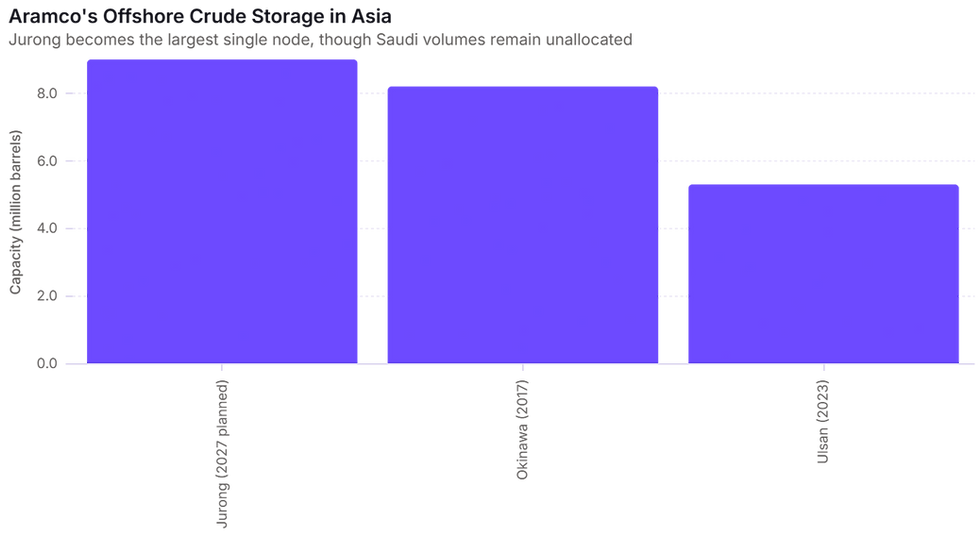
The arrangement extends a proven model rather than inventing one. Saudi crude storage in Singapore follows established templates: 13.5 million barrels already sit leased across Okinawa and Ulsan, where host governments hold first-call rights in an emergency (Oil & Gas Middle East, 26 October 2026). Jurong would become the largest single node: Southeast Asia's first underground commercial storage complex, 1.47 million cubic metres — about 9 million barrels — carved 150 metres down (JTC Corporation; Channel News Asia, 15 April 2026). For regional buyers, that scale is structural rather than transformative: a barrel released from Jurong crosses no chokepoint and buys no war-risk premium, yet the full complex barely dents flows that Asia drew from the Gulf before the war. Pre-positioning the stock south of the strait attacks the cost structure above at its root. The wager is likely to compress Asian supply-risk premia only modestly at the flat price, but measurably in term negotiations, where contractual access to a physical buffer inside client territory becomes a differentiator (see our Malacca Strait theatre assessment, 2026). Tokyo's $10 billion POWERR Asia initiative, launched to regionalise stockpiling, now faces a producer-funded rival architecture that bypasses multilateral governance altogether (Reuters, 26 October 2026).
What nine million barrels actually buy
The materiality of 26 October is the announcement, not the flow. The volume earmarked for Saudi crude is undisclosed — only part of the complex is in play — negotiations are expected to conclude within months, and no barrel arrives before late 2027 (Reuters, 26 October 2026). Against a war the EIA assumes is shutting in 4.5 million barrels a day this quarter, the buffer buys duration rather than market calm (U.S. EIA, 6 October 2026). That is precisely the trade Aramco is underwriting: Nasser expects post-war demand to rise by about 3 million barrels a day once conditions normalise, including 1 million for replenishing depleted inventories, a rebuild measured in years (Al Arabiya interview, 22 October 2026). Buyers with sovereign depth already negotiate from strength — Beijing rode the war on a stockpile estimated at some 1.2 billion barrels without net drawdown through three quarters (Hydrocarbon Processing, 21 October 2026). Saudi crude storage in Singapore mirrors this strategy with the ownership reversed: Beijing built its buffer at home, Riyadh is renting its resilience abroad — the producer now holds the option, and the customer's territory becomes the vault. Singapore's own numbers show the hub role is not speculative: bunker sales reached 41.97 million tonnes in the first nine months of 2026, up 1.8 per cent year on year even as the war squeezed availability, with VLSFO prices at $870 a tonne in September against $491 a year earlier (MPA data via Ship & Bunker, 15 October 2026). Producer-owned forward storage is the mirror instrument, and its effect on regional premia should be read alongside the pressure still radiating from the Red Sea approaches (see our Bab al-Mandeb blockade analysis, 2026). In the assessment of this desk, a realistic possibility exists that access conditions for third-party buyers become the deal's decisive variable — barrels locked to Aramco's term customers would narrow the hub effect to Singapore alone.
SIGNALS TO WATCH
The memorandum converts into definitive terms within the coming months — the EMA–Aramco instrument's disclosed volume and any first-call clause for the host state determine whether this is durable architecture or an opportunistic deposit; a commitment above half the cavern complex signals intent.
A second Asian strategic-storage announcement involving Aramco or another Gulf producer before the second quarter of 2027 confirms the model is replicating faster than Japan's multilateral track.
Further strikes on the East-West pipeline or Yanbu loadings before year-end test whether the late-2027 timeline holds or accelerates.
The EIA's February 2027 outlook: a shut-in assumption persisting past the first quarter starts the inventory-rebuild clock from a higher base, raising strategic-storage demand beyond the states already negotiating.
---
Want deeper analysis?
Confidential advisory programs scoped to your organization — continuous monitoring, dedicated analysis, board-level support. Engagements are annual.
---
DISCLAIMER — This analysis is provided for informational and strategic planning purposes only. It is not investment advice, financial advice, or legal advice, and it should not be treated as such. Probability assessments reflect the analyst's calibrated judgment based on available open-source intelligence as of the date of publication, and are subject to revision as new information emerges. Some quantitative estimates and reported events are based on regional sourcing that may evolve as additional confirmation becomes available.


