
Pacific Islands 2026 Geopolitical Risk Assessment: Small States, Large Stakes

Updated: 1 day ago

Contents
Key Takeaways
The region is not a security vacuum. It is a security marketplace. Fourteen island states — eleven of which field no military at all — have converted geography into a saleable commodity: fifty-six security arrangements now bind them to five rival patrons. The competition runs through paperwork, not deployments, and it is highly likely that the treaty count keeps rising through 2027 regardless of which patron claims momentum.
Policing has displaced basing as the contested frontier. The blocking mechanisms embedded in Australia's treaty architecture — Falepili, Nakamal, the Naoero veto, Veitacini — are engineered against military footholds, yet the vector Beijing actually exploits is the police liaison team and the donated equipment convoy. The gap between what the treaties prohibit and what the islands import is the central vulnerability of the next eighteen months.
The money has moved, and the diesel bill has not. Australia supplied roughly 37 per cent of regional development spending in 2024 against China's 6 per cent; imported fuel costs the islands more than US$6 billion a year, between 5 and 15 per cent of regional GDP. It is likely that energy-import stress, not Chinese debt, is the binding economic constraint on every government in the system through 2027 — and that whoever funds the diesel transition buys more loyalty than any security treaty can.
Consensus leaks, and the lock-outs leak with it. When Naoero dissociated from the softened missile-notification clause days after Kiribati blocked a firmer text, the August–September sequence proved that treaty signature and behavioural alignment are different assets. Signature-based exposure models will systematically misprice states whose domestic incentives reward defection.
Notification is the new credibility currency. The July submarine-launched missile test — conducted hours after a flagship Australian treaty signing, announced to Canberra in language about "hazardous operations or space debris" — converted advance notification from diplomatic courtesy into the region's most measurable norm. Whether the second launch is notified is a realistic possibility worth building scenario libraries around, because it is the single clearest test of intent available through 2027.
Portfolio-level. The investable distinction over a 6–24 month horizon sits between structural mechanisation of the regional architecture — treaty deliveries, police logistics procurement, cable and energy-infrastructure build-out, all pipeline-visible and contractible — and rupture events that reprice everything at once: an unnotified second splash, a designation cascade touching a third sitting official, or a multi-day intrusion into regional financial systems. The first category rewards positioning into delivery chains; the second punishes any exposure underwritten on signature compliance alone. Boards that have not separated the two are holding a single factor they have named twice.
1. The Instrumentalisation of Smallness: Fourteen Flags, Five Patrons, Fifty-Six Arrangements
The micro-states covered by this Pacific Islands geopolitical risk assessment operate in 2026 not as strategic prizes awaiting capture. They are sophisticated price-setters running the only genuinely liquid market in strategic access anywhere in the world. Fourteen island countries, only three of which maintain militaries — Fiji, Papua New Guinea and Tonga (Japan Ministry of Defense, Defence of Japan 2026, October 2026) — have contracted their geography to five competing patrons simultaneously, and the ledger of commitments has grown dense enough to require professional cartography.
The cartographer arrived in October. An interactive map released by the Center for Strategic and International Studies plots 56 security arrangements across the fourteen states, involving the United States, Australia, New Zealand, mainland China and Taiwan, weighted across treaty-level defence commitments, status-of-forces agreements, maritime surveillance arrangements, policing cooperation and memorandums of understanding (CSIS, 20 October 2026; SCMP, 23 October 2026). The tool's three-tier classification — defence treaty ally, formal security agreement, non-binding cooperation only — makes visible what two decades of crisis diplomacy obscured: the islands have assembled more collective security paperwork per capita than any NATO member.
Two structural facts in that dataset deserve board-level attention. First, the surge followed Beijing's April 2022 security agreement with Honiara, but most arrangements signed since have come from partners other than China (CSIS, 20 October 2026) — the allies out-drafted Beijing, converting his worst regional setback into a paperwork rout. Second, the diversity of instruments means no single government coordinates the whole: a state can hold a defence treaty with Canberra, a police memorandum with Beijing and a surveillance agreement with Washington at once, each priced separately. The commercial consequence follows directly from the board-level exposure framework we developed in our South China Sea grey-zone assessment: access portfolios in this theatre are assembled treaty by treaty, and they can be dismantled that way.
For organisations with regional operating footprints, shipping routes or communications infrastructure exposure: model Pacific exposure as a portfolio of individually revocable bilateral instruments, not as country-level alignment. Baseline: 56 arrangements across 14 states and 5 patrons; three tiers of commitment depth; 11 of 14 states without standing militaries; Australia's treaty-class instruments now cover Tuvalu (2023), Naoero (December 2024), Vanuatu (June 2026) and Fiji (July 2026), with Solomon Islands under negotiation; the Chinese arrangement base remains anchored on the 2022 Honiara framework plus policing memoranda. Contract into instrument risk, not country risk.
2. The Splash Point: A Dummy Warhead, a Vague Notice, and the Birth of a Notification Norm
The most strategically consequential weapon fired in the Pacific in 2026 carried no explosive payload. On 6 July, a submarine of the PLAN launched an intercontinental-range ballistic missile carrying a dummy warhead into international waters north of Fiji — the first publicly acknowledged strategic launch of its kind into international waters, conducted hours after Australia signed its new defence pact with Suva (CSIS, 20 October 2026; Crikey, 29 October 2026). Xinhua, the state news agency, confirmed that the third-generation Changzheng-series submarines had "successfully organized the test launch of a submarine-launched strategic missile" (Xinhua, per Crikey, 29 October 2026).
The notification mechanics matter more than the splash. Canberra's pre-launch alert referenced only "hazardous operations or space debris", foreign affairs officials disclosed under parliamentary questioning — not a missile test, not a launch zone, not a nuclear submarine on deployment (Crikey, 29 October 2026). Fiji's defence minister had asked that the launch be cancelled outright; the request was ignored (CSIS, 20 October 2026). Japan and New Zealand registered alarm alongside Australia. One test thus produced three simultaneous revelations: Beijing's notificatory standards are deliberately vague, its consultation veto is priced at nil, and its submarine deterrent is operationally mature.
The institutional response filled August and September with a slow-motion hardening. At the Pacific foreign ministers' meeting, Kiribati and Naoero blocked a collective statement condemning the test — prompting New Zealand's foreign minister to accuse both of appeasement, in the assessment of regional participants (CSIS, 20 October 2026). A month later at the 55th Pacific Islands Forum leaders' meeting in Koror, Palau (31 August–3 September 2026), a softened clause registering concern and calling for advance notification of such launches passed — over Naoero's explicit dissociation and Kiribati's absence from the leaders' retreat (CSIS, 20 October 2026). The clause is a sentence, not a regime. But sentences become regimes when they are invoked, and it is likely that the advance-notification formula becomes the standing yardstick for judging Chinese conduct through 2027 — the grey-zone escalation logic, familiar from other theatres, compressed into a single paragraph of forum text.
For organisations with satellite, maritime-tracking, aviation or reinsurance exposure across the central Pacific: build the notification gap, not the launch event, into scenario planning. Baseline: launch date 6 July 2026, impact zone north of Fiji, announced via generic hazard notice; one regional precedent clause (concern plus advance notification) adopted September 2026; two Forum members dissented or abstained; no reciprocal Chinese notification commitment exists. Treat a repeat launch without advance notice as a regional-crisis trigger carrying a 48–96 hour information vacuum, not as a defence news item.
3. The Lock-Out Constellation: Veitacini, Nakamal, Falepili, and Australia's Easement Treaties
Australia's Pacific strategy in 2026 is not alliance-building in any conventional sense. It is easement acquisition — the systematic purchase of contractual rights over other states' security decision-making, one micro-state at a time. The instruments form a constellation signed at accelerating tempo, and each forecloses a specific Chinese option.
The sequence is instructive. The Falepili Union with Tuvalu (2023) bundled a defined annual climate-migration pathway with commitments over security arrangements (DFAT, Australia–Tuvalu Falepili Union Treaty, 2023). The December 2024 treaty with Naoero gave Canberra an effective veto over third-party security arrangements — locking in a state that had switched diplomatic recognition to Beijing that same year. The Nakamal Agreement with Vanuatu, concluded in June 2026, is explicitly designed to foreclose Chinese military basing and to constrain security arrangements presented as police cooperation, funnelling about A$500 million (US$348 million) into Vanuatu's priorities over a decade (CSIS, 20 October 2026; Islands Business/PACNEWS, 20 October 2026). And on 6 July, hours before the missile surfaced, the Veitacini treaty with Fiji — a full defence pact with the state fielding the region's largest island military (CSIS, 20 October 2026; Crikey, 29 October 2026). A fifth instrument, a comprehensive treaty with Solomon Islands, was agreed for negotiation at the 3 June leaders' meeting in Canberra (Australia–Solomon Islands leaders' statement, 3 June 2026).
Execution, however, is already contradicting signature — the pattern that matters most. Port Vila signed the Nakamal Agreement in June, and by September its internal affairs minister was in Beijing renewing the policing cooperation pact; in October he publicly contradicted the treaty's premise by declaring no plans to reduce the Chinese police presence (ABC, 22 October 2026; Anadolu Agency, 19 October 2026). DFAT's Pacific Office responded through parliamentary estimates that Australia expects "arrangements with other parties would reduce over time" — and that the reassurance had come from the Vanuatu government itself (Politico Canberra Playbook, 28 October 2026). The oscillation is now running in both directions on an official record. At the inaugural Nakamal Committee meeting of 15 October, the Vanuatu government formally described its Chinese policing arrangement as "time-limited and expected to reduce over time", contrasting it with the Nakamal Agreement's status as "legally binding" with "no expiry date" (UTS ACRI Australia–China Weekly Brief, 29 October 2026). A week later, the same internal affairs minister publicly declined to schedule that reduction (ABC, 22 October 2026). Port Vila is not oscillating between two positions; it is holding both simultaneously — a dual-entry ledger that signature-based monitoring will never reconcile, replicable wherever a treaty meets a ministry with its own donor relationships. The basing-foreclosure logic we set out in our China military bases assessment applies with a twist: the threat is not the base Beijing builds, but the police compound nobody declares.
Canberra's counter-purchase runs in parallel. The Waqa Moana initiative — an A$600 million maritime security package against illicit trafficking — will deliver Australian-made Bluebottle unmanned surface vessels to Fiji's navy, capable of remaining at sea over 180 days on renewable power, with first arrivals expected in 2027; Fiji's entire blue-water capability otherwise rests on two Australian-donated Guardian-class patrol boats, the RFNS Savenaca and RFNS Timo (RNZ, 30 October 2026). The regional police apparatus examined next is the soft twin of these hulls.
For organisations with defence-industrial, maritime logistics or Pacific-sited construction exposure: price treaty signature and treaty compliance as separate securities. Baseline: four Australian treaty-class instruments signed 2023–2026, a fifth under negotiation; one documented compliance contradiction (Vanuatu, October 2026) inside the first sixteen weeks of the Nakamal Agreement; A$600 million Waqa Moana envelope with deliveries from 2027; two Guardian-class hulls constituting Fiji's deep-water reach; Chinese policing presence in Vanuatu continuous since 2023. Require conduct-linked milestones, not signature dates, as contract force-majeure triggers across the arc from Suva to Port Vila.
4. The Police Frontier: Training Teams, Donated Drones, and a Corridor the Cartels Found First
The most contested security instrument in the region in 2026 is not a warship. It is a police training team — a dozen uniformed instructors, a donation manifest, and a legal-technical gap that no treaty chapter currently closes. Beijing has understood this arithmetic for years; Canberra and Washington have now built an entire counter-architecture around it.
Consider the donation ledger first. The Chinese embassy in Vanuatu has equipped the national police force with surveillance drones, dozens of motorcycles, patrol boats, uniforms, minibuses, riot gear and forensics laboratory equipment, while maintaining a small training team in-country continuously since 2023 (ABC, 19 October 2026). In Solomon Islands, Chinese officers trained municipal enforcement officers in Honiara in October, and residents of one remote village that requested help with youth disorder received instead a Chinese-donated surveillance system — a presence that provoked local backlash once installed (Honiara City Council, October 2026; The New York Times, October 2026). The 2022 Honiara security agreement, whose leaked draft text contemplated requesting "police, armed police, military personnel and other law enforcement and armed forces" to "assist in maintaining social order" (Australian Centre on China in the World, June 2022), was never revoked — it is under government review begun in August, with publication barred by a non-disclosure clause (ABC, 10 June 2026). Whatever the review concludes, the donated stock — cameras, drones, laboratories — does not ship back.
Suva, notably, pulled the plug years ago: Fijian Prime Minister Sitiveni Rabuka repatriated the Chinese police presence in 2024, citing incompatible legal systems (ABC, 19 October 2026). That decision is the reason Veitacini, a defence treaty, was politically possible — and the reason Beijing's police frontier now concentrates on the two states where donation preceded debate.
The demand pull under the supply, however, is neither Chinese nor Australian. It is criminal. The corridor through Fiji, Tonga and Samoa has been dubbed a drug "superhighway", with cocaine moving toward Australia and New Zealand across waters that no island constabulary can patrol (Lowy Institute, The Interpreter, 7 October 2026); semi-submersible "narco-subs" have been discovered in island waters over the past two years (RNZ, 30 October 2026). The police-capacity gap is real, quantifiable in seized tonnage and unpatrolled sea-lanes, and exploited long before either patron arrived. This is what makes donated policing viable: Beijing sells order without conditionality into a genuine market. The allied response, in 2026, is to institutionalise what Beijing personalised. Pacific police chiefs endorsed the constitution establishing PACPOL, a standing regional policing arrangement, earlier this autumn (Islands Business/PACNEWS, 16 October 2026). On 26 October, the United States and Palau co-chaired the first Pacific police ministers' meeting, issuing a joint communiqué — "Securing the Pacific Together" — committing participants to strengthened anti-money-laundering and cybercrime frameworks and to protecting Pacific access to the global financial system, anchored explicitly to the Forum's Regional Peace and Security Action Plan 2026–2030 (US Department of State, 26 October 2026). Weeks earlier, the Pacific Police Support Group logged its fifth and largest deployment — 119 personnel drawn from Australia and Papua New Guinea securing the Palau leaders' summit (DFAT, 20 October 2026). The equipment trickle is already flowing: on 4 November, Australia handed the Vanuatu Police Force an 11-metre Naiad rescue vessel and thirteen banana boats, with the police commissioner citing the Nakamal framework and the internal affairs minister standing alongside (Islands Business/PACNEWS, 4 November 2026).
The analytical point is that this is a standards race, not a numbers race. Chinese teams number in the dozens; allied frameworks number in the hundreds of personnel-days. But Beijing's exposure per team is far higher, because its presence rides on gifts that become permanent. It is a realistic possibility that at least one additional Pacific government requests formal Chinese police assistance in 2027 notwithstanding its allied commitments — the Napuat precedent is less an aberration than an advertisement that both suitcases are acceptable.
For organisations with compliance, financial-services or corporate-security exposure in the region: audit every counterparty whose security or IT procurement traces to non-transparent donation channels. Baseline: one continuous Chinese police presence since 2023 (Vanuatu), one under review but unreleased (Solomon Islands, since 2022), one repatriated (Fiji, 2024); one regional policing constitution (PACPOL) and one ministerial communiqué (26 October 2026) defining allied standards; AML and cybercrime frameworks under construction under a 2026–2030 action plan; a documented narco-corridor through Fiji–Tonga–Samoa supplying the underlying demand pull. Treat donated-surveillance infrastructure as an indefinite data-residency liability attached to the host jurisdiction, not as a policing gift.
5. The Money Map: Donor Shares, Diesel Bills, and the Licensing Economy
The single most quoted number in the Pacific strategic debate — Chinese debt — stopped describing reality years ago, and the 2026 edition of the Lowy Institute's Pacific Aid Map finally forced the correction into the open. The ninth edition of the database, tracking more than 50,000 projects across some US$60 billion of official development finance, confirms that the era of big-ticket Beijing lending has closed: Australia now dominates regional lending alongside the multilateral banks, while China has pivoted to frequent, small grants as its project lending subsides (Lowy Institute, 2026 Pacific Aid Map, July 2026). Chinese state firms, however, still dominate the region's infrastructure contracts (Lowy Institute, 2026 Key Findings).

The shift deserves precision rather than triumphalism. When Beijing was the region's lender of consequence, its terms were structured exactly as the debt-trap literature described: 97 per cent of China's official Pacific lending flowed as EXIM Bank concessional credit — renminbi-denominated, 2 per cent interest, five-to-seven-year grace, fifteen-to-twenty-year maturity (Lowy Institute, Ocean of Debt). During the 2011–2017 peak, official financing averaged US$2.4 billion a year into the islands, 81 per cent of it grant-based, equal to roughly 7.5 per cent of regional GDP (Lowy Institute, Ocean of Debt). That machine has not vanished because the region rejected it; it has quieted because Beijing re-priced its own instrument. Grants buy presence without discipline; contracts keep Chinese firms on the ground long after the loan spreadsheets close.
What replaced it carries its own risk signature. Official financing to the islands rebounded in 2024 after three years of decline — but the growth came predominantly from concessional loans offsetting falling grants, a shift Lowy describes as aid stabilising while becoming increasingly debt-driven (Lowy Institute, 2026 Pacific Aid Map). Australia alone provided roughly 37 per cent of all development spending in 2024, with New Zealand at 11, the United States at 8, China at 6 and Japan at 3 (ABC News, 28 July 2026). The region's balance sheets are therefore migrating from Beijing-priced exposure to Canberra- and bank-priced exposure — softer terms, longer tenors, and a creditor concentrated in a single patron whose treaty architecture now doubles as its collection mechanism. It is likely that sovereign distress events, when they come, will arrive through delivery disputes rather than debt service: a stalled aid tranche tied to a policing disagreement reprices faster than a coupon.
But the bigger story is not the ledger of donor shares. It is the bill nobody funds yet. Imported fuels cost the islands more than US$6 billion a year, between 5 and 15 per cent of regional GDP, with fuel imports accounting for 16–24 per cent of total imports in seven states (Lowy Institute, The Interpreter, 2026; UNSW Institute for Climate Risk and Response, August 2026). When the Strait of Hormuz briefly closed in early 2026, kerosene prices jumped 42 per cent and diesel climbed 35 per cent within weeks (UNDP Pacific, 2026).Some islands generate over 80 per cent of their electricity using fuel imports, leaving them exposed every time global energy markets spiral into crisis (Freerange Stats, March 2026). The Marshall Islands have already declared a ninety-day economic emergency in response to the oil-price surge (Lowy Institute, The Interpreter, 2026). For governments already carrying rising debt burdens, with average debt servicing costs that often exceed 40 per cent of government revenue, the arithmetic is brutal: fuel imports consuming up to a quarter of national income, foreign reserves declining, and no short-term path to relief (UNSD Pacific, 2026).
Meanwhile, the region's only large-scale legal revenue stream — tuna fisheries — continues to underperform relative to its potential. License and access fee revenues have stabilised at about US$480 million annually over the past decade, though catch-share reductions for foreign fleets have created a downward pressure on total access-fee revenue in 2022–2023 (FFA, 2023). Access fee prices remain between US$9,000 and US$14,000 per VDS day, with purse-seine access fees consistently exceeding 30 per cent of the value of the catch since 2015 (FFA, 2025; MDPI, December 2026). The Parties to the Nauru Agreement (PNA) collectively control the most valuable tuna stocks in the world, yet the leakage of value through distant-water fleets remains structural. The diversification logic we mapped in our critical minerals assessment applies here too: revenue streams that are visible, contractible and scalable matter more than debt ratios when assessing political leverage.
For organisations with project finance, ESG-screened portfolios or regional construction exposure: underwrite delivery chains, not sovereign spreads. Baseline: five donors controlling 65 per cent of 2024 official flows; loan-driven growth led by Australia and the multilateral banks; Chinese lending reduced to grant-and-contract cadence while its state firms retain infrastructure primacy; historical EXIM benchmark of 2 per cent over fifteen-to-twenty years still governing legacy stock; fuel imports consuming 10–25 per cent of GDP in the most exposed islands; tuna access fees stabilised at US$480 million annually. Model the islands as a procurement arena, and treat any facility whose security contingencies ride on Chinese contractor mobilisation as carrying latent schedule risk independent of financing currency.
6. The Capture Map: Designations, Intrusions, and the Two-Tier Nervous System
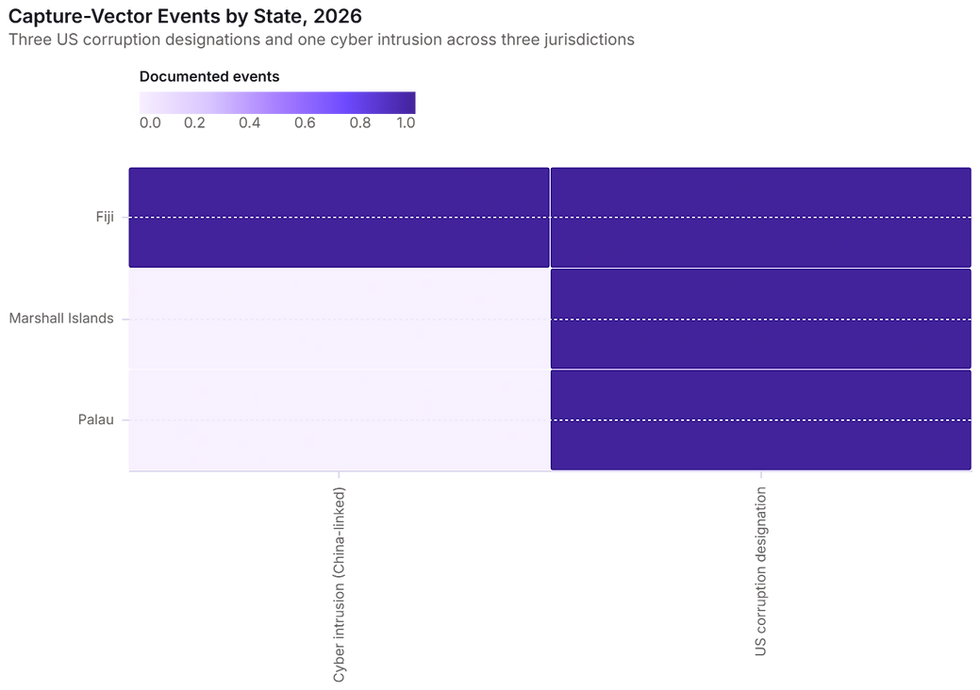
A corruption designation in this theatre is not a law-enforcement event. It is a market signal, priced simultaneously by three capitals — the sanctioned jurisdiction, Washington and Canberra — and 2026 has run the experiment three times over. In February, the US Treasury sanctioned Hokkons Baules, president of Palau's Senate, and Anderson Jibas, a former Marshall Islands mayor, alleging they had created openings for expanded Chinese influence (Al Jazeera/AFP, 8 October 2026). Eight months later, the State Department publicly designated Zhao Fugang, director of the Overseas Chinese Service Center in Fiji, for paying bribes to Fijian citizens to advance "China-based government, business and criminal interests" — barring him and his family from US entry, in a move Australia's Criminal Intelligence Commission had pre-loaded by listing him among its priority organised-crime targets (OCCRP, 8 October 2026; ABC News, 8 October 2026; The Bureau, 8 October 2026).
The designation's aftershocks exposed the transactional reality beneath the diplomatic language. Suva publicly demanded Washington's evidence; Zhao professed himself never questioned by either government and demanded particulars of the claims against him (PMN, 9 October 2026; Hong Kong Free Press, 13 October 2026). Beijing's foreign ministry rejected the framing outright as smearing. The signal, whatever its evidentiary merits, split the region's alignment physics precisely as an analyst quoted by Islands Business predicted it would: if a one-off, Beijing absorbs the hit and moves on; if a campaign, the calculus changes "for every Chinese operative and every compromised Pacific official in the region" (Islands Business/PACNEWS, 16 October 2026).
The fourth event of the sequence was digital, and quieter. Days after the Suva designation, the US embassy disclosed that China-linked hackers had maintained access over several days to the network of a regional organisation headquartered in Fiji, with regional governments and telecommunications networks flagged as parallel targets (Hong Kong Free Press, 13 October 2026; The Next Web, 13 October 2026). The intrusion mechanics — persistence in a collective body's systems, timed to a designation cycle — follow the infrastructure-warfare grammar we mapped in our cyber front assessment: capture the connective tissue, not the capital.
Strip away the personalities and the structural mechanism is legible: US interdiction is running upstream of alliance consensus rather than downstream of it, naming officials in COFA and partner states whose governments have not opened the cases. It is highly likely that the designation series continues into 2027 — three actions across eight months already constitute a campaign by any frequency standard — and each iteration converts another bilateral relationship into contested political terrain while leaving formal treaty architecture untouched.
The connectivity layer complicates the equation. On 18 May 2026, NEC completed construction of the East Micronesia Cable System (EMCS), a 2,250 km submarine cable linking Tarawa in Kiribati to Nauru, then via Kosrae and Pohnpei in the Federated States of Micronesia (Telecoms.com, 18 May 2026; Developing Telecoms, 15 May 2026). This is the first optical submarine cable connecting Kiribati and Nauru, all of whom have relied exclusively on satellites for international connectivity. The project received grant funding from Australia, Japan and the United States, creating a physical dependency that mirrors the treaty-layer lock-out: once the cable lands, the hosting state's vulnerability to disruption becomes a shared security concern, and the funding consortium gains leverage in future negotiations. It is unlikely that similar multi-patron cable projects will be approved in 2027 for states already locked into competing treaty constellations, because the redundancy logic of resilience conflicts with the concentration logic of influence.
For organisations with financial-services, correspondent-banking or data-dependent regional exposure: map counterparty proximity to designation risk the way sanctions desks map facilitators, not the way country teams map jurisdictions. Baseline: three designations since February 2026 across Palau, the Marshall Islands and Fiji; one disclosed multi-day network compromise of a regional body in Suva; AML and cybercrime frameworks for the region under joint construction under the Forum's 2026–2030 action plan; no indication the campaign pauses for electoral calendars; one major submarine cable commissioned in May 2026 with trilateral backing. Assume designation opacity of six-to-twelve weeks between preparation and announcement when pricing partner conduct, and audit regional-organisation data residency before auditing vendor lists.
7. The Dissent Ledger: Kiribati, Naoero, and the Limits of Consensus
Regional consensus in 2026 behaves like a traded option, not a treaty commitment — repeatedly exercised, never quite honoured, and priced by everyone accordingly. The sequence is compact enough to state in full. In August, at the Pacific foreign ministers' meeting, Kiribati and Naoero blocked a collective statement condemning China's July missile test; New Zealand's foreign minister answered by accusing both of appeasement (CSIS, 20 October 2026). In September, at the leaders' meeting in Koror, a softened clause registering concern and calling for advance notification of such launches passed — over Naoero's formal dissociation and Kiribati's absence from the leaders' retreat (CSIS, 20 October 2026). One launch, two meetings, three acts of defection, and a final text stripped of the word condemnation.
The Naoero dissociation carries particular analytical weight because of what it voids. This is a state that switched diplomatic recognition from Taipei to Beijing in January 2024, then signed a treaty with Australia in December of that same year granting Canberra an effective veto over its third-party security arrangements (CSIS, 20 October 2026). The veto, in other words, covers the paperwork of alignment while leaving behavioural alignment unsecured. When Koror tested the difference, the answer came back in a single dissociation statement: signature and conduct are separate asset classes, and Wellington's appeasement broadside — delivered from a foreign ministry navigating its own independence calculus, as assessed in our New Zealand 2026 report — moved neither.
The deeper pattern is economic, not diplomatic. Micro-state defection is now a revenue position. Blocking a communiqué invites quiet gratitude from one patron and intensified courtship from the other; dissociation preserves a state's price as a swing jurisdiction without permanently foreclosing either bidder. Kiribati's earlier rupture with the Forum — its 2022 withdrawal, later healed — reads in retrospect as a rehearsal for exactly this leverage, and its September absence fit the pattern. Neither patron is willing to make an example of a defector, because each still needs the swing votes for the next communiqué.
The climate layer is the variable that binds the dissent ledger to real policy. The Pre-COP31 summit convened in Fiji and Tuvalu from 5 to 8 October 2026, setting negotiation priorities for the UN Climate Change Conference (COP31) in Antalya, Türkiye, from 9 to 20 November 2026 (Parliament of the Republic of Türkiye, October 2026; UNEP FI, 8 October 2026). The 55th Pacific Islands Forum Leaders' meeting in Koror endorsed the BELAU Declaration on 3 September 2026, which calls for improved access to climate finance for small island developing states, restating long-standing demands for loss and damage funding and fossil-fuel phase-out support (European Parliament Study, 13 October 2026; SPC, October 2026). Australia presides over the COP31 presidency, creating a dual role that amplifies both its leverage and its contradictions: as climate champion for the islands at the table, and as a coal and gas exporter whose domestic policy deepens the harm to its neighbours (Amnesty International, 2 November 2026).
The through-line of Sections 5 through 7 is a single proposition: the region is selling access, and 2027 determines whether what was bought works. Financing has migrated, presence has been institutionalised, defection has been monetised, and the allies have accumulated obligations faster than delivery capacity. It is likely that at least one flagship allied commitment slips visibly before end-2027 — the Vanuatu contradiction sets the precedent, the election calendar supplies the motive, and a decade-scale funding pace supplies the excuse — and there is a realistic possibility that Beijing converts the first visible slip into a renewed grant-and-presence offensive pitched precisely at the treaty partners whose deliveries were deferred.
For organisations with regional government contracts, diplomatic-adjacent services or forum-cycle engagement calendars: stop weighting communiqué language as an alignment indicator. Baseline: one softened clause adopted September 2026 with one dissociation and one absence; two states with documented records of defection-defection-absence (Kiribati, Naoero) against treaty partners on both sides; NZ appeasement rhetoric with no documented withdrawal consequence; three military-equipped states among fourteen members constraining any enforcement mechanism; COP31 hosted by a coal-exporting patron with contradictory domestic policy. Treat communiqués as sentiment sampling with a half-life measured in weeks, and anchor continuity plans in the bilateral instrument layer where obligations are actually enforceable.
8. The Delivery Test: Elections, Chequebooks, and the Clock Running Down
Strategy in this theatre gets written in treaties and judged in deliveries, and 2027 is when the judgement falls due. The minister managing Australia's effort puts the frame plainly: "I think we've done pretty well," Pacific Islands Affairs Minister Pat Conroy told Bloomberg — before conceding that Canberra now has to deliver on the commitments made, with "every Pacific nation that's elevated their relationship with us" expecting the benefits to arrive (Bloomberg, 28 October 2026). The same week, Australian senators were pressing DFAT through estimates over Vanuatu's refusal to schedule down its Chinese policing relationship — evidence that delivery scepticism has already reached the accountability machinery (Politico Canberra Playbook, 28 October 2026).
The delivery ledger is now public enough to grade, and it is mixed. On the promise side: Waqa Moana's Bluebottle vessels arrive for Fiji from 2027, the Nakamal Agreement pipelines roughly A$500 million into Vanuatu over a decade, and the NZ–Cook Islands reconciliation advanced through April's defence declaration with restored aid of NZ$29.8 million a year and the 5 October ministerial forum renewing the Waka Hourua/Vaka Purua partnership statement (RNZ, 30 October 2026; Islands Business/PACNEWS, 20 October 2026; RNZ, 2 April 2026; PACNEWS, 9 October 2026). The EMCS submarine cable went live in May 2026, ending exclusive satellite reliance for Kiribati and Nauru (Developing Telecoms, 15 May 2026). On the doubt side: the Nakamal compliance contradiction stands unresolved sixteen weeks in; the police ministers' communiqué of 26 October is explicitly "a statement of shared intent" that is "not legally binding", reporting back through forum processes rather than courts (US Department of State, 26 October 2026); and the critical-minerals play — Washington's Penrhyn port investment in the Cook Islands — is an early-stage bet whose revenue horizon lies well beyond the political cycle now driving the spending (RNZ, 1 September 2026).
That cycle is the variable most external watchers price last and local politicians price first. Australian election funding scrutiny was already consuming Senate estimates bandwidth in late October (Politico Canberra Playbook, 28 October 2026), and Suva has now fixed its own clock: Prime Minister Rabuka confirmed on 3 November that the constitutional referendum and general election will proceed on 9 December, despite an extended consultation window on Bill 32 and a deepening coalition rift (PMN, 3 November 2026). Delivery timelines that straddle either a change of government in Canberra or a contested electoral cycle in Suva inherit a discount no communiqué can offset. The same compression applies from the other direction: if Beijing judges the allied consolidation to be succeeding, its counter-bids escalate in exactly the window when chequebooks are hardest to refill — the timing compression we described in our Pacific compression / Taiwan exposure assessment operates here in miniature, with the same logic, smaller numbers and faster clocks.
For organisations with exposure running through allied delivery chains — defence logistics, donor-funded construction, regional programme management: build slippage into every milestone dated after mid-2027 and identify now which commitments carry reputational rather than contractual penalties. Baseline: one documented compliance contradiction (Vanuatu) at sixteen weeks post-signature; first major hardware deliveries (Bluebottles, 2027) pending; one non-binding ministerial communiqué defining the police front's interim enforcement ceiling; A$600 million Waqa Moana, A$500 million Nakamal and NZ$29.8 million annual Cook Islands flows as the concrete deliverable set; Chinese delivery machinery idle but intact, with frequent small grants as the standing ready reserve. Hedge by contracting performance, not partnership.
9. Pacific Islands 2026 Geopolitical Risk Assessment — Three Scenarios
Source: CES Intelligence calibrated judgment, 4 November 2026 — triggers and bidirectional justification below.
Scenario A — The Ledger Holds: Managed Presence and the Long Paperwork War (Probability: ~40–45%)
The architecture assembled through 2026 keeps absorbing strain without rupturing. Fiji's Bluebottle deliveries land broadly on their 2027 timetable, the Solomon Islands treaty negotiation advances in form if not in signature, and the Vanuatu contradiction settles into the ambient friction of a decade-long partnership rather than escalating into a crisis. Beijing sustains its grant-and-presence cadence — small sums, police teams, ceremonial infrastructure — without attempting a second strategic acquisition of the Solomon Islands type. The diesel crisis persists as a chronic budget strain without tipping a government into visible default; the tuna licensing economy continues yielding its US$480 million a year to modestly rising VDS prices. The Forum produces one more softened communiqué in 2027, and the advance-notification clause survives as an aspiration occasionally honoured. COP31 closes in Antalya with incremental climate-finance language — enough for Canberra to claim momentum, not enough to change any island balance sheet.
This scenario holds unless: the pending Vanuatu–China policing memorandum — still unsigned — reaches signature and converts the single documented contradiction into a replicable template; a flagship allied delivery slips visibly before the second half of 2027, handing Beijing a marketing window for a larger counter-offer; the fuel-import bill, running at 5–15 per cent of GDP, tips the Marshall Islands' precedent of a declared economic emergency into a second state with contagion optics; or a second missile test is conducted without advance notification, converting the region's softest norm into its first broken one. The probability is elevated by the funded delivery queues already banked, by the region's demonstrated crisis-containment record (one launch, two meetings, one softened sentence, no rupture), and by Beijing's structural lending reticence; it is reduced only by the accumulating defection ledger, the unresolved Solomon review, and the electoral-cycle compression bearing down on every chequebook in the constellation.
Scenario B — The Hairline Crack: The Vanuatu Template Goes Regional (Probability: ~30–35%)
Delivery slippage and behavioural defection couple. The Vanuatu contradiction proves to be a preview rather than an aberration: Port Vila signs the policing memorandum with Beijing, invoking the Namele Agreement track shelved during the Nakamal negotiation, and one additional treaty state — Naoero being the natural candidate, given its 2024 recognition switch and its 2026 dissociation record — accepts a strategic-grade Chinese offer that formally respects its Australian treaty while hollowing its intent. Beijing, having watched its May 2022 region-wide overture fail, re-learns that bilateral offers work: it re-prices its toolkit with one visible package — a port refurbishment, a stadium, a police compound — pitched precisely at whichever state absorbed the first allied delivery slip. The corruption-designation campaign widens in response, and the region enters a phase of open, routinised bidding in which each communiqué vote carries a price tag. The diesel emergency supplies the opening: the first patron to fund fuel-storage or grid infrastructure at scale in a distressed state converts an economic emergency into a geopolitical acquisition. The treaty layer survives intact; it simply stops describing behaviour.
This scenario holds unless: Canberra accelerates identifiable cash flows into the treaty states ahead of the electoral calendar, converting abstract decade-scale promises into visible quarterly arrivals; the Solomon Islands review publishes its findings and measurably rolls back the Chinese policing footprint, demonstrating that lock-out instruments can bite; the COP31 presidency delivers a climate-finance package concrete enough to relieve the fuel-fiscal squeeze before Beijing volunteers to; or the police ministers' process delivers tangible capacity fast enough that policing gifts lose scarcity value. The probability is elevated by the sixteen-week compliance contradiction already on the record, by the defection-as-revenue economics documented at the Forum layer, by one unsigned memorandum sitting ready to convert, and by the raw size of the unaddressed energy bill — a demand pull larger than every aid programme in the region combined; it is reduced only by the irreversibility of signed treaties, by the depth of allied financing dominance in the aid data, and by Beijing's demonstrated preference for presence over confrontation.
Scenario C — The Unnotified Summer: A Second Splash and the Open Cascade (Probability: ~15–20%)
The notification norm breaks, and the cascade follows. A second submarine-launched missile test into the central Pacific is conducted without the advance notification the Palau clause called for — possibly coinciding, as the July test did, with a moment calculated to maximise diplomatic humiliation — and the regional response machinery discovers that a softened sentence generates no usable sanction. The designation campaign and the defection ledger interact explosively: a designated jurisdiction pushes back against Washington's extraterritorial assertiveness by extending an invitation Beijing has waited years to receive — berthing rights, observer status, or a full internal-security package. Naval shadowing incidents multiply; Japan, Australia, New Zealand and the United States surge ISR coverage; the Forum convenes an emergency session that cannot agree on language beyond concern. A degraded subsea or satellite connectivity incident — plausible in a theatre where Kiribati and Nauru ran on single-path satellite until May — converts strategic ambiguity into operational crisis for regional banks, airlines and data-dependent services. The region experiences its first genuinely open great-power confrontation, conducted not through the small states but across their heads, with their airspace, ports and cables as the terrain.
This scenario holds unless: Beijing calculates that breaking its own freshly-established notification standard forfeits more influence than the test yields in deterrent signalling; both patrons continue preferring stable ambiguity to open bids, as four decades of regional restraint suggests; or the corruption-designation campaign serves as a functioning pressure valve, absorbing escalation energy into a manageable, deniable, prosecutorial register rather than letting it accumulate toward a splash-point. The probability is elevated by the July precedent — a first-of-its-kind launch conducted hours after a treaty signing, against an ignored cancellation request, and hailed domestically as strategic proof — and by the demonstrated capacity of the designation sequence to destabilise alignments; it is reduced by the asymmetry that the Pacific gains Beijing far more as a bargaining theatre than as a staging ground, by the police-grade rather than base-grade character of Chinese ambitions documented to date, and by the ratchet effect of a softened-clause consensus that has already pre-exhausted the region's escalation vocabulary.

10. Implications
Country-risk monitoring. Replace country alignment scoring with instrument-layer monitoring across the arc from Suva to Port Vila: track the Vanuatu–China policing memorandum's signature status weekly, the Solomon Islands review's publication status, and the five named treaty negotiations as dated gates. Set rating actions to the defection ledger, not the communiqué record: two documented defections and one sixteen-week compliance contradiction already justify a one-notch internal downgrade on any exposure underwritten on signature compliance alone.
Duty of care and operations security. Build notification-gap protocols into all Pacific crisis-management plans: assume any ambiguous high-altitude or maritime incident generates a 48–96 hour information vacuum in which no patron speaks with authority, and pre-position holding communications and travel-decision criteria accordingly. Restrict reliance on regional-organisation digital infrastructure pending assurance audits — one multi-day compromise of a Suva-headquartered body is on the record — and price the single-path connectivity risk of states that left satellite exclusivity only in May 2026.
Energy and infrastructure. Treat the fuel-import emergency as the region's largest unaddressed procurement market: US$6 billion a year of demand, 10–25 per cent of GDP in the most exposed states, and a funder-of-first-resort position still vacant. Screen every Pacific energy bid for dual-reading — a storage hub is balance-sheet relief for the host state and a strategic chokepoint for the funder — and require provenance, inspection and removal clauses in any contract touched by donation-channel equipment, specifying the right to refuse, audit and physically decommission.
Financial exposure. Reprice all island-sovereign and quasi-sovereign exposure on the post-2026 financing reality: model debt-service stress on delivery disputes and election-calendar discontinuities rather than on Chinese-lending repricing, cap unhedged concentration in any single patron-financed instrument at 5 per cent of regional book, and map counterparty exposure to the designation campaign — three actions in eight months establishes a baseline rate of one per quarter, not a tail. Weight the tuna licensing economy, with its US$480 million annual flow and US$9,000–14,000 VDS pricing, as the one revenue stream that scales without patron debt.
Insurance and continuity. Re-underwrite policies covering Pacific-sited assets, fishing operations and logistics lanes against a two-tier claims reality: the police-and-paperwork baseline of Scenario A, and the naval-shadowing regime of Scenario C. Define war-exclusion trigger language against the notification norm explicitly, and pre-agree response obligations for regional-organisation network compromise, which carries no body count and therefore no standard claims grammar.
Board-level strategy. Treat micro-state defection as the region's highest-signal indicator, not as diplomatic noise: brief the board on each communiqué dissociation, treaty contradiction and designation as a single recurring pattern, review Pacific exposure quarterly against the defection ledger, and allocate pre-approved discretionary reserves against Scenario B conversion events, where the first visible allied slip meets the first visible Chinese counter-offer. Monitor COP31 outcomes not for climate targets but for financing mechanics: whoever converts the BELAU Declaration's climate-finance demands into first-mover funded projects in 2027 acquires the loyalty dividend that the security treaties alone were never going to buy.
11. Core Analytical Judgment
The Pacific of 2026 is operating a vending machine, and every actor knows what it dispenses. Geography in, obligations out — with the crucial complication that the machine now has two loading hatches and no refund policy. The fourteen flags at the centre of this contest are neither naive victims of empire nor confident mercenaries of sovereignty; they are democracies with publics, running the only genuinely symmetric bargaining position in the contemporary state system, and their leverage decays the moment either patron monopolises the shelf.
The error to avoid is reading the paperwork as the system. Treaty architecture and behavioural alignment are two different assets with different half-lives, and they are coupled only through lag — signatures are instantaneous, conduct adjusts over quarters, procurement adjusts over years. The Vanuatu contradiction, the Naoero dissociation and the donation manifests are not anomalies in the allied record; they are the record, occurring at a tempo that signature-count metrics will never register. When the diplomatic histories of this period are written, the fifty-six arrangements will fill the annexes and the untranslated behaviours will fill the chapters.
There is no stable equilibrium in this system, only a managed oscillation between over-priced presence and under-priced protection. The variables are coupled: every allied delivery slip raises the clearing price of defection, every Chinese provocation re-sponsors the allied chequebook, and every corruption designation converts an alignment question into a litigation question. The oscillation has narrowed since 2022 — that much is progress, of a kind. But the system's largest variable sits outside the security layer entirely. A region spending up to a quarter of national income on imported diesel, while its principal legal export industry nets US$480 million a year and its patrons argue over policing delegations, is a region whose sovereign decisions are ultimately priced at the fuel dock. Whichever patron understands that first — and funds it first — buys what no treaty has purchased.
The tell for the next twenty-four months is neither the communiqué register nor the aid map. It is the unloaded question sitting in Suva's files about a warhead splash and a vague hazard notice. Norms in small-state regions are not written in texts; they are priced by the response to the first breach. Watch the second splash.
In this theatre, sovereignty is rented — and for the first time in the post-colonial era, both landlords are paying rent to the tenants.
---
Want deeper analysis?
Confidential advisory programs scoped to your organization — continuous monitoring, dedicated analysis, board-level support. Engagements are annual.
---
DISCLAIMER — This analysis is provided for informational and strategic planning purposes only. It is not investment advice, financial advice, or legal advice, and it should not be treated as such. Probability assessments reflect the analyst's calibrated judgment based on available open-source intelligence as of the date of publication, and are subject to revision as new information emerges. Some quantitative estimates and reported events are based on regional sourcing that may evolve as additional confirmation becomes available.


