
Pyongyang Answers Dialogue With a Fence

CES DAILY SIGNAL — October 27, 2026
On 23 October, Seoul's deputy defence minister stood before cameras to offer Pyongyang military talks on jointly verifying the two Koreas' disputed land border (Al Jazeera, 23 October 2026). Three days later, the DPRK's permanent representative at the United Nations signed a letter to the Security Council president branding September's mine explosions inside the Demilitarized Zone a "fabrication" by the South and warning that the North stood ready to exercise its right to self-defence (UPI, 26 October 2026).
By branding as "fabricated" the incident it is accused of causing precisely when Seoul holds out a military channel, Pyongyang is closing the one exit it claims the South manufactured. The pattern is now legible: North Korea border tensions are no longer episodes of rhetoric but a construction programme.
TRAJECTORY
Seoul's offer expires unanswered. Through the winter, the North completes the physical sealing of its southern frontier — fences pushed up to the demarcation line, mines forward of them, artillery visibly rather than covertly posted — while rhetorical escalation substitutes for diplomacy at the United Nations. Incidents along the line multiply without coordination mechanisms: warning shots, crossings, broadcasts and counter-broadcasts. Neither side seeks war; both now operate on a border engineered for friction, not management.
SECOND-ORDER EFFECTS
Washington. The armistice-enforcement question migrates from legal archive to live US politics. If Pyongyang's fortification-as-sovereignty framing consolidates, the Trump administration's quiet drift from "denuclearization" toward a freeze paradigm will accelerate — realistic possibility before the next APEC cycle.
Beijing. Kim Jong-un's recent travel to China, weeks after its party plenum season, converts every DMZ incident into a stress test of Chinese "constructive stability." A highly likely Chinese call for restraint, at zero cost to its alignment with Pyongyang.
Tokyo. Japan reads frontier hardening as one data point in a broader rearmament sequence; acquisition cycles and ammunition contracts priced for chronic friction, not resolution.
ANALYSIS
The letter pre-loads the narrative
Since our Signal earlier this month on the DMZ standoff, the escalation has changed register: it has acquired a written record. The letter's operative function is not to persuade the Council but to place on file, before events occur, that whatever happens next along the border constitutes anticipatory self-defence. The document arrived on Sunday, per state media, denouncing the "provocation the ROK committed by groundlessly shifting the blame for the dubious 'mine explosion incident'" (UPI, 26 October 2026). It answered a roughly two-page South Korean communication demanding an apology for the 21 September explosions that injured three South Korean soldiers, two seriously, and asserting a violation of the 1953 armistice (Korea Times, 26 October 2026). The United Nations Command has already assessed that a North Korean mine placed south of the line breached the armistice (Sky News, 26 October 2026). The filing and the fortification serve one posture; the fortification campaign continuing regardless of any Council uptake is highly likely.
The severed circuit
The anatomy of Seoul's offer matters. The proposal of 23 October sought three things: joint verification of the Military Demarcation Line, restoration of severed military communication channels, and mechanisms to prevent accidental clashes, with a three-way format including the US-led United Nations Command left open (Al Jazeera, 23 October 2026). Each element targets exactly the failure modes now operating. Against it stands a rejection architecture that predates the letter: Kim Yo Jong dismissed the mine incident as "staged" on 30 September and 2 October, while personally announcing a ballistic missile launch on 3 October — an institutional anomaly in the announcement itself (ISW, 7 October 2026). Marshal Pak Jong Chon threatened an "overwhelming response" to any South Korean countermeasure (AP, 23 October 2026). The channel is not merely unused; it is being dismantled piece by piece (see our North Korea 2026 Geopolitical Risk Assessment, 2026). Acceptance of military talks within ninety days is unlikely, and every week of silence further entrenches the severed-circuit baseline.
North Korea border tensions are now measured in metres
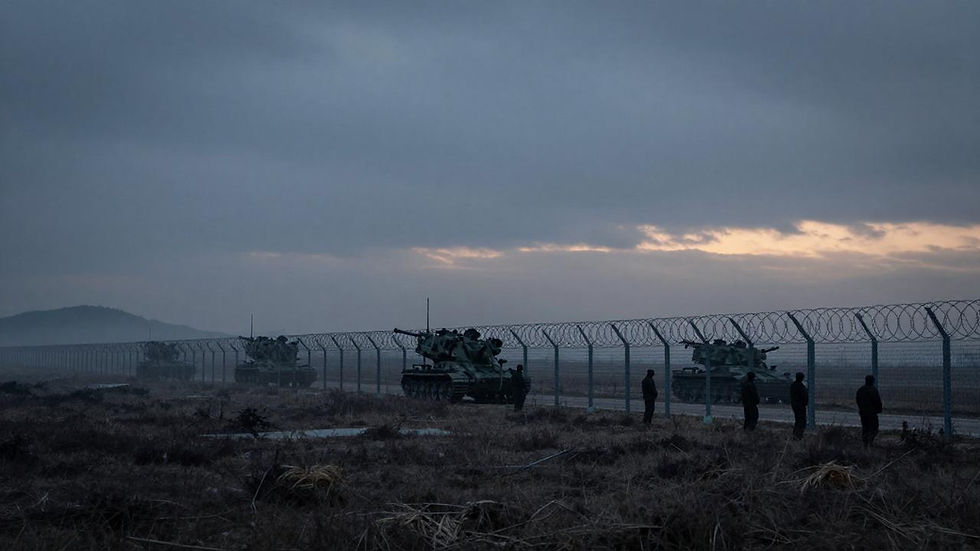
The frontier is now measured in bodies and metres. North Korean soldiers have been recorded crossing the line roughly fifty times this year during construction work, against nine in all of 2024, per the South Korean Joint Chiefs of Staff (AP, 23 October 2026). Fences stand within eighty metres of the line, with ground cleared for mines five to ten metres from it (JoongAng Daily, 22 June 2026), and imagery reviewed in early October suggested a first fence segment constructed south of the line in the central sector (JoongAng Daily, 9 October 2026). On 26 October, Yonhap identified three self-propelled 122-mm howitzers in open emplacement in Kaepung County, barrels oriented south — a rare exposed posting of artillery normally kept in bunkers, observed from the Aegibong observatory in Gimpo (Yonhap, 26 October 2026). The guns' engagement geometry is the point of the deployment: a 122-mm battery posted on the frontier line reaches deep into inhabited Gyeonggi. Against this landscape, further crossing incidents of at least notable intensity are likely, with a realistic possibility of a localized exchange of fire — accidental in origin, deliberate in duration.
Beijing's arithmetic
The Chinese position defines the ceiling of this crisis. Foreign Minister Wang Yi framed the peninsula's tensions as rooted in US "hostile policy" during an August visit to Seoul, urging Seoul not to pick sides (Reuters, 20 August 2026). Since our Signal on this theatre, however, the variable has moved: South Korea's foreign minister now acknowledges that discussions on US–North Korea dialogue may have occurred during Kim Jong-un's China trip, ahead of a summit season Trump is expected to attend (JoongAng Daily, 27 October 2026). Beijing thus manages two clocks — plenum-anchored internal consolidation and an external de-escalation file it prefers to handle without public mediation (see our China 2026 Geopolitical Risk Assessment, 2026). Quiet damping of uncontrolled escalation is likely; visible Chinese brokerage before spring 2027 remains a remote possibility.
SIGNALS TO WATCH
This reading holds unless Pyongyang responds to Seoul's standing offer by mid-November; a lapse beyond that date converts the proposal into a standing casualty of the diplomatic record.
Escalation becomes probable if cross-border propaganda broadcasts resume before mid-November, as pledged — the reciprocal loudspeaker cycle of the 2015 and 2025 precedents then reactivates in full.
If additional artillery is moved out of bunkers into open emplacements before the end of December, the signalling phase is hardening into a semi-permanent posture.
If the Security Council takes any procedural step on the exchanged letters, the legal front graduates from correspondence to item — watch the Greek presidency's agenda through year-end.
---
Want deeper analysis?
Confidential advisory programs scoped to your organization — continuous monitoring, dedicated analysis, board-level support. Engagements are annual.
---
DISCLAIMER — This analysis is provided for informational and strategic planning purposes only. It is not investment advice, financial advice, or legal advice, and it should not be treated as such. Probability assessments reflect the analyst's calibrated judgment based on available open-source intelligence as of the date of publication, and are subject to revision as new information emerges. Some quantitative estimates and reported events are based on regional sourcing that may evolve as additional confirmation becomes available.


