Zambia 2026: The Mineral Prison

Updated: Sep 30
Contents
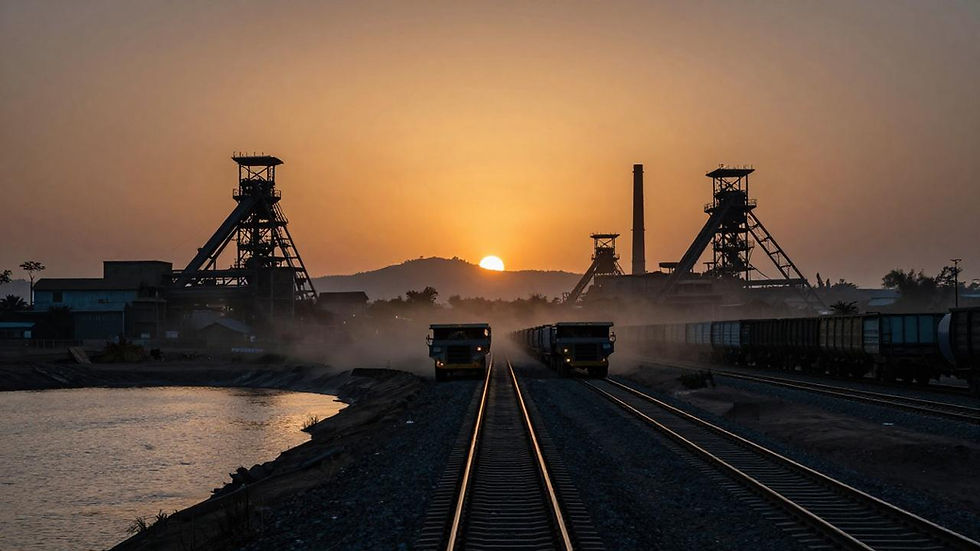
This Zambia 2026 geopolitical risk assessment maps the theatre where US-China critical-minerals competition, an unresolved electoral transition, sovereign-debt restructuring, climate-driven energy vulnerability, and Congolese border dynamics converge on a landlocked state whose entire economic model depends on exporting copper through contested corridors.
Key Takeaways
Hichilema's re-election produced a mandate without a legal contest — and that is the problem. He won roughly 60% of the vote against Brian Mundubile's 38%, but the seven-day constitutional window for an election petition expired with the courts physically sealed across the country, no petition filed, an opposition figure shot dead, and the challenger in hiding. The legitimacy deficit now has no judicial remedy available.
The corridor competition is the defining geopolitical variable. The US-backed Lobito Corridor ($753 million in closed financing, up to $1 billion pledged for the DRC section) and the China-financed $1.4 billion TAZARA overhaul are competing architectures for the export direction of Copperbelt minerals. Its territory is the hinge.
The copper gamble is the government's core wager. The country exported 890,346 metric tons in 2025 — up 8%, but a miss against the 1 million ton target — and has pledged 3 million tons by 2031. Over $5 billion in committed expansions (Lumwana, Kansanshi, Konkola, Mingomba, Luanshya) is colliding with a binding energy ceiling.
Debt restructuring reduced the burden without resolving the structure. The $1.36 billion eurobond buyback completed in June 2026 unlocked $275 million for energy infrastructure, but an estimated $13–15 billion in Chinese collateralized exposure remains secured against export receivables — and a successor IMF programme is still under negotiation.
Crisis-level hunger is projected to surge 72% as a super El Niño converges with Middle East conflict-driven fuel and fertilizer inflation — the transmission mechanism through which external shocks become political instability.
The Contested Mandate: A Petition That Never Reached the Court
Hakainde Hichilema secured a second term in the August 13, 2026 presidential election with approximately 60% of the vote, against roughly 38% for Brian Mundubile of the National Reconciliation Party for Unity and Prosperity, according to Reuters and the BBC. The Copperbelt Province flipped to the incumbent's United Party for National Development — a politically significant shift in the country's most economically critical region — and turnout rose to 57% nationally, according to official electoral commission figures reported in regional media. Preparations for the inauguration proceeded without interruption.
The post-election fortnight, however, transformed a decisive result into a legitimacy problem with no institutional exit.
On August 24 — the final day to file an election petition under Article 101 of the constitution — court premises in Lusaka and elsewhere were physically sealed with police tape, with courts closed country-wide citing security concerns, as reported by Reuters and the BBC. The Law Association of Zambia demanded the urgent restoration of access, warning that security measures must not undermine judicial independence (DW, 26 August 2026). The constitutional registry confirmed in writing that no petition had been received by the 6 p.m. deadline on August 24. The window closed the next day. In parallel, Mundubile was in hiding citing threats, had been summoned by police for questioning over alleged national security offences he describes as fabricated, and several of his associates had been arrested; one opposition figure was shot dead in the post-election period, according to BBC and Reuters reporting.
The analytical reading matters more than the chronology. The state has not slid into consolidation-era authoritarianism — Hichilema's party noted Mundubile was free to use legal routes, and international monitors broadly accepted the result. But the sequence — courts sealed precisely on the filing deadline, opposition figures detained or worse, a challenger in hiding — removes the judicial channel through which electoral disputes here have historically been resolved and absorbed. What remains is an unlitigated grievance. Post-election analyses have documented turnout anomalies in at least 27 constituencies — predominantly UPND-aligned districts recording above 80% turnout against a 57% national average — with estimates of the potentially affected vote exposure ranging from 350,000 to 550,000, according to regional press investigations. That allegation now has nowhere legally to go. It survives instead in the political space: opposition street mobilization, international monitor footnotes, and the diaspora narrative.
The delivery gap frames the second term. Zambia Development Agency data indicates that 2,338 investment licences worth approximately $97 billion were issued between 2021 and mid-2026, of which roughly $19.07 billion has been actualized — an 80% gap between announced and realized capital that opposition narratives will monetize for the next five years, now without the pressure valve of a court challenge (ZDA figures carried by ZNBC, June 2026).
The analytical implication is uncomfortable for the democracy narrative that underpinned the country's international repositioning after 2021: a competitive, high-turnout election whose outcome is probably robust has simultaneously produced a weaker institutional settlement than it started with. These two facts are not in contradiction. They are the condition.
The Corridor War: Lobito versus Tazara
The defining geopolitical competition is not fought in Lusaka's conference rooms. It is fought on two railways.
The Lobito Corridor — a 1,300-kilometre rail line linking Angola's Atlantic port of Lobito to the Copperbelt and the DRC — closed a $753 million rehabilitation financing package through the African Finance Corporation in July 2026, with concessions signed with both Angola and the host nation and a target freight capacity of 4.6 million tonnes per year by 2030, according to Further Africa and Business Insider Africa. The United States has pledged up to $1 billion to back a 30-year concession for the Congolese section, explicitly framed in Washington as critical-minerals policy — a counterweight to Chinese dominance of Central African supply chains (Business Insider Africa, 27 August 2026).
The TAZARA railway — the 1970s Chinese-built line to Dar es Salaam — is undergoing a $1.4 billion Chinese-financed overhaul, maintaining the Indian Ocean route as Beijing's anchored export corridor for the region.
Two great powers are thus financing competing rail architectures across the country's territory to control the direction of a metal the energy transition cannot do without. The Copperbelt holds roughly 15% of global copper reserves; the overwhelming majority of the world's cobalt lies across the border in Katanga, making bilateral interdependence a physical fact rather than a policy choice. This is the competitive dynamic documented in our DR Congo 2026 assessment. The difference is territorial: the DRC holds the deposits; the state holds the transit. Transit control is leverage — the logic that underpins our Panama Canal 2026 and Bab al-Mandeb assessments.
The dilemma mirrors the one identified in the India 2026 analysis: non-alignment is viable only while both suitors accept coexistence. Export controls on critical-mineral supply chains and financing conditioned on alignment are the two pressure vectors that could collapse the dual-route optionality into a binary choice.
The commercial risk is underappreciated in Lusaka's own messaging. If Lobito reaches 4.6 million tonnes per year by 2030 while TAZARA modernization lags, export flows shift structurally westward — an outcome that serves Atlantic-facing supply chains but marginalizes the Chinese-financed infrastructure underlying a significant share of its bilateral obligations. If the Chinese route loses commercial viability, Beijing's willingness to maintain concessional terms on the associated debt diminishes, and the arithmetic examined below comes under pressure. The equilibrium documented by Further Africa — route competition rather than a binary choice — holds only while both corridors remain commercially viable. That is a condition, not a right.
The Copper Arithmetic: Records, Targets, and the 3 Million Ton Gamble
The mining sector is simultaneously the greatest strength and the most time-constrained bet.
The output trajectory is real. Production rose 8% to 890,346 metric tons in 2025, up from 825,513 tons in 2024, driven by a four-fold increase at Vedanta's Konkola Copper Mines and a 40% increase at Mopani, though the year still missed the 1 million ton target (mines ministry data carried by Reuters, January 2026). Copper exports earned over $6 billion in the first half of 2026 alone, per official statistics reported by Zambian Business Times (17 August 2026). The investment pipeline is the deepest in a generation: Barrick is investing $2 billion in the Lumwana Super Pit expansion to double production, with first output anticipated in 2028 (Barrick statements); First Quantum commissioned the $1.25 billion Kansanshi S3 expansion in 2025, lifting annual output toward 270,000 tons (industry reports, April 2026); KoBold Metals — the AI-enabled, US-backed exploration company — broke ground on its $2.3 billion Mingomba project in April 2026, targeting 300,000 tons annually in the early 2030s (Forbes, 5 May 2026; Reuters); Vedanta committed $1.5 billion through a new subsidiary to expand Konkola, whose Chingola section reopened in May 2026 after an 18-year shutdown, per company statements carried by financial newswires; and China Nonferrous is restarting the long-idled Luanshya mine with a $710 million redevelopment targeting 100,000 tons a year, according to mining sector reporting. The official target — 3 million tons by 2031, stated as a centrepiece of Hichilema's campaign under the 10-10-5-3-3-1-1 development framework — would place the country ahead of the United States and China among global producers (AP, 12 August 2026; Ministry of Information and Media, August 2026).
Three frictions qualify the narrative.
Smelting is the bottleneck, not geology. Lusaka extended the suspension of its 10% copper concentrate export duty to September 30, 2026, covering 271,742 tons of unprocessed material, precisely because major smelters are in extended maintenance — a signal that downstream processing capacity, not geology, is the current constraint (Reuters, 3 June 2026). A mining state exporting concentrates rather than cathodes captures less value and weakens the fiscal base the debt service depends on.
The ownership map is the geopolitical map. Mopani is now majority-held by Abu Dhabi's International Resources Holding alongside state ZCCM-IH; Lubambe is 70% owned by China's JCHX Mining; Konkola is Vedanta's; Lumwana is Barrick's; Mingomba is KoBold's, with the US ambassador publicly framing it as a flagship of the Washington–Lusaka relationship (Forbes, 5 May 2026). This is diversification of capital, yes — but it is also the embedding of competing strategic patrons directly inside the production base, upstream of the corridor competition. The DR Congo 2026 assessment documents the same pattern in Katanga; here it is replicated within a single national jurisdiction.
The 2026/27 El Niño threat sits directly on this ramp-up. Every new mine in the pipeline is power-hungry, and the power system is examined below. The production target and the energy ceiling are scheduled to collide within the same twelve-month window.
The Debt Mirage: Restructured, Bought Back, Renegotiated
The post-default arc is presented as a success story, and on its own terms it is — but the sequencing of 2026 reveals a state still in treatment, not remission.
The headline improvements are real. External debt service fell from an estimated $2.6 billion per year to roughly $900 million annually from 2026 onward, per government statements carried by Reuters. Inflation fell from 24.6% in December 2021 to 6.2% in August 2026, while international reserves rose to approximately $6.5 billion (Ministry of Information and Media, August 2026). The IMF completed its sixth review under the Extended Credit Facility in January 2026, with the Fund projecting inflation to converge gradually toward the 6–8% target band only by 2027 — a phrasing that concedes above-target inflation in the interim, with independent analysts at MCB Group projecting roughly 8.5% by end-2026. In June 2026, Lusaka completed the buyback of its $1.36 billion eurobond due 2053, unlocking approximately $275 million redirected into energy infrastructure under a pioneering debt-for-development programme (Business Insider Africa, 10 June 2026) — the instrument that converts external claims into power-sector capital precisely because the power sector is the binding constraint.
Three structural weaknesses remain, and one development reframes them all.
Copper price dependency. The debt trajectory is endogenously correlated with copper prices; the 2020 default was triggered partly by declining copper revenue. A sustained correction — whether from demand compression or Chinese slowdown, as analyzed in the China 2026 assessment — would compress the revenue base servicing the restructured stock.
Collateralized Chinese exposure. Third-party datasets, including those referenced in ISS African Futures analysis, place Chinese lending at $13–15 billion, much of it secured against export receivables. A portion of copper earnings is pre-committed before it reaches the treasury — invisible in headline debt-to-GDP ratios, decisive in fiscal space.
The grace-period cliff. The three-year grace period and extended maturities provide breathing space, not resolution. By 2028–2029, amortization accelerates under assumptions of sustained copper revenue, stable exchange rates, and programme compliance — three correlated variables, not independent ones.
The reframing development: Finance Minister Situmbeko Musokotwane told Reuters in July 2026 that Lusaka aims to conclude a successor IMF programme by year-end, centred on channeling capital into mining, energy, and agriculture — and explicitly named two risks: fuel prices linked to the Middle East conflict, and a drought straining hydropower. The finance ministry's own risk map, in other words, is the skeleton of this assessment. A state six months into a successor IMF negotiation is a state whose stabilization is explicitly provisional.
The Chinese Anchor: Collateralized Sovereignty
Chinese engagement in the country has evolved from infrastructure-for-resources into something more constraining.
Chinese lending estimated at $13–15 billion, much of it collateralized against export receivables, channels a portion of copper earnings toward Chinese obligations before it reaches the treasury — a dependency invisible in headline debt ratios but decisive in fiscal space, as documented in ISS African Futures analysis of the restructuring. Simultaneously, the $1.4 billion TAZARA modernization maintains infrastructural leverage over the Indian Ocean export route. The combination is a dual instrument — financial leverage through debt, corridor leverage through export infrastructure — exercised not through overt conditionality but through structural entrenchment, the pattern mapped across the mineral corridor in our DR Congo 2026 assessment.
The ownership structure of the mining base reinforces the pattern. Chinese entities hold or have recently held controlling stakes across multiple mid-tier operations — JCHX at Lubambe, China Nonferrous at Luanshya, with its restart scheduled for August 2026 — while Beijing finances the export artery on the Indian Ocean side. The US counter-architecture (Lobito, KoBold's Mingomba as its declared flagship) diversifies routing without substituting the lending relationship. It adds an option; it does not replace the dependency.
For Hichilema, the management problem is symmetrical: alienating China risks the financing beneath the mining sector; rejecting the US corridor cedes the diversification protecting against single-corridor dependency. The Oman 2026 assessment documents the small-state equivalent — extracting value from great-power rivalry without committing to either side. The difference is that Oman sits on hydrocarbons and open water. The country sits on copper and two railways, each owned in effect by a different patron.
The Energy Ceiling: Kariba, Solar, and the Mining Power Constraint
The energy matrix is a single point of failure disguised as a diversification story in progress.
More than 80% of electricity comes from hydropower, dominated by the Kariba complex shared with Zimbabwe. The 2023–24 El Niño drought drove Kariba North Bank to the point where only one of six generating units was running, and load-shedding rose from 8 to as many as 21 hours per day within seven months, as documented by the Pulitzer Center's field reporting and ZESCO operational disclosures. The Energy Regulation Board's mid-2024 statistical bulletin confirmed electricity imports surging from 70,830 MWh to 128,776 MWh in the first half of 2024, while Kariba North Bank's chief engineer confirmed the station had exhausted its allocated 8 billion cubic metres of water. The government was spending roughly $51 million per month on emergency power imports and diesel generation, according to finance ministry disclosures cited in regional reporting. The BBC documented ZESCO's emergency imports from Mozambique and South Africa, with a utility spokesman confirming that mining — the country's main export earner — was being prioritized in load-shedding schedules, transferring the burden to households and businesses (BBC, 2024).
The 750 MW Kafue Gorge Lower project, completed at a cost of approximately $2.3 billion, has restored some margin, per utility and government disclosures. The response has been real and unusually fast: the government is targeting 1,000 megawatts of solar capacity by end-2026 within a plan to lift national generation from roughly 4.5 GW toward the 10 GW stipulated in the 10-10-5-3-3-1-1 framework, with utility-scale solar plants deploying rapidly, per energy-sector reporting and government statements (Ministry of Information, August 2026). First Quantum and Anzana Electric Group announced a partnership in February 2026 to deliver up to 50 MW of baseload hydropower in northern Zambia through a wheeling arrangement with ZESCO — explicitly framed as mining-led growth along the Lobito Corridor, per the companies' joint announcement. The debt-for-energy conversion redirects restructured debt service into power infrastructure. This is a coherent response.
The window is the problem. The 2026/27 super El Niño is projected to bring prolonged dry spells and below-average rainfall across the season, per climate authorities cited in regional reporting — the same season in which the mines driving the 3-million-ton target must run at full tilt, and in which Kariba water levels may repeat the 2023–24 collapse. Solar helps daytime demand; it does not power a mill at 3 a.m. The energy-water nexus mirrors the constraint documented in our Mexico 2026 assessment, inverted: it is not water scarcity capping industry, but dependence on water for electricity capping the export economy. Meanwhile, the interconnection is deepening regionally — the DRC is weighing an equity stake in a $270 million cross-border power link of up to 550 MW, as mining expansion on both sides of the border strains a shared, fragile grid (Business Insider Africa, 6 May 2026). Lusaka is becoming the power broker for the broader Copperbelt — a source of leverage that doubles as a single point of failure for two countries' mineral output.
The Food Security Vector: El Niño and Imported Inflation
On August 27, 2026, Save the Children reported that the number of people facing crisis-level hunger is projected to surge by 72%.
The causes are convergent. The anticipated super El Niño is expected to produce poor crop performance, reduced output, and localized crop failures across the 2026/27 season, per Save the Children. The Copperbelt — roughly 7% of national maize output per Ministry of Agriculture data cited by agricultural economist Wandile Sihlobo — faces sharp water-availability cuts threatening both its farming and its mining operations. Simultaneously, the Middle East conflict, now in its sixth month and analysed in our US-Iran Strait of Hormuz assessment, has driven fuel and fertilizer costs upward; the IPC attributes part of the deterioration in food affordability directly to that conflict, per Save the Children. The scale is not without precedent: during the 2023–24 drought, an estimated 5.8 million people were projected to face acute food insecurity (IPC Phase 3 and above), triggering a $197 million UN flash appeal targeting 3.3 million people with life-saving assistance between May 2024 and June 2025 (OCHA, 2024–2025).
Food insecurity is the transmission mechanism through which climate, energy, and geopolitical shocks converge into domestic political pressure. A 72% surge in crisis-level hunger is not a humanitarian statistic in isolation; it is a leading indicator of social instability. The Mozambique 2026 assessment documents how food-price inflation and resource competition feed insurgency; the country is not at that threshold, but the distance from food stress to political mobilization is shorter than decision-makers assume — and the events of August 2026 have already demonstrated the volatility of the political substrate.
The government's palliative architecture is expanding but under fiscal strain. The Social Cash Transfer programme covers 1.5 million households with monthly payments of K400 (K600 for vulnerable categories), per UNICEF's analysis of the 2026 budget, raised further to K1,000 for older-person households in July 2026, with disability households lifted from K1,200 to K1,400 (government announcement, 27 July 2026). The Cash-for-Work programme, born out of the 2023/24 drought response, reached 2.5 million beneficiaries as of April 2025 and has been relaunched in an expanded 2026 revision (ResearchGate microsimulation, April 2025; Ministry of Local Government and Rural Development, 2026).
The Homegrown School Feeding Programme has expanded from 2.3 million beneficiaries in 2021 to 5.1 million learners across 116 districts by 2026 (ZNBC, citing Ministry of Health, 2026). These are meaningful interventions, funded by fiscal space that depends on copper revenues, which depend on mines powered by hydroelectricity threatened by the same drought destroying the crops. The circularity is the vulnerability.
The DRC Seam: Kasumbalesa, Lonshi, and the Parallel Economy
The border with the DRC is the seam where mineral wealth, informal economies, and security fragility intersect — and where the corridor war acquires a physical bottleneck.
Kasumbalesa is the throat of the Copperbelt. Southbound traffic carries Congolese copper cathodes, cobalt, coltan, manganese, and zinc concentrates toward its corridors and regional ports; northbound carries fuel, consumer goods, and mining inputs (regional logistics industry reporting, August 2026). The crossing routinely imposes additional hold-ups of several days on operators, and unpredictability is structural: DRC border closures, protests, and security incidents can halt operations entirely. The DRC is advancing a $600 million, 60-hectare dry port at Kasumbalesa designed for more than 1,250 trucks and up to 11 million tonnes of freight annually (Xtrafrica, 26 August 2026) — an admission that the chokepoint itself constrains the mineral trade both corridors depend on. The two governments have moved in parallel: the Lonshi border post was officially opened on August 26, 2026, as a designated decongestion alternative under a bilateral agreement (state media, August 2026). The dynamics here extend the transit-leverage logic documented in our DR Congo 2026 and Panama Canal 2026 assessments — this time at truck-stop granularity rather than ocean-chokepoint scale.
The security layer compounds the logistics layer. Illegal and artisanal mining — often involving cross-border actors — weakens state authority in border zones and generates parallel supply chains bypassing both corridors, reaching global markets without revenue capture, environmental oversight, or traceability. The pattern resembles the zones of de facto non-state governance mapped in our Sahel security crisis assessment, transposed to a mineral economy. The consequence for downstream buyers is direct: due diligence on Copperbelt-sourced material must screen for contamination by informal cross-border flows — the integrity concern our Sudan 2026 assessment documents for Sudanese gold, here applied to cobalt and copper transiting unofficial routes through its territory. Every week of added dwell time at Kasumbalesa is also a working-capital levy on the entire corridor system — a tax nobody legislates.
Zambia 2026 Geopolitical Risk Assessment — Three Scenarios
Scenario A — Managed Stabilization and Dual-Corridor Equilibrium (probability: ~40–45%, revised down from an initial ~45–50% on post-electoral repression indicators)
The unfiled petition fades as a legal matter but persists as a political grievance managed, not resolved. The successor IMF programme is concluded by year-end as the finance minister projects, anchoring fiscal policy through the transition. The 2026/27 El Niño materializes at moderate severity: drought stress, food insecurity rising roughly in line with the 72% projection, but no Kariba collapse. Copper production passes 1 million tons for the first time in a century of commercial mining as Kansanshi S3, Konkola's reopened Chingola section, and Lumwana's ramp contribute. Both corridors proceed in parallel, preserving route optionality. Growth averages 4–4.5%. Inflation converges gradually toward the 6–8% band through 2027, per IMF projections.
This scenario fails if any of the following fire: a copper price correction exceeding 25% from prevailing levels sustained over two quarters; Kariba water levels forcing mining curtailment; corridor competition escalating into exclusive-alignment conditionality; or a post-electoral flashpoint — protest mobilization met with lethal force, or further opposition deaths — that converts an unlitigated grievance into sustained urban unrest.
Scenario B — Stabilization Erosion, Energy Shock Recurrence, and Deepening Chinese Leverage (probability: ~30–35%)
The super El Niño arrives at projected severity. Kariba generation drops below one-third capacity; load-shedding resumes at double-digit daily hours; emergency power purchases resume their $51 million monthly burn, and the fiscal deficit breaches its target. Mining expansion slips: Lumwana's 2028 first production slides right, Konkola's restarted sections throttle back, and the 1-million-ton ambition recedes toward 2027. Smelter maintenance outages persist, extending the concentrate-export dependence documented in June's duty waiver. Successor IMF negotiations stall as compliance wavers; kwacha depreciation accelerates imported inflation; hunger surges beyond projection. Chinese creditors, watching collateral coverage thin as export receivables compress, apply renegotiation pressure while TAZARA disbursement slow-walks. Kasumbalesa friction worsens as Congolese border infrastructure works disrupt flows. Hichilema governs with diminished authority — the legitimacy deficit of the sealed courts compounding every economic disappointment. This is the erosion scenario: not rupture, but the partial unwind of the 2024–2026 stabilization.
Scenario C — Climate-Fiscal Cascade and Internal Crisis (probability: ~15–20%)
Multiple vectors fire simultaneously. The super El Niño exceeds 2023–24 severity; Kariba generation collapses; load-shedding touches mining operations directly. Copper output misses badly against the target, debt-service coverage deteriorates, the IMF anchor wavers, and collateral claims against stressed export receivables divert revenue from the treasury at the precise moment social spending must expand. The unresolved electoral grievance — lacking any judicial outlet — finds expression in street mobilization; the post-election pattern (sealed courts, a slain opposition figure, associates in detention) has already rehearsed the coercive playbook and hardened both sides. Displacement toward urban centres accelerates; the Kasumbalesa seam and the north-western mining belt become zones of intensified informal extraction and episodic disorder; the US-China corridor rivalry hardens into alignment pressure that Lusaka can no longer finesse. The feedback loop closes: less revenue, less fiscal space, less stability, less investment, less production. The correlation structure of these variables makes convergence more probable than independent probability assessment suggests — which is why this tail warrants a hedge, not a dismissal.
Implications
Mining and extractive industries. Model climate-driven power risk as a baseline operational constraint: Kariba water-level projections belong in production planning as a primary input, not a footnote. Qualify private-generation and wheeling structures (the FQM-Anzana template) as a hedge against grid curtailment rather than relying on ZESCO allocation. Contracts specifying export routing through TAZARA or Lobito should carry force majeure provisions covering corridor disruption, and smelter-outage scenarios should be stress-tested given the concentrate-export dependency revealed by the duty waiver. Political risk insurance should cover creditor-pressure expropriation scenarios on collateralized receivables.
Critical minerals supply chains. Downstream actors — battery, EV, and electronics manufacturers — should treat energy stability, DRC border security at Kasumbalesa, and Chinese processing capacity as correlated variables in a single chain; a disruption at any node propagates across all of them. The 3-million-ton trajectory to 2031 is credible only under Scenario A energy conditions; underwrite offtake commitments accordingly, with staged volumes keyed to ZESCO capacity milestones rather than headline targets.
Financial institutions and sovereign credit. The near-term stabilizers are real: buyback completed, IMF anchor renewed, service burden halved, inflation at 6.2%, reserves at $6.5 billion. The exposure points are equally identifiable: the successor programme negotiation as a binary confidence event in H2 2026; the unlitigated electoral grievance as a stability overhang without institutional release; the grace-period cliff in 2028–2029 as the structural inflection. Stress-test sovereign exposure against a 25%+ copper correction sustained over 12–18 months and against collateral claims diverting export receivables ahead of treasury inflows.
Energy and infrastructure investors. The 1,000 MW solar target, the Kafue Gorge Lower completion, and the debt-for-energy conversion define a genuine pipeline — and the national grid is becoming the power spine for Congolese mining as well, via the $270 million interconnection. Bankability depends on execution capacity under fiscal constraint and on corridor-adjacent demand; assess corridor-political exposure as a determinant of project economics, not a regulatory footnote.
Agriculture, food systems, and humanitarian actors. The projected 72% surge in crisis-level hunger is both exposure and early-warning. Importers and distributors should model price scenarios combining El Niño crop failure with conflict-driven input inflation; organizations with in-country footprints should treat the food security variable as the leading indicator of the political instability that follows, and calibrate contingency planning to the post-election baseline — which is now one of suppressed, unlitigated grievance rather than judicial contest.
Core Analytical Judgment: Zambia in 2026 is a state that has optimized its balance sheet and is betting the balance sheet on physics. The debt is restructured, the buyback is done, the IMF anchor is being renewed — and every stabilization gain is routed through a single commodity, pulled from the ground by a power system that depends on rain, exported through corridors that two rival powers are building in opposite directions, past a border crossing that imposes days of friction on the very trade that pays for everything. The second election was won decisively and defended poorly: courts sealed, a challenger hunted, an opponent dead. The regime's competence in economic management is not in question; its institutional reflexes under challenge are.
The 3-million-ton target by 2031 is the strategy's crescendo — a quadrupling of output on a hydro-dependent grid entering a super El Niño cycle, through corridors still under construction, in a polity whose legitimacy question has been closed administratively rather than resolved institutionally. None of this makes crisis imminent. All of it makes the system thinner than its headline indicators suggest. The mineral prison is not that Zambia lacks wealth; it is that every escape route from single-commodity dependency runs through infrastructure someone else financed, powered by water the climate no longer guarantees, along a social contract that absorbed its latest electoral stress test without the safety of a court record.
The wager is that the copper arrives before the water runs out. The question is whether it does.
The indicators CES Intelligence is tracking through this geopolitical risk assessment on a continuous basis are: successor IMF programme negotiation milestones through year-end; Kariba water levels and ZESCO load-shedding schedules into the 2026/27 season; solar deployment against the 1,000 MW end-2026 target; copper output against the 1-million-ton marker and smelter outage duration; the duty-waiver expiry of September 30 and any extension; Lobito freight ramp versus TAZARA disbursement; Kasumbalesa wait times and the Lonshi decongestion uptake; copper price benchmarks and Chinese demand data; IPC hunger projections and school-feeding coverage; and post-election flashpoints — protest incidence, detentions, and any further violence — alongside ZCCM-IH transactions affecting the ownership map.
---
If your organization is assessing exposure to Copperbelt mining operations, Lobito or TAZARA corridor logistics, Zambia-linked copper and cobalt offtake, sovereign credit and IMF programme trajectory, or power-sector investment across the Zambia–DRC interconnection, CES Intelligence maintains continuous situational awareness and can provide bespoke risk assessments, crisis stress-testing, and board-level briefings.
Want more analysis like this?
Bespoke advisory available on request.
Thierry Marquez — Founder & Principal Advisor, CES Intelligence
+33 (0)9 55 16 54 98 →
DISCLAIMER
This analysis is provided for informational and strategic planning purposes only. It is not investment advice, financial advice, or legal advice, and it should not be treated as such. Probability assessments reflect the analyst's calibrated judgment based on available open-source intelligence as of the date of publication and are subject to revision as new information emerges. Some quantitative estimates and reported events are based on regional sourcing that may evolve as additional confirmation becomes available.


