Panama Canal 2026: The Canal at the Convergence Point

Updated: Aug 18
Contents
Key Takeaways
The eviction of CK Hutchison from Balboa and Cristóbal terminals — executed via Supreme Court ruling on 29 January 2026 and transfer to APM Terminals and TiL on 23 February — represents the first physical rollback of Chinese commercial port presence in the Western Hemisphere under direct US pressure. It establishes a precedent that concessionary arrangements can be retroactively annulled by judicial fiat when they intersect with great-power competition.
El Niño probability has surged from 25% in April to 81% in July, prompting the Canal Authority to suspend Period 3 close-in slot auctions for Regular and Super segments as of 25 July. Combined with Middle East-driven traffic diversion (average 35 daily transits, 10,726 year-to-date, +5.2% YoY), a drought-induced throughput reduction would compress an already strained system — replicating conditions last seen during the 2023-24 El Niño cycle, when the Authority was forced to reduce daily transits significantly to preserve water levels.
The proposed Cobre Panama restart — a public-private partnership granting First Quantum 60-65% and a new Panamanian state mining entity 35-40% — is not merely an economic decision. The mine represented approximately 1% of global copper supply and 5% of Panamanian GDP before its 2023 shutdown. Its restart calculus intersects directly with the US-China critical minerals competition and China's status as the world's largest copper consumer.
The United States is now managing simultaneous strategic commitments across five theatres: the Iran war in the Gulf (active since February 2026, with a pause announced 26 July to allow diplomatic space), grey-zone confrontation with China in the South China Sea (Second Thomas Shoal baton incident, 20 July), governance of Venezuela's zombie state under acting president Delcy Rodríguez, construction of a Cuba intervention pretext, and now the enforcement of what Axios has termed the "Donroe Doctrine" — a revival of the Monroe Doctrine calibrated for great-power competition. The critical driver — as in every other assessment in the CES Intelligence framework — is American strategic bandwidth.
Sanctions enforcement is migrating from financial systems to physical space. The blockade of Venezuelan oil, interdiction of Iranian-linked vessels, and the expansion of maritime boarding operations to European and Indian participants signal a structural shift: trade routes are becoming zones of force. Panama — whose shipping registry is among the world's largest — sits at the centre of this transformation.
The Three Pressures Driving Panama Canal 2026 Geopolitical Risk
Panama in mid-2026 is not a crisis. It is a convergence point — the place where three structural pressures, each manageable in isolation, become destabilising together.
The first pressure is geopolitical: the Trump administration's determination to roll back Chinese commercial and strategic presence in the Western Hemisphere, framed through what Axios has labelled a "Donroe Doctrine" — a revival of the Monroe Doctrine calibrated for the era of great-power competition rather than gunboat diplomacy. The eviction of CK Hutchison from the canal's two principal container terminals is the most visible expression of this posture to date. It will not be the last.
The second pressure is climatic. The probability of a severe El Niño event has risen from 25% in April to 81% in July, according to Panama Canal Authority Administrator Ricaurte Vásquez. The canal is a freshwater system — Gatun Lake feeds the lock system — and the 2023-24 El Niño cycle forced substantial reductions in daily transits, with cascading effects on global supply chains that took months to absorb. The Authority has already suspended Period 3 close-in slot auctions for Regular and Super segments. These are precautionary measures. They are also early indicators.
The third pressure is economic: the unresolved status of the Cobre Panama mine, shuttered since November 2023, which represented approximately 1% of global copper supply and 5% of Panamanian GDP. The Panamanian government is now considering a public-private partnership structure — with First Quantum holding 60-65% and a newly created state mining entity holding 35-40% — to restart operations. The decision intersects with the US-China critical minerals competition, China's dominance as the world's largest copper consumer, and Chile's recently announced $100 billion copper investment plan explicitly designed, according to its top diplomat, to diversify the customer base beyond Beijing.
None of these pressures is, in isolation, a strategic emergency. Their simultaneity is.
The CK Hutchison Eviction: Judicial Annulment as
Geopolitical Instrument
On 29 January 2026, Panama's Supreme Court ruled the 29-year concession granted to CK Hutchison's Panama Ports Company unconstitutional. The two terminals — Balboa (Pacific entrance) and Cristóbal (Atlantic entrance) — were placed under the Panama Maritime Authority's administration. On 23 February, operational control was transferred: APM Terminals, the port operating arm of A.P. Møller-Mærsk (Denmark), assumed administration of Balboa; Terminal Investment Limited (TiL, Switzerland-based, majority-owned by MSC) took over Cristóbal.
The sequence is analytically significant on three levels.
First, the choice of replacement operators. APM Terminals and TiL are neither American nor Chinese. They are European-headquartered entities with established global portfolios. This is not a US government takeover of canal-adjacent infrastructure — which would violate the 1977 Torrijos-Carter Neutrality Treaty and provoke exactly the kind of sovereignty confrontation Washington wishes to avoid. It is a commercially plausible substitution that removes a Chinese operator without installing a US government proxy. The doctrinal elegance should not obscure the coercive substance: CK Hutchison lost its concession because Washington determined that a Hong Kong-based conglomerate operating the canal's bookend terminals was incompatible with American hemispheric security doctrine. Acting US Ambassador Dorothy Shea framed the stakes explicitly at the UN Maritime Security debate: "China's influence in the canal area is not just a risk to Panama and the United States, but rather a potential threat to global trade and security."
Second, the instrument. The eviction was executed through a judicial ruling — a Supreme Court finding of unconstitutionality — rather than through executive decree or legislative action. This is structurally similar to the mechanism used to shutter Cobre Panama in November 2023, when the same Supreme Court ruled First Quantum's mining contract unconstitutional under intense public pressure. The pattern reveals something about Panama's institutional architecture: its judiciary functions as the settlement mechanism for politically intractable commercial disputes. For boards, the implication is clear: concessionary arrangements in Panama carry sovereign-annulment risk that is not adequately priced into standard political risk models, which typically assess executive or legislative channels but rarely weight judicial invalidation as a primary vector.
Third, the precedent. The CK Hutchison eviction is the first instance in the current cycle where a Chinese commercial operator has been physically removed from strategic infrastructure in the Western Hemisphere through legal process rather than negotiation. This establishes a template. Chinese-linked port operations across the Caribbean basin — Kingston's transshipment hub in Jamaica, Freeport in the Bahamas, and the broader network of Belt and Road port investments documented across the AMER zone — now operate under the demonstrated possibility that their concessions can be retroactively invalidated when geopolitical winds shift.
The question is whether China treats this as a contained incident or as a pattern requiring countermeasures.
El Niño and the Hydrological Vise: 81% and Rising
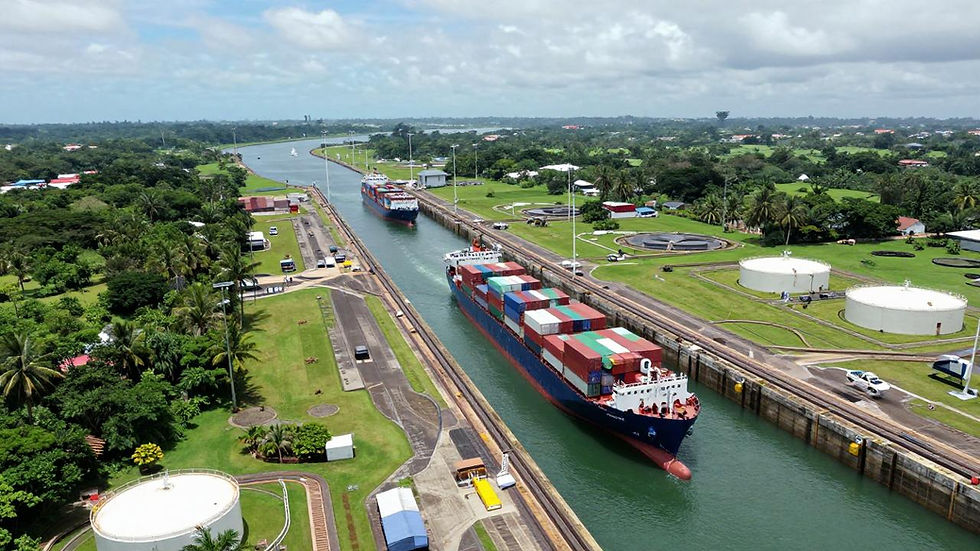
The Panama Canal is a freshwater system. Each lock transit draws from Gatun Lake — a rain-fed reservoir whose water levels determine the canal's functional capacity. Climate variability is not an environmental footnote in the canal's operational model. It is the operational model.
The 2023-24 El Niño cycle demonstrated this with brutal clarity. Daily transits were reduced substantially — the Authority implemented precautionary measures, slot restrictions, and draft limitations that cascaded through global supply chains with a lag that took months to absorb. Container lines rerouted vessels via the Suez Canal — a route that, in 2026, is itself under pressure from Houthi threats in the Bab al-Mandeb and the cascading effects of the Iran war on Gulf shipping. The rerouting option that existed in 2023 no longer exists at equivalent cost.
Administrator Vásquez's disclosure that El Niño probability has risen from 25% in April to 81% in July is not a routine weather advisory. It is a strategic warning. The Canal Authority's decision to suspend Period 3 close-in slot auctions — the mechanism by which shippers can purchase priority transit slots 96 to 48 hours before passage — signals that the Authority is already in conservative water-management mode. The 2023-24 experience taught the Authority that reactive measures implemented after water levels drop are too late; the interventions must begin months ahead of the stress point. Vásquez explicitly cited "lessons learnt during the 2023-2024 event" as the basis for current preparedness.
The compounding variable is traffic volume. The canal recorded 10,726 transits in the current fiscal year (October–June), a 5.2% increase over the 10,191 recorded in the same period of FY2025. The surge is driven by two factors: Middle East disruptions diverting traffic that would otherwise transit the Suez/Red Sea route, and high US LNG export demand. The Southwest Airlines decision to barge 12.6 million gallons of jet fuel from Texas to California via the canal — using a Jones Act waiver, as reported by CNBC on 23 July — illustrates the canal's embedded role even in US domestic logistics. More traffic through a system facing potential water constraints is not a recipe for resilience.
If El Niño materialises at the severity implied by the 81% probability, the Canal Authority will face the same operational dilemma as in 2023-24: reduce daily transits to preserve water levels, or maintain throughput and risk depleting Gatun Lake below the threshold required for lock operations. Either choice imposes costs. Reduced transits mean congestion, delays, and premium pricing for available slots — costs that propagate through supply chains with a lag of 30-60 days. Maintained throughput risks a harder stop if water levels fall below critical thresholds, which would be the functional equivalent of a forced closure.
The confidence level on a transit reduction occurring before Q1 2027 is moderate-high (approximately 65%). The confidence level on a reduction exceeding the 2023-24 severity is low-moderate (approximately 25-30%), contingent on El Niño intensity, Atlantic hurricane season rainfall contribution to the watershed, and the Authority's willingness to accept ecological stress on Gatun Lake as a trade-off for commercial continuity.
Cobre Panama: The Critical Minerals Frontline Nobody Is Watching
The Cobre Panama mine — one of the world's largest open-pit copper deposits — has been shuttered since November 2023, when the same Supreme Court that would later invalidate the CK Hutchison port concessions ruled First Quantum's mining contract unconstitutional. The economic damage has been substantial: an estimated 5% of GDP and 7% of export earnings eliminated, according to Panama's private sector association CONEP. Communities dependent on mining-related income have seen consumption and commercial activity decline. Contractors and small businesses have reported steep revenue losses.
The mine produced 350,000 tonnes of copper in 2022, representing approximately 1% of global supply and 5% of Panama's GDP. Before shutdown, Cobre Panama was First Quantum's largest copper operation.
The Panamanian government is now considering a restart structure: a public-private partnership in which a newly created state-owned mining entity would hold 35-40%, with First Quantum retaining operational control and a 60-65% stake, according to two sources familiar with the development cited by Reuters on 22 July. The government has already authorised the removal, processing, and export of approximately 38 million tonnes of stockpiled ore containing around 70,000 tonnes of recoverable copper — generating $29 million in royalties allocated to public works. S&P Global Ratings has upgraded First Quantum's outlook to positive, citing progress toward reopening. The mine is projected to contribute approximately 120,000 tonnes of copper and 40,000 ounces of gold in fiscal 2026, with production accelerating into Q3.
The restart calculus is not purely economic. Three geopolitical vectors intersect here.
First, critical minerals competition. Copper is classified as a critical mineral by the US, EU, and allied governments — essential for energy transition infrastructure, electric vehicle manufacturing, grid modernisation, and defence systems. China is the world's largest copper consumer and refiner. Chile's announcement of a $100 billion copper investment plan — explicitly framed by its top diplomat as a strategy to "diversify the customer base beyond China" — signals that producer states are beginning to view copper through the same strategic lens that governs rare earths and semiconductors. A restarted Cobre Panama adds supply to a tightening market, but the ownership structure determines where that supply flows.
Second, Chinese leverage. China has demonstrated willingness to weaponise critical minerals — rare earth export restrictions triggered international coordination among the US, Japan, EU, Australia, and South Korea, according to CSIS analysis reported by Mining.com. If Beijing perceives the Cobre Panama restart as serving US strategic mineral diversification, it has tools to retaliate: export controls on downstream copper products, pressure on Chinese-invested mining operations elsewhere, or regulatory friction for Western mining companies operating in China-aligned jurisdictions. Panama's copper becomes a piece on the board, not just a commodity.
Third, domestic political risk. The mine's original shutdown was driven not by commercial failure but by environmental protests that reached a scale the government could not manage. Any restart — even under a PPP structure with state participation — will face the same civil society pressure. The difference in 2026 is that Panama's government is operating under US strategic patronage that did not exist in 2023. Whether that patronage translates into political cover for a mine restart, or whether it becomes a liability (framing the restart as serving US interests rather than Panamanian ones), will depend on the government's communications strategy and the intensity of environmental mobilisation.
The Donroe Doctrine Meets American Overstretch
The most consequential variable in the Panama equation is the same variable identified in every CES Intelligence assessment of the current strategic cycle: American strategic bandwidth.
The United States is managing five concurrent commitments:
The Iran war — active conflict since February 2026, with intermittent Strait of Hormuz closures, US blockade of Iranian ports, and ongoing Gulf state self-defence operations. Trump announced a pause in strikes on 26 July to allow diplomatic space, but the underlying confrontation persists.
Grey-zone competition with China in the South China Sea — the 20 July Second Thomas Shoal incident, in which a Chinese coast guard officer struck a Filipino sailor with a wooden baton, represents the most serious physical altercation in years. Secretary Rubio's subsequent meeting with Foreign Minister Wang Yi in Manila on 22 July, and a proposed Trump-Xi summit flagged for end-September (which Rubio indicated was "still anticipated" as of 20 July), suggest that both sides are managing the escalation ladder — but the number of actors, vessels, and contested encounters is growing faster than any deconfliction mechanism can absorb.
Venezuela's zombie state — the Maduro removal operation succeeded in eliminating the head of state but installed acting president Delcy Rodríguez, who represents continuity with the Chavista apparatus the operation was designed to dismantle. The state lurches forward, performing minimum governance functions while consuming resources without producing outputs.
Cuba intervention pretext — the State Department's allegations of "coordinated nationwide actions" by Cuba-linked groups outside US military bases and ICE facilities, combined with 24-hour blackouts and food scarcity on the island, elevate the perceived threat level and generate migration pressure on the US southern border.
The Donroe Doctrine in Panama — the rollback of CK Hutchison, pressure on Chinese commercial presence across the hemisphere, and the broader framing of China as a hostile influence in the Western Hemisphere.
Each commitment consumes political capital, military resources, and diplomatic attention. The paradox is fundamental: the Donroe Doctrine presumes a capacity to enforce hemispheric exclusion of rival powers, but the same administration executing the doctrine is concurrently fighting a regional war in the Middle East, managing grey-zone confrontation in the Indo-Pacific, and governing a collapsed state in Venezuela. The doctrine's ambition exceeds the capacity available to sustain it.
This does not mean the doctrine will fail. It means it will be enforced selectively, inconsistently, and with gaps that adversarial actors can exploit. Panama — squeezed between US pressure to sever Chinese commercial ties and its own economic dependence on the canal's throughput — becomes the test case for whether selective enforcement can produce durable outcomes or merely deferred crises.
The Navalization of Economic Warfare: Panama Registry as Leverage
A structural shift is underway in how great powers project economic coercion. As The Maritime Executive documented in July 2026, sanctions enforcement is migrating from financial systems to physical interdiction — from SWIFT codes and correspondent banking restrictions to boarding ships at sea.
Since the US blockade of Venezuelan oil began in late 2025, interdiction has expanded beyond Russian-linked tankers to Iranian and Venezuelan vessels, with European and Indian authorities joining the effort. The trend suggests, in the publication's framing, "not a coordinated global policy but a broader shift in practice: sanctions enforcement is moving from financial systems back into physical space."
Panama occupies a unique position in this trend. The Panamanian shipping registry is one of the world's largest by tonnage — a flag of convenience that serves the global maritime industry precisely because it offers operational neutrality, low fees, and minimal regulatory burden. This neutrality is now a vulnerability.
China has already demonstrated willingness to use regulatory mechanisms as geopolitical instruments. In July 2026, Beijing imposed export controls on 14 European entities, including German defence giant Rheinmetall, in retaliation for EU sanctions on Chinese firms linked to Russia. The action was announced by China's Commerce Ministry as a direct response to the EU's 21st round of sanctions against Russia, which had targeted 14 Chinese mainland and Hong Kong entities.
Against this backdrop, reporting from Al Jazeera and the US Federal Maritime Commission indicates that China has already used its port-state-control inspection regime to detain Panama-flagged vessels at elevated rates following the Supreme Court ruling on the CK Hutchison terminals. According to FMC Chair Laura DiBella, reporting in March 2026, approximately 75% of all ships detained in Chinese ports — 92 of 124 vessels — were Panama-flagged, a rate described as "far exceeding historical norms." Al Jazeera reported in late April that nearly 70 Panama-flagged vessels had been detained. Six governments — the United States and five Latin American states — issued a joint statement condemning the actions as "a blatant attempt to politicise maritime trade and infringe on the sovereignty of the nations of our hemisphere."
The confidence level on continued Chinese maritime pressure against Panama-flagged vessels within the next 12 months is moderate (approximately 35-40%). The confidence level on such retaliation remaining below the threshold of formal WTO complaint or collective diplomatic response is moderate-high (approximately 60%), reflecting the structural difficulty of proving that port-state control inspections are politically motivated rather than compliance-driven.
Scenario Analysis: Four Pathways Through Q1 2027
Scenario A — Managed Strain (probability: ~35–40%). El Niño materialises at moderate severity, imposing transit reductions for 8–12 weeks. The Canal Authority manages through pre-positioned measures without requiring emergency interventions. The CK Hutchison eviction is absorbed without further Chinese escalation beyond existing port-state-control pressure. Cobre Panama restart proceeds under PPP structure with limited protests that do not derail the timeline. US overstretch prevents escalation of Donroe Doctrine enforcement beyond existing measures. Costs are absorbed by supply chains without systemic disruption; freight rates rise modestly on affected routes but no major rerouting occurs. This trajectory requires that El Niño severity remains moderate, Chinese retaliation stays below diplomatic threshold, and US bandwidth constraints prevent additional hemispheric initiatives. These conditions are individually probable but their alignment is not guaranteed.
Scenario B — Compression Crisis (probability: ~30-35%). Severe El Niño drives substantial transit reductions for 12–16 weeks, forcing draft limitations and slot restrictions that exceed 2023–24 severity. Chinese regulatory pressure on Panama-flagged vessels intensifies beyond current levels—detention rates remain elevated, insurance premiums spike, and commercial operators begin seeking alternative registries. Cobre Panama restart delayed by environmental protests exacerbated by anti-US framing; the PPP negotiation stalls as Panama's government faces domestic backlash from appearing to acquiesce to American demands. Supply chain disruption propagates through Q4 2026–Q1 2027, with freight rates spiking 15–25% on trans-Pacific and Asia-East Coast routes. This trajectory represents the most likely failure mode—the compounding of three manageable pressures into an unmanageable convergence. It does not require any single catastrophe, only the simultaneous occurrence of all three stressors at elevated intensity.
Scenario C — Escalation Spiral (probability: ~15-20%). El Niño stress combines with active Chinese countermeasures—sustained detention of Panama-flagged vessels, diplomatic pressure at multilateral fora, and economic coercion targeting Panamanian financial services. The US responds with enhanced hemispheric posture, deploying Southern Command assets to signal commitment. The canal becomes a formal battleground in US-China competition, with commercial operators facing bifurcated routing decisions: US-aligned versus China-aligned supply chains. Some carriers may choose to route exclusively through one hemisphere or another depending on their market exposure and regulatory risk tolerance. This scenario transforms Panama from a chokepoint into a fault line—where traffic is not merely constrained but politically sorted. The probability remains low because both Washington and Beijing recognise the systemic costs of open confrontation, but the structural incentives are present should either side miscalculate.
Scenario D — De-escalation Window (probability: ~10-15%). Trump-Xi summit (end-September) produces a tactical understanding on hemispheric competition. China accepts CK Hutchison eviction as a sunk cost in exchange for US restraint on secondary sanctions and de-escalation of port-state-control pressure. El Niño severity proves lower than projected, with Atlantic hurricane season contributing adequate rainfall to the Gatún watershed. Cobre Panama restarts under PPP with clearer political cover. Strategic bandwidth partially freed by Iran ceasefire or de-escalation allows Washington to focus resources on the Indo-Pacific rather than hemispheric enforcement. Panama recovers breathing room—but the structural pressures remain, merely deferred. This scenario is least probable because it requires multiple favourable alignments: summit success, climate moderation, Middle East de-escalation, and domestic political cover in Panama. Yet it remains plausible if all sides prioritise avoiding systemic cascade over maximalist positioning.
The analytical point is not to predict which scenario will materialise but to identify the indicators that would signal movement between trajectories. Boards should monitor: El Niño intensity metrics from NOAA, port-state-control detention rates in Chinese ports, Cobre Panama PPP negotiation milestones, US Southern Command deployment patterns, and diplomatic signalling ahead of the September summit. Early warning thresholds should be established for each variable, with trigger points for contingency planning activation.
Implications
Shipping and logistics operators with exposure to the Panama Canal should model transit reductions for a 8-12 week window in Q4 2026-Q1 2027, with contingency routing via the Cape of Good Hope. The 2023-24 experience provides the baseline; the compounding effect of Middle East traffic diversion means the system has less slack than it did then. Companies should assess the flag status of their fleet: Panamanian-flagged vessels face elevated regulatory risk in Chinese ports, as documented by the FMC and reported through the Tokyo MOU port-state-control framework.
Energy and commodities firms should monitor the El Niño-Gatun Lake interaction as a primary supply chain risk. The Southwest Airlines precedent — barging jet fuel through the canal under a Jones Act waiver — demonstrates the canal's role in domestic US energy logistics, not just international trade. A transit reduction affects US LNG exports, refined product movements, and agricultural commodity flows.
Mining and critical minerals companies should treat the Cobre Panama restart as a leading indicator of how Western Hemisphere resource nationalism intersects with US-China strategic competition. The PPP structure — state minority equity, Western operator majority — may become a template for other jurisdictions seeking to restart contested mining projects while maintaining sovereign control. Boards should assess whether similar structures could de-risk projects in their own portfolios.
Financial institutions should price sovereign-annulment risk into Panamanian exposure models. The CK Hutchison and Cobre Panama precedents demonstrate that judicial invalidation of concessionary contracts is a primary — not secondary — political risk vector in Panama. Standard models that weight executive and legislative channels should be recalibrated.
Multinationals with Western Hemisphere operations should assess supply chain exposure to Panama Canal throughput, Panamanian-flag shipping, and Chinese retaliatory measures against Panamanian commercial interests. The convergence of climate stress, geopolitical competition, and the navalization of economic warfare means that risks previously assessed in isolation must now be modelled as interacting variables.
The core analytical judgment: Panama is not a flashpoint — it is a chokepoint. Unlike the South China Sea, where the risk is kinetic miscalculation between military vessels, or the Strait of Hormuz, where the risk is deliberate closure by a belligerent state, Panama's risk is systemic convergence. Three pressures — geopolitical eviction of Chinese commercial presence, climatic stress on a freshwater-dependent transit system, and the unresolved status of a critical minerals asset — are arriving simultaneously, each manageable alone, potentially destabilising in combination. The United States has acquired the responsibility of managing this convergence through a doctrine whose ambition exceeds the strategic bandwidth available to sustain it. The gap between doctrine and capacity is where risk lives — and it is widening, not because anyone is miscalculating, but because the number of variables interacting in a single geography is growing faster than any single actor's ability to coordinate across them.
Boards with exposure to canal transit, Panamanian-flag shipping, critical minerals supply chains, or Western Hemisphere commercial operations should treat Panama as a compounding risk environment — not a single-variable problem to be monitored, but a multi-vector system to be stress-tested. The costs of inattention are paid in instalments that compound.
---
If your organisation operates in or has exposure to Western Hemisphere supply chains, critical minerals markets, maritime shipping lanes, or energy logistics dependent on the Panama Canal, CES Intelligence maintains 24/7 situational awareness and can provide bespoke risk assessments, crisis stress-testing, and board-level briefings.
Want more analysis like this?
Free weekly digest. Full access and bespoke advisory available on request.
Thierry Marquez — Founder & Principal Advisor, CES Intelligence
+33 (0)9 55 16 54 98 →
DISCLAIMER
This analysis is provided for informational and strategic planning purposes only. It is not investment advice, financial advice, or legal advice, and it should not be treated as such. Probability assessments reflect the analyst's calibrated judgment based on available open-source intelligence as of the date of publication and are subject to revision as new information emerges. Some quantitative estimates and reported events are based on regional sourcing that may evolve as additional confirmation becomes available.