The Worst Ever Recorded? Mapping Latin America's Board-Level El Niño Exposure

Updated: Oct 9

Contents
Key Takeaways
The probability architecture has already hardened. The US Climate Prediction Center's diagnostic discussion now carries an Advisory with a greater than 90% probability of a very strong event during the Northern Hemisphere fall and winter of 2026–27, and a 75% probability that the October–December Oceanic Niño Index reaches the +2.5°C historic-strength threshold, exceeding every comparable episode in a record dating to 1950. The 2026–27 event is highly likely to verify in the top tier of instrumental history; the residual planning question is not whether the region is hit, but which month each transmission channel breaks.
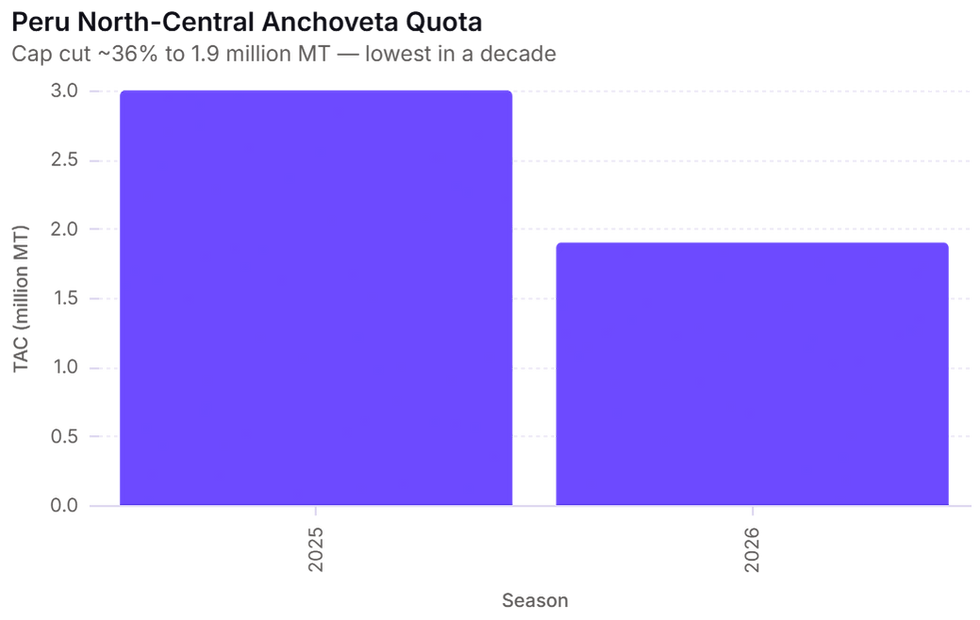
The first casualty is already booked, not forecast. Peru's North-Central anchoveta quota was set at 1.9 million tonnes, down roughly 36% from the 3 million tonnes of 2025 and the lowest in a decade, while an indefinite fishing suspension under coastal El Niño conditions drags global fishmeal output down more than a quarter year-on-year. By the time the winter peak arrives, the anchoveta complex will have been in contraction for two consecutive seasons.
The chokepoint coupling is the genuinely novel variable. The canal entered restriction territory in the same season that the Strait of Hormuz has been effectively closed and Suez transit degraded, collapsing the number of viable alternative routings precisely when displaced cargo is seeking them. A record $5.3 million auctioned transit slot on 1 September 2026 is not a waterway statistic; it is the market pricing the absence of every other option.
Latin America's exposure is polarised, not uniform. Excess rainfall and flood risk on the Ecuadorian coast and southern Brazil coincide with drought in the Amazon basin, the Central American Dry Corridor, and the Colombian and Venezuelan hydrological systems. Boards treating this as a single-direction "bad weather" event will misprice both the losses and the offsets.
The transmission is financial before it is physical. Peru's central bank has already shaved 0.9 percentage points off 2026 growth, with fishing contracting nearly 31% and agriculture turning negative ; the World Bank's trackers show cereals up 18% and maize up 26% since June. It is likely that food-led inflation becomes the dominant Latin American monetary story of the first half of 2027.
Portfolio-level (investable horizon: Q4 2026 – Q2 2027). Soft-commodity, marine-logistics, aquaculture-feed, and Andean-power exposures should be repriced now against three dated scenarios: managed degradation (40–45%), record-intensity event with compounded chokepoint stress (35–40%), and compound rupture (15–20%). The asymmetry runs one way: the scenario set contains no upside variant that does not require the CPC forecast to fail in both directions at once.
1. The Signal: Probability Mass, Not Prophecy
The 2026–27 El Niño is not a weather forecast. It is a contract with a counterparty the region cannot negotiate with — and the terms have been converging, month after month, toward the historic end of the distribution.
Start with the physics as an intelligence problem. The Climate Prediction Center's September discussion raised the probability of a very strong event for the fall and winter above 90%, up from an 81% assessment in July, with the likelihood of an October–December index reading at or above +2.5°C — the threshold NOAA describes as exceeding all prior events in the 1950-present record — at 69 to 75% depending on measurement vintage (NOAA CPC, 10 September 2026; The Watchers, 17 August 2026). The European Centre for Medium-Range Weather Forecasts has gone further, projecting a central Pacific anomaly of 3–4°C, which would make the episode the strongest on record (ECMWF, as reported by monitoring aggregators, June 2026). Sea-surface anomalies off Ecuador and Peru have already reached +4.5°C in places (Ecuador Brief, 20 September 2026).
Two properties of this probability mass matter more than its headline size. First, persistence: the CPC expects the event to hold through March–May 2027, with only a 55% chance of neutral conditions by April–June (NOAA CPC, September 2026). This is a highly likely nine-month operating environment, not a discrete shock. Second, ascent: the World Meteorological Organization put development odds at roughly 80% for June–August and 90% through November back in early June, and every successive reassessment has moved upward, not sideways (WMO, 2 June 2026). Forecasts that only ratchet in one direction are telling the observer something about the ocean-atmosphere system's momentum — and about the diminishing value of waiting for "confirmation" before moving hedges.
The temperature transmission is already locked in for the year after: NOAA's National Centers for Environmental Information assesses it as virtually certain that 2026 ranks among the five warmest years on record, with 2027 the probable record-holder (NOAA NCEI via ABC News, 13 August 2026). And the humanitarian agencies have stopped treating this as a routine oscillation: the FAO and World Food Programme issued their first joint appeal of the cycle in early June, warning of severe disruptions for farmers in regions already absorbing fuel and fertiliser inflation linked to the Gulf conflict (FAO/WFP, 4 June 2026).
The question for an executive is not the anomaly's Celsius reading. It is the conversion rate — how many dollars of quota, transit slots, megawatt-hours, and basis points of inflation does each tenth of a degree buy. The remainder of this assessment maps that ledger, theatre by theatre, starting where the conversion has already happened.
For organisations with commodity, food-manufacturing, or Andean asset exposure: treat the CPC probability ladder itself as the tripwire. Baseline: very strong event (>90%), historic-strength threshold 75% probability for October–December, persistence through boreal spring 2027, 55% probability of neutralisation only by April–June. Re-anchor every physical-risk model in the supply chain to the index, not to weather headlines.
2. The Humboldt Ledger: Anchoveta, Fishmeal, and the First Casualty Already Booked
The anchoveta is not a commodity. It is the world's shortest protein supply chain — and it is the first line in the region's balance sheet where the ocean has already signed.
Peru's North-Central fishery, the largest single-species operation on the planet, entered 2026 under a total allowable catch of 1.9 million tonnes — down approximately 36% from the 3 million tonnes permitted the prior year and, per PRODUCE, the smallest cap in a decade (SeafoodSource, 12 June 2026; Latin Times, 14 September 2026). The cuts did not stop at the quota. Under persistent coastal El Niño conditions and a high proportion of juvenile fish in the stock, Peruvian authorities extended the fishing suspension — originally set to lapse on 10 June — indefinitely, across the maritime domain from the northern limit to 16°S (IFFO, 11 June 2026; Salmon Business, 3 July 2026).
The downstream mathematics are unambiguous because they are already printed. Per IFFO's member statistics, global fishmeal production fell 21% year-on-year in April 2026, with cumulative output down 26% and fish oil off 14% — declines driven principally by Peru (IFFO, 11 June 2026). Chilean processor Camanchaca disclosed a 46% drop in pelagic volumes over the first half, blaming scarce jack mackerel and anchovy under the same warming pattern (Undercurrent News, via Latin Times, 14 September 2026). Peru alone accounts for roughly one-fifth of the raw material behind global fishmeal and fish oil, which is why, in the assessment of IFFO market director Enrico Bachis, "disruptions quickly tighten availability" far beyond the country's borders (IFFO, 11 June 2026).
The transmission channel runs straight into animal protein pricing. Fishmeal and fish oil remain load-bearing inputs for aquaculture feed — carnivorous species and early life stages especially — and the aquafeed sector enters the event's peak with formulation flexibility already partially exhausted after the 2023–24 cycle (mispeces, 12 June 2026). Benchmark prices tell the story without commentary: from $1,626 per tonne in October 2025 to $2,423 by June 2026, with spot assessments around $2,500 in May — roughly 25% above the previous cycle's peak (IMF benchmark data via Manolin Aqua, July 2026; Latin Times, 14 September 2026). It is likely that salmon and shrimp feed costs reprice further before the end of Q1 2027, with the pass-through visible in harvest contracts rather than in headline inflation statistics. Precedent quantifies the tail: the 2023 season cancellation alone cost Peru more than $1.4 billion in lost fishmeal and fish oil export sales, an episode industry observers described as the worst in decades (SeafoodSource, 12 June 2026).

What elevates this from sectoral noise to structural signal is the composition of the response. The Peruvian authorities chose conservation — quota cuts, indefinite closures, scientific assessment via Imarpe — over extraction, which is the rational long-run policy and the expensive short-run one. The 2027 second season is the open variable; a warm-water column that persists through the austral summer makes a full-season repeat of 2023 a realistic possibility rather than a tail.
For organisations with aquaculture, animal-feed, or pet-food exposure: model marine-ingredient supply as capacity-constrained through at least mid-2027. Baseline: Peru at ~20% of global fishmeal raw material; global output down 26% year-to-date; a quota already at decade lows before the winter peak; last cycle's cancellation cost at $1.4 billion in lost export sales. Reformulation and forward cover are cheaper now than in Q1 2027 — for Peru-specific country risk architecture, see the companion assessment in our Peru 2026 geopolitical risk report.
3. The Freshwater Chokepoint: Panama and the Geometry of Coincidence
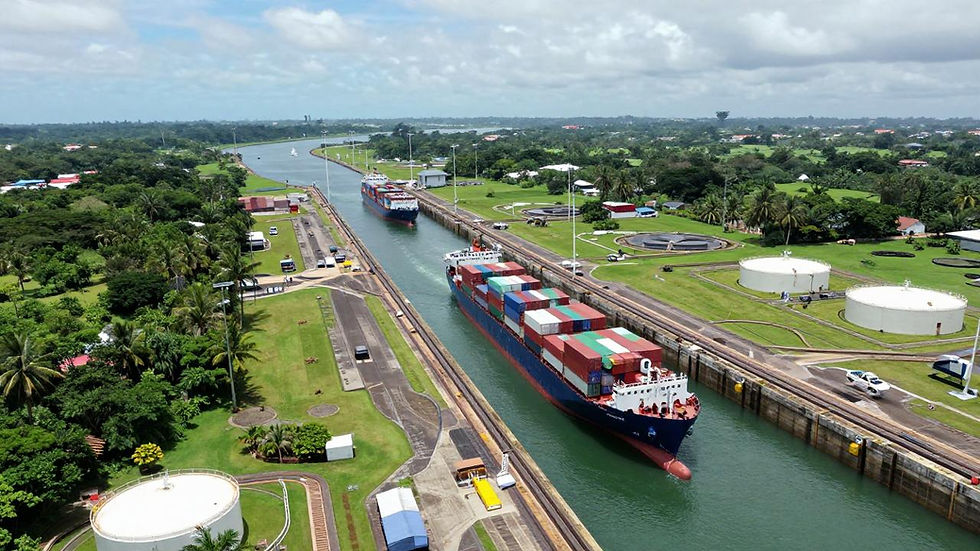
The Panama Canal is not a shipping lane. It is a freshwater utility that happens to move ships — and in 2026–27, its reservoir math intersects with the worst imaginable chokepoint calendar.
The water data arrived first. Rainfall across the watershed ran approximately 34% below the long-term average from May through August 2026, the months when Gatún Lake is supposed to refill (Industrial Info, 10 September 2026). Lake levels held near 84 feet — roughly a foot below the five-year August average — as the authority began phasing capacity down: daily transits cut from 36 to 34 in early September, then to 32 from 15 September, with Panamax lock slots reduced from 25 to 23 and Neopanamax drafts pinned at 47.5 feet (Maritime News, 12 September 2026; DTN, 2 September 2026). A partial easing to 33 daily transits at end-September, on lake readings near 84.7 feet, was explicitly conditioned on water projections for the coming dry season (The Maritime Executive, 29 September 2026).

The waterway's own planning envelope for the fiscal year that began 1 October assumes 29.5 large-ship transits per day and drafts near 44 feet in the driest months, on projected revenue of about $5.56 billion — and the Río Indio reservoir meant to secure the isthmus's long-term water supply will not be ready before 2031 (Rio Times, 4 October 2026).
Administrator Ricaurte Vásquez has said the operator is preparing for a longer-than-usual event (ACP via Hindustan Times, 21 August 2026). The structural exposure is not speculative: 79% of the fourteen lowest Gatún Lake events since 1965 followed El Niño conditions (Industrial Info, 10 September 2026), and the 2023–24 episode cut transits from the mid-30s to as few as 18–22 per day by early 2024, when the lake bottomed near 79.6 feet (Rio Times guide, 2 September 2026; The Guardian, 15 September 2026).
What makes 2026 categorically different from 2023 is the map on which the drought is landing. The Strait of Hormuz has been effectively closed to commercial traffic since late February, and Suez transits remain far below pre-crisis levels — S&P Global data put east-to-west Suez share at 18.7% against roughly 80% before the disruption (Windward, 9 September 2026; Newsroom Panama, 29 April 2026). Cargo displaced from the Gulf corridor has been arriving at the isthmus looking for capacity that is contracting on a published schedule; about 60% of US LPG exports have moved to Asia so far in 2026, up from 55% for all of 2025, tightening the exact segment that uses the canal's liquid bulk slots (Kpler via Bloomberg, cited 21 August 2026). The pricing followed the scarcity: South Korea's SK Gas paid a record $5.3 million for a single auctioned transit slot on 1 September for the LPG carrier G. Spirit, and a container vessel chartered to ONE bid nearly $4 million to jump a queue that reached ten days in August (DTN, 2 September 2026; The Maritime Executive, 20 August 2026). Container lines — CMA CGM, MSC, ONE, and Hapag-Lloyd among them — introduced or revised dedicated surcharges between late August and early September (Maritime News, 12 September 2026).
The strategic geometry deserves naming. The waterway carries about 5% of global maritime trade and roughly 40% of US container traffic, plus around 3.2 million barrels per day of hydrocarbons in the second quarter of 2026 alone (The Guardian, 15 September 2026; Industrial Info, 10 September 2026). When a single freshwater system carries that load while its two classical relief valves — Hormuz and Suez — are degraded, the fallback options are grim: the Swedish Club's September member alert noted that Cape Horn and the Strait of Magellan are being weighed "not because they have become attractive but because the other options have become harder," with compulsory Chilean pilotage, weather risk, and liability documentation as binding constraints (Swedish Club via gCaptain, 14 September 2026). The January–April 2027 dry season, arriving on lake levels that never fully recharged, is highly likely to force the canal back below 30 daily transits — the condition under which 2023–24's queues, auctions, and surcharge cascade replayed, this time without a functioning Hormuz corridor to absorb the spillover. Our Panama Canal 2026 assessment and Strait of Hormuz conflict analysis develop the two halves of this coupling in depth.
For organisations with US East Coast sourcing, LPG/LNG logistics, or perishables routing: stop modelling the waterway as infrastructure and start modelling it as a capacity auction with weather risk. Baseline: 32–33 transits/day entering the dry season; FY2027 budget case at 29.5 with 44-foot drafts; record slot pricing at $5.3 million already booked; queue times near ten days at the last squeeze; watershed rainfall running a third below normal at the last measurement; relief capacity at Río Indio five fiscal years away. Contract for Pacific–Atlantic alternatives before January 2027, not during it.
4. The Pacific Epicentre: Ecuador and the Concentration Paradox
Ecuador is not diversifying. It is concentrating — and the entity it is concentrating on is the Pacific Ocean.
The country's export crown has already changed hands in a way that makes the coast's climate exposure the centre of gravity of the national account. January–July 2026 exports reached $23.3 billion, up 9.3% year-on-year, with shrimp at $5.77 billion overtaking oil and derivatives at $5.72 billion — the first time the marine protein complex, not hydrocarbons, has led the basket, with mining at $3.18 billion, bananas and plantains at $2.74 billion, and cocoa at $1.20 billion behind (Central Bank of Ecuador via El Universo and La Hora, 12 September 2026). Every one of the three engines — shrimp, bananas, cocoa — is a coastal-plain or lowland activity exposed to the same rainfall physics that the strengthening event delivers to Guayas, Los Ríos, and Esmeraldas (Inamhi forecasts cited by Ecuador Brief, 20 September 2026).
The forward warnings are specific. The banana industry association AEBE cautioned in May that a strong El Niño would worsen field conditions, degrade fruit quality, and jeopardise the continuity of shipments through the second half of 2026, on top of existing logistics pressure (AEBE via Fruitnet, 29 May 2026). Ports have activated contingency planning: Guayaquil's terminal operators have drawn up protocols covering drainage, berth access, and corridor redundancy (DataPortuaria, 19 June 2026). And the electricity system — the sector's silent dependency — is already rationing by stealth: the Ministry of Environment and Energy has asked high-voltage industrial consumers to voluntarily disconnect one day per week while contracting barge-based generation (Ecuador Brief, 19 September 2026). The precedent for what a hard hydrological year does to Ecuadorian power is quantified in the last cycle, when the Coca Codo Sinclair facility curtailed output for up to fourteen hours a day under low inflows (Environment + Energy Leader, 20 May 2026).
The macro texture is therefore an economy posting record export receipts while its production base sits in the flood plain. Banana shipments were actually up 8.36% year-on-year through July at 247 million boxes (Ecuador Brief, 19 September 2026) — evidence of strength, and equally evidence of how much volume is at stake when the rains arrive in earnest. The trade-policy overlay compounds it: more than half of shrimp exports go to a single destination, China, and former trade minister Francisco Rivadeneira has flagged the climate cycle, alongside logistics costs, as the moderator on the second half (Streamlinefeed, 16 September 2026). A flood year that interrupts pond cycles or shuttered packing plants would transmit into Chinese seafood protein prices within a quarter; a road and bridge failure on the coastal corridor would do it faster.
Quantified loss geometry from the producer associations frames the downside: during the last strong coastal event, industry bodies estimated potential inundation of up to roughly 50,000 hectares of banana plantations out of slightly more than 200,000 cultivated — a quarter of the sector (ProducePay, April 2024; FreshFruitPortal, July 2023). Those figures were contested by exporters at the time, and should be treated as producer-side planning bands rather than audited loss estimates; but the direction is not in dispute. With sea-surface anomalies already reaching +4.5°C off the coast (Ecuador Brief, 20 September 2026), it is highly likely that the December–February window brings episodic coastal flooding at intensities the post-2023 infrastructure has not been tested against. Country-specific governance context is developed in our Ecuador 2026 geopolitical risk report.
For organisations with seafood, banana, or cocoa procurement exposure: split Ecuadorian supply risk into two clocks. Baseline: $5.8 billion shrimp and $2.7 billion banana annualised export flow concentrated on one coastal plain; voluntary one-day-per-week industrial power disconnections already in force; port contingencies activated; historical inundation bands up to a quarter of banana area in a strong event; export dependency on Asia above 50% for shrimp. Pre-position alternative origins for Q4 2026–Q1 2027 volumes now, while spot premiums have not yet repriced the December rains.
5. The Southern Inversion: Brazil's Two Faces and the Argentine Counter-Current
Brazil's exposure is not a drought story. It is a polarity story — the same ocean anomaly that starves the north drowns the south, and both halves of the country are production systems.
The government's own monitoring panel documents the split in real time. The fourth El Niño bulletin of the season records rapidly deteriorating drought across the Amazon, logistics constraints affecting 564 locations on northern river networks, and mounting replanting risk for the 2026/27 grain crop — while, simultaneously, the Uruguay, Caí, and Taquari basins in Rio Grande do Sul record flood episodes, with the Geological Service issuing more than 170 hydrological alerts across the South in 2026 (Brazil federal monitoring panel via Brazil Stock Guide, 1 October 2026). The 2024 Rio Grande do Sul floods — some 500 millimetres in days, more than two million people affected, 200 dead, roughly $15 billion in losses of which under $1 billion was insured — define what the wet face of the oscillation does to the region when the tail is fat (Munich Re, 5 November 2025).
The agricultural clock is running early. Arabica coffee flowered roughly a month ahead of schedule, raising the risk of an uneven 2027 crop; economists in the central bank's June survey saw the climate event adding 0.3 points to inflation this year and 0.4 points in 2027; and the government has earmarked R$1.335 billion (about $256 million) for food stocks, health, and firefighting (Rio Times, 4 October 2026). The sugar market has already voted: raw sugar rose about 10% in September as weather damaged Asian crops and rain slowed the Brazilian crush (Rio Times, 4 October 2026), and Itaú BBA projects Center-South sugar production at 39.4 million tonnes for 2026/27 — a million tonnes below the prior season, with the sugar mix at 46.4% (Itaú BBA via The AgriBiz, 6 July 2026). Copersucar's own read is the honest one: the pattern may favour cane growth in the field while degrading milling operations in the yard (Reuters, 23 June 2026). Reuters' assessment that Brazil's coffee crop faces headwinds but has grown more resilient than in prior cycles tempers the bear case (Reuters, 13 July 2026), and Bradesco BBI's historical work flags the Northeast drought and Center-West replanting risks as the swing factors rather than a national wipeout (Bradesco BBI via The AgriBiz, 17 June 2026).
Argentina is the counter-current, and any honest regional exposure model must carry it as such. The Pampas leans wetter during these phases — historically friendly for soy and maize planted into the event's peak, a genuine global supply cushion after the La Niña droughts that savaged Argentine harvests earlier this decade (elninolive climate tracking, 2 July 2026; AgWeb, 12 December 2025). The offset is qualified: USDA's Buenos Aires post already forecasts 2026/27 rice production at 1.05 million tonnes rough basis, the lowest since 2004/05, precisely because excessive rainfall disrupts planting, and models some area shifting from corn to soybeans (USDA FAS, April 2026). The wet-Pampas dividend, in other words, arrives with disease pressure, harvest-window volatility, and logistical friction baked in — and it cushions global protein balances, not Brazilian electricity bills.
For polarised exposure the operational rule is geographic segregation. Brazil's December–February risk is a compound of northern logistics (river-draft restrictions on Amazonian corridors affecting grain evacuation) and southern flood reactivation (basins already at alert thresholds in September, before the austral summer peak). It is likely that at least one southern Brazilian state experiences a flood event at or above the 2024 benchmark's insured-loss footprint by Q1 2027, given that the basins entered October at levels normally seen in mid-summer. Context on the political calendar that will shape Brasília's response — an election on 4 October 2026 delivering the drought-and-flood file to a new administration — is covered in our Brazil 2026 and Argentina 2026 reports.
For organisations with coffee, sugar, grain, or Brazilian logistics exposure: model the country as two adjacent risk zones with opposite signs. Baseline: Amazon basin drought affecting 564 monitored locations with river-transport constraints; southern basins at flood-alert thresholds pre-summer; arabica flowering a month early into a biennial cycle; Center-South sugar projected 1 million tonnes lower than 2025/26; federal contingency at R$1.335 billion; last comparable southern flood at ~$15 billion economic / <$1 billion insured. Price Q1 2027 Brazilian origin risk accordingly; treat Argentine supply as a partial hedge, not a substitute.
6. The Dry Corridor: The Humanitarian Transmission Belt
The Central American Dry Corridor is not a climate zone. It is a supply chain that eats itself — maize and beans first, then labour, then stability — and it is already in triage.
The numbers from the ground are the hardest in this assessment. Guatemala's food-security secretariat SESAN projects 3.2 million people — roughly 17% of the population — in acute food insecurity between July and September 2026; UNAH estimates 1.8 million already affected in Honduras, potentially rising to 2.2 million by year-end; Honduras and El Salvador have declared national emergencies after maize and bean harvests failed (SESAN and UNAH via Rio Times, 12 August 2026; avisor country ranking, 27 September 2026). The UN's regional reach: more than 16 million people affected across Latin America and the Caribbean, with Central America the sharpest riser, and a global warning that a stronger event could add 49 million people to acute hunger worldwide (WFP via Rio Times, 12 August 2026). Cattle deaths and staple-crop stress are being reported in the regional press (Tico Times, 16 September 2026).
The coffee belt that shadows the Corridor converts subsistence failure into export risk. USDA projects Nicaraguan production at approximately 2.4 million bags for 2026/27, below recent levels, and expects the strengthening conditions to negatively affect both flowering and harvest activity across the region (USDA via StoneX/CoffeeNetwork, 5 August 2026). Origin reports through 2025–26 already show delayed, uneven harvests across Central America and Mexico from drought, storms, and erratic rains, layered on labour shortages in Honduras and Guatemala (Royal New York, 8 June 2026). Latin America as a whole accounts for more than half of global coffee output (The Guardian, 10 March 2026), which means the Corridor's agronomy problem is a Brooklyn roaster's procurement problem.
What distinguishes this theatre from the others is the transmission belt into migration and politics. The region is entering the event's peak carrying unresolved carrying-capacity losses from earlier climate shocks and elevated fuel and fertiliser prices, the combination FEWS NET flags in its 2026–27 outlook for the zone (FEWS NET via Rio Times, 12 August 2026). Smallholder default in the Corridor does not stay in the Corridor: it moves north, along routes that end at the US border, inside the migration politics already rated as a first-order driver in Washington's hemisphere policy. The anticipatory-action record is the region's one genuine success metric — FAO's early interventions against the 2023–24 cycle protected livelihoods and production for more than 1.6 million people across 23 countries (FAO via Infobae, 2 October 2026) — and it argues that funding speed, not meteorology, is the controllable variable. Country-level political context is developed in our Guatemala and Nicaragua 2026 reports.
It is highly likely that Corridor food insecurity worsens materially through the first quarter of 2027, because the December–February rainfall deficit would land on already-failed primera harvests. The realistic possibility that should occupy planners is not further harvest loss per se but its political conversion — protest cycles, emergency decrees, and a migration surge in the US election-adjacent news cycle.
For organisations with Central American sourcing, farm-level outgrower networks, or US-bound labour and migration exposure in their risk registers: fund anticipatory positions now. Baseline: 3.2 million acutely food-insecure in Guatemala; up to 2.2 million in Honduras by year-end; national emergencies already declared in two countries; Nicaraguan coffee at 2.4 million bags and falling; outgrower credit the scarcest input in the Corridor. Every dollar of pre-positioned agricultural input credit buys more now than triple in Q1 2027.
7. The Hydroelectric Cascade: Colombia, Venezuela, and the Load-Bearing Dam
Colombia's grid is not an energy system. It is a reservoir with a country attached — and the water level is now a national security variable.
Hydropower supplies roughly 65–70% of Colombian electricity, concentrated in the Andean departments where the drought signature is strongest (i4sea, 12 June 2026; industry data via Voxpopuli, 10 May 2026). The grid operator XM sees a 7.7% shortfall in firm energy for 2026–27 and has warned of scheduled power cuts from December to April; the generators' association Acolgen puts the structural firm-energy gap at −2.3% in 2026, deepening to −6.8% by 2030 (XM via avisor, 27 September 2026; Acolgen via Voxpopuli, 10 May 2026).
The government's response has been preventive but revealing of the margin: the "Energía Ya" savings programme, approved by regulator CREG and running from 1 September 2026 for a planned six months, prices household overshoot against personalised savings targets — rationing's polite cousin (CREG Resolutions 101/120 and 101/126 via Rio Times, 9 September 2026). Water stress is not waiting for the programme: night-time supply cuts in six comunas of Medellín have been intermittently in force since late August (Foro Noticioso, 24 September 2026).
The engineering detail that converts stress into crisis: XM flagged a risk to the grid's eastern area — Bogotá, Cundinamarca, Meta, and Guaviare — between December 2026 and April 2027 if major maintenance at El Guavio overlapped the Chivor II outage; on 26 September the government forced a rescheduling so the two dams serving the capital are not offline together in the driest months (Rio Times, 27 September 2026). Corficolombiana prices the exposure at 5.6 billion pesos — about $1.7 million — in lost output per hour of rationing (Corficolombiana via Rio Times, 27 September 2026). The institutional memory is not hypothetical: nationwide rationing during the 1992–93 El Niño drought, and a 2015–16 sequence in which rainfall fell about 40% below normal and dam levels dropped 60–70%, bringing the country within sight of programmed blackouts (Inter-American Development Bank, 2017; World Energy Council case study via Voxpopuli, 10 May 2026).
Venezuela has no such runway. Hydroelectricity supplies around 90% of its power, anchored on the Guri complex; the country is enduring its most intense blackout wave since 2019, with acting president Delcy Rodríguez announcing water and electricity rationing amid rising social tension (Americas Quarterly, 9 September 2026). The IEA's historical record — supply interruptions in 2016 and 2018 traced to drought-lowered dams — establishes the mechanism even before the current stress (IEA, Latin America hydropower analysis). Add Ecuador's already-active voluntary disconnection regime (Ecuador Brief, 19 September 2026), and the map shows three Andean economies whose power systems move in correlated failure rather than in parallel: a drought that hits the hydrological zone hits them together, as South America generates roughly 45% of its electricity from water (Environment + Energy Leader, 20 May 2026).
The scenario geometry is uncomfortable but calculable. Scheduled cuts in Colombia from December through April are a realistic possibility that rises toward likely if the CPC's historic-strength probabilities verify, because the entire mitigation stack — maintenance rescheduling, savings programmes, thermal backup — assumes a normal dry season, not a record one. And Colombia's rationing interacts with Venezuela's collapse and Ecuador's rationing along shared borders and shared grids of exchange, a coupling developed from the state-stability side in our Colombia 2026 and Venezuela 2026 reports.
For organisations with Colombian industrial operations, data-centre or cold-chain footprints, or border-region logistics: build the December–April curtailment plan now, not in December. Baseline: XM's firm-energy shortfall at 7.7% for the peak season; savings programme in force since 1 September; the capital's two critical dams administratively prevented from simultaneous outage — a management constraint, not a capacity solution; rationing costed at $1.7 million per hour; national precedent in 1992–93. Secure thermal backup, on-site generation, or contractual curtailment compensation before spot prices reprice the dry season.
8. The Financial Translation: From Physical Hazard to Board-Level Exposure
Inflation in this cycle is not a lagging indicator. It is a leading one — priced by forecasters before the rain falls, because the loss functions are already visible in the quota and transit data.
Peru is the cleanest natural experiment, because its central bank has published the conversion rate. On 18 September the BCRP cut its 2026 growth forecast from 3.4% to 3.2% and its 2027 figure from 3.2% to 3.0%, explicitly attributing the revision to a phenomenon of "extraordinary magnitude," with the quantified drag rising from 0.7 to 0.9 percentage points for 2026 and from 0.9 to 1.1 points for 2027 — decomposed into a 30.7% contraction in fishing and a 1.5% fall in agriculture (BCRP via Gestión, 18 September 2026; EFE via Infobae, 18 September 2026). Governor Julio Velarde has not ruled out raising the policy rate — held at 4.25% for twelve consecutive meetings — if the event intensifies as forecast (BCRP via Rio Times, 27 September 2026). Lima's September inflation at 4.55%, driven partly by a 29% jump in tomato prices, shows the pass-through arriving ahead of the meteorological peak (INEI via Rio Times, 4 October 2026), and consultancy Preciso estimates Peruvian farm-export losses at around $1.5 billion across 2026–27 (Preciso via Rio Times, 4 October 2026).

One line in the same central-bank ledger deserves board attention beyond its size: metallic mining is forecast to grow just 0.3% in 2026 despite copper and gold prices near record levels (BCRP via Rio Times, 22 June 2026). The extraction sector — the payer of the region's Andean bills — is thus entering the hydrological stress test with no momentum and no buffer, while the water intensity of mineral processing in Central America is already identified as a drought vulnerability (i4sea, 12 June 2026). The mining angle is the quietest transmission channel in this cycle precisely because it fails slowly: a shortfall accumulates in concentrate shipments and exports before it appears in any blackout or flood bulletin.
The global pricing layer sits on top of this. The World Bank's food-security tracker shows cereals up 18% and maize up 26% since June 2026, with real food prices outpacing headline inflation in about 22% of the 150 countries analysed — against 14% in the prior period (World Bank Food Security Update, 27 September 2026). FAO chief economist Máximo Torero has put the sequencing on the record: commodity price increases take three to six months to filter through the food supply chain, meaning consumers begin seeing stronger food inflation by end-2026 with additional increases likely throughout 2027 (Torero via Reuters, reported 5 August 2026). Analysts at one major bank frame the tail bluntly — price shocks of 10–50% across core commodities, with rice, palm oil, sugar, and coffee potentially rising 50–100% or more, and the food system entering the second half of 2026 "with buffers, but with little margin for error" (The Guardian, 12 July 2026). The most exposed crops named in that analysis — coffee, sugar — are disproportionately Latin American.
The freight layer stacks on top of the food layer. Drewry's World Container Index stood at $4,434 per forty-foot container on 1 October, and carriers have already monetised the canal: MSC's revised surcharge runs $297 per 40-foot container effective 12 September, CMA CGM lifted its charge to $500 per TEU on Asia–US East Coast strings, and Drewry counts 79 blank sailings across the east–west trades for weeks 38–42 — an 11% cancellation rate, with 52% of the cuts on the transpacific eastbound lane exactly where the region's perishables and holiday cargo ride (Drewry, 1 October 2026; Renkert Oil shipping update, 14 September 2026; AllBestShipping, 14 September 2026). Drewry's senior container researcher Simon Heaney has noted the surcharge opacity itself is now a carrier–shipper flashpoint (Heaney via Sourcing Journal, 14 August 2026).
And the feed chain closes the loop back to the fisheries. Benchmark fishmeal prices climbed from $1,626 per tonne in October 2025 to $2,423 by June 2026, with the spot market fetching around $2,500 in May — roughly 25% above the previous cycle's peak (IMF benchmark data and spot assessments via Manolin Aqua and Latin Times, July–September 2026). Chilean salmon producers — AquaChile, Blumar, Salmones Camanchaca among them — posted year-over-year Q1 2026 losses into the squeeze (SeafoodSource, 22 July 2026), and Rabobank's sector analyst Gorjan Nikolik has identified biological cost drivers as the single greatest threat to the Chilean growth scenario precisely because "a strong El Niño condition dominates the second half of 2026" (Rabobank via SeafoodSource, 20 July 2026). The 2016 precedent — more than 100,000 tonnes of farmed salmon lost across some 37 sites to event-associated episodes — is the sector's priced-in nightmare (contemporary reports via Fish Farming Expert, 3 August 2026).
The financial translation is therefore complete before the meteorological peak: quota cuts are printed, transit caps are scheduled, surcharges are invoiced, central bank revisions are published, and feed costs have repriced. The remaining variance lies in severity and synchronisation, which is the domain of the scenarios below.
For organisations with food-manufacturing, consumer-retail, or Latin American sovereign exposure: build the inflation pass-through into Q1 2027 pricing and treasury plans now. Baseline: cereals +18% and maize +26% since June; fishmeal +49% since October 2025; WCI at $4,434/FEU with $500/TEU canal surcharges live; Peru's GDP already haircut 0.9 points. Assume food-led inflation prints force at least one Andean central bank to reverse an easing cycle before Q2 2027.
9. Latin America's El Niño Exposure: Three Pathways Through Q2 2027
Scenario A — Managed Degradation: The Strong Event Within Tolerance (Probability: ~40–45%)
The event verifies as very strong but not historic: the index peaks below +2.5°C, or briefly exceeds it without the sustained duration that amplifies damage. The canal's dry season forces transits to the budgeted 29.5 per day without a collapse below the mid-20s; queues lengthen and surcharges bite, but the auction record stands. Peru's second anchoveta season opens late and thin, capping 2027 supply without a cancellation. Ecuadorian coastal flooding is episodic rather than structural — weeks of disruption, not months. Colombia's savings programme plus maintenance rescheduling holds the grid together without scheduled cuts; Venezuela's rationing deepens but stays politically contained. Brazil's polarity persists without a 2024-class southern flood; the Argentine Pampas collects its wet dividend. Central America's food emergency deepens but is met by funded anticipatory action and does not convert into a mass migration event. This scenario is elevated by the ACP's own budget assumptions, by the conservation-first design of Peru's quota policy, and by the fact that forecast intensity gains have so far outpaced realised damage on the ground. It holds unless: the October–December index prints at historic strength for three consecutive overlapping seasons; a single tropical system delivers compound flooding to the Ecuadorian coast or southern Brazil; or the watershed's rainfall deficit extends into the November recharge window.
Scenario B — The Historic Print: Record Intensity and Compounded Chokepoints (Probability: ~35–40%)
The 75% conditional probability of a +2.5°C October–December reading verifies, and the record event begins to behave like one. The waterway drops below 29.5 daily transits toward the 22–24 band by February, with drafts pinched to 44 feet and auction slots repricing past the $5.3 million record precisely as displaced Hormuz traffic competes for the remaining capacity — the Swedish Club's Cape Horn caveat becomes live routing doctrine rather than an advisory. Peru cancels its second season outright; global fishmeal breaches $3,000 per tonne and aquaculture harvest plans for 2027 are rewritten. Coastal Ecuador takes a December–February inundation sequence that floods a material fraction of the historic 50,000-hectare band and severs coastal corridors for weeks, interrupting shrimp pond cycles and banana shipments in the same quarter. Colombia implements the December–April scheduled cuts XM has already flagged for the eastern grid, with Venezuela in rolling blackout and Ecuador's voluntary disconnections hardening into formal rationing. A southern Brazilian flood at or near the 2024 footprint completes the picture. Food inflation across the region breaks central bank tolerance bands in Q1 2027, forcing rate hikes into stagnating economies. This scenario is elevated by the one-directional drift of every successive forecast, by the record-low starting buffer of the anchoveta quota, by the three-chokepoint coupling that removes routing relief valves, and by hydrological head starts — southern basins already at alert levels in September, Gatún's recharge season already failing. It is reduced only by: the consistent under-performance of realised global insured catastrophe losses relative to modelled tails in H1 2026; the non-linear and probabilistic — never deterministic — mapping from index strength to regional impact; and the operational learning curve embedded in every institution that lived through 2015–16 and 2023–24.

Scenario C — Compound Rupture: The Synchronised Systems Failure (Probability: ~15–20%)
The historic print and the chokepoint coupling of Scenario B converge with non-climate failures to break multiple load-bearing systems in the same quarter. A Colombian rationing regime coincides with a Guri-driven Venezuelan grid collapse that spills mass migration into Colombia's already-stressed Caribbean coast and border departments; the Dry Corridor's food emergency converts into a caravan-scale migration event in the US news cycle; a major earthquake, bank failure, or political rupture anywhere in the region strips government bandwidth precisely when fiscal response is most needed; or a second Atlantic-basin storm anomaly — suppressed this year by the event itself — delivers an unexpected landfall catastrophe onto an already-stretched insurance market whose Latin American protection gap exceeds 90% in most jurisdictions. In this scenario, the canal falls below 20 daily transits, Ecuadorian exports contract for two consecutive quarters, and the regional food-inflation shock becomes a global headline. The probability is deliberately held low: every element requires a second-order failure stacked on the first-order event, and the scenario contains the most genuine uncertainty. But its cost is categorically distinct — this is the scenario markets price least, because it requires the compounding of events that individually are rated improbable. It holds unless the reader believes 2026 has exhausted its capacity for compounding shocks — a belief the year's own record, from Hormuz to Gatún, does not support.
10. Implications
Supply chain and procurement. Rebuild Latin American source-of-supply models on a scenario-weighted basis by 31 October 2026, not a deterministic one. Tier suppliers exposed to Peruvian marine ingredients, Ecuadorian coastal agriculture, Central American coffee, and canal-dependent routing into a single probability-weighted disruption index. Lock alternative-origin coverage for Q4 2026–Q1 2027 volumes before spot premiums reprice the December peak; the historical bands say the repricing window closes when the first coastal flood bulletin is issued, not when the flooding occurs.
Logistics and routing. Treat the waterway as a scheduling constraint with a published degradation path. Contract Pacific–Atlantic alternatives — Suez-avoiding strings, US intermodal, Chilean and Brazilian coastal pickup — before 15 December 2026. Model the FY2027 floor of 29.5 transits per day as the base case and 22 as the stress case; budget surcharges as a fixed cost line at $300–500 per container, and auction exposure as a separate contingency at up to $5 million per critical slot. Any delivery commitment into the US East Coast with a Q1 2027 date that assumes full canal capacity is not a plan; it is a hope.
Treasury and financial exposure. Reprice sovereign and corporate exposure across the region on the BCRP's published conversion rates — a minimum 0.9-point growth drag in the epicentre, with fishing and agriculture contractions of 30.7% and 1.5% as the sectoral template. Hedge food-input exposure for Q1 2027 delivery now; the FAO's three-to-six-month transmission clock and the futures curve's current complacency make this the cheapest window remaining. Assume at least one Andean central bank reverses to rate hikes by Q2 2027 under Scenario B; stress currency positions against the food-inflation pass-through.
Operations and energy. For Colombian industrial footprints, secure thermal backup, on-site generation, or contractual curtailment compensation before 1 December 2026 — XM's December–April risk window is public, dated, and priced at $1.7 million per hour of lost output. For Ecuadorian operations, model the voluntary one-day-per-week disconnection regime hardening into formal rationing under Scenario B. For Brazilian northern logistics, pre-position alternative grain evacuation capacity for the 564 monitored drought-affected locations.
Insurance and risk transfer. Renew ENSO-exposed lines — agriculture, marine cargo, business interruption, Latin American property cat — ahead of the January 2027 renewal rather than into it; the market's own analysts anticipate 5–20% increases in exposed regions with agricultural lines steepest at 15–30% (industry renewal analysis, August 2026). Where parametric structures exist, prioritise them over indemnity for the climate-adjacent layers; where they do not, accept retained risk knowingly rather than by default, given regional protection gaps above 90%.
Corporate affairs and human capital. Map every facility, outgrower network, and workforce concentration against the food-insecurity baselines — 3.2 million acutely insecure in Guatemala, up to 2.2 million in Honduras — and fund anticipatory agricultural credit and input programmes before Q4 2026 closes. The 2023–24 cycle demonstrated the conversion rate: FAO's anticipatory action protected 1.6 million people across 23 countries at a fraction of post-crisis response cost. Fund the cheap version.
11. Core Analytical Judgment
The variables in this assessment are not merely correlated. They are coupled — through the same body of water, the same rainfall deficit, the same freight network, the same food basket — and coupled systems do not average their risks. They oscillate between states, transferring stress from one load-bearing component to the next until either the input (the anomaly) subsides or one component breaks. Between October 2026 and June 2027, Latin America will spend the driest, hottest, most expensive stretch of its modern economic history inside exactly such a system: an export economy whose three leading marine products sit in the Pacific's warming path, a freshwater canal that doubles as the Western hemisphere's load-bearing joint, a power grid whose fuel is rainfall, and an insurance market that has priced the region's catastrophes at less than one dollar in ten. The scenario probabilities in this report are calibrated against the ocean's own published odds — and the ocean has been revising its forecast upward, every single month, since June.
There is no stable equilibrium available in the next three quarters. There is only a sequence of degraded operating states, each one manageable individually and corrosive in combination, punctuated by the real possibility that the print of historic intensity collides with the tightest chokepoint map the shipping industry has known since the Second World War. The organisations that navigate this period will not be those that predicted the weather most accurately. They will be those that understood, early enough to act, that the weather had become a counterparty — and that counterparties of this kind do not renegotiate, do not extend, and do not accept force majeure claims.
What boards owe their organisations is not a better forecast, but a faster conversion from signal to hedge.
---
Want deeper analysis?
Bespoke advisory and theatre-level assessments are available on request — scenario planning, country and sector deep dives, crisis stress-testing, and board-level briefings. Engagements are confidential.
Thierry Marquez — Founder & Principal Advisor, CES Intelligence
+33 (0)9 55 16 54 98 →
DISCLAIMER
This analysis is provided for informational and strategic planning purposes only. It is not investment advice, financial advice, or legal advice, and it should not be treated as such. Probability assessments reflect the analyst's calibrated judgment based on available open-source intelligence as of the date of publication and are subject to revision as new information emerges. Some quantitative estimates and reported events are based on regional sourcing that may evolve as additional confirmation becomes available.