Djibouti 2026: The Anchor Tenant — Great-Power Tenancy, Debt, and the Red Sea Rent Economy

Updated: Sep 29
Contents
The Rent Ledger: Eight Tenants, One Landlord, and the Price of Geography
The Sixth Term: Age Limits, Selectorates, and the Succession Vacuum
The Single-Customer Problem: Ethiopia, the Nine-Million-Tonne Habit
The Moratorium Clock: Exim China, the 2028 Peak, and Borrowed Fiscal Space
The Litigation Long Tail: Doraleh, DP World, and the Sovereign Risk Premium
The Escalation Premium: Perim Island, the Saudi Blockade, and the War Next Door
The Signal Station: SIGINT, Carrier Piers, and the Chinese Upgrade Cycle
The Megawatt Mirage: Ghoubet Wind, the Khat Line, and the 2035 Renewable Bet
Djibouti 2026 Geopolitical Risk Assessment — Three Scenarios
Key Takeaways
The rent is the state. The port republic has converted great-power insecurity into a fiscal model: base-hosting agreements generate roughly $300 million a year, around 10% of GDP, paid by tenants who each fear the other's presence more than they resent the cost. The state apparatus is calibrated to preserve this revenue stream, not to broaden it. Every 2026 decision — the April election, the debt moratorium, the port concessions — is downstream of one requirement: keep every lease renewing.
The anchor is ageing. Ismaïl Omar Guelleh, 78, secured a sixth term on 10 April 2026 with 97.81% of the vote after a November 2025 constitutional amendment removed the 75-year age ceiling. The amendment resolved a legal problem by deepening a structural one: there is still no succession mechanism, only a succession vacuum, in a system where every patron relationship, lease, and concession is personally intermediated.
The single-customer economy has a single-customer solution on the table — and it was refused. Ethiopia moves over 95% of its trade through the enclave's ports; its 9.5 million tonnes of 2025 cargo is the load-bearing wall of the entire economy. When offered a 60% stake in Tadjoura, Addis Ababa asked for a corridor instead. That refusal is the clearest signal yet that the customer is shopping — and the price evidence now shows the shopping is not purely emotional: Berbera has already captured a 14.3% share of the three-port gateway range on the strength of eastern-Ethiopian hinterland economics.
The moratorium is a clock, not a cure. The Exim Bank China arrangement caps railway and water-pipeline interest at about $20 million annually through 2027, against a projected $276 million. The IMF projects debt service peaking at 5% of GDP in 2028 upon expiry — in the same window as the regime's first plausible succession stress test. The country is not in debt distress today; it has purchased its absence, at retail.
The war next door is both revenue and contingency — and it has now priced the host itself. The September 2026 Houthi seizure of Perim Island and the Saudi port blockade re-priced Bab el-Mandeb risk even as Hormuz disruptions pushed transshipment volumes toward the one hub still open. In March 2026, Lloyd's Joint War Committee added the jurisdiction itself to its Listed Areas: the landlord is no longer an observer of war-risk pricing but a named subject of it.
Portfolio-level. For the next twelve to eighteen months, the operative distinction is between events that confirm the rented-stability baseline — lease renewals, corridor upgrades, moratorium extensions — which are largely priced, and events that breach the perimeter: a full Bab el-Mandeb closure, an Ethiopian corridor defection, or a succession shock. The former reward patient, contracted exposure priced off the port chain and the base economy; the latter are unpriceable in advance and must be pre-positioned, not hedged. Institutions treating this jurisdiction as a low-volatility logistics annuity should recognise it as a leveraged position on everyone else's war.
1. The Rent Ledger: Eight Tenants, One Landlord, and the Price of Geography
Djibouti is not a client state. It is a landlord state — and one of the few in history whose property is the anxiety of others.
The inventory is unmatched anywhere on earth. The United States operates Camp Lemonnier, its only enduring installation in Africa, housing over 5,000 military and civilian personnel under a twenty-year lease negotiated in 2014, at approximately $63–70 million per year (Congressional Research Service, IF11303/IF11304). France fields around 1,500 troops under a defence cooperation treaty reformed in July 2024. China, Japan, Italy, and a rotating cast of EU operations complete the roster — at least eight foreign military presences on roughly 23,000 square kilometres. Aggregate lease and related revenues are estimated at around $300 million annually, some 10% of GDP; a decade ago the base economy was estimated closer to a fifth of national output, meaning the rents have been diluted not by decline but by GDP growth elsewhere in the port economy (Al Jazeera, 8 April 2026; Congressional Research Service, June 2025).
The pricing is deliberately opaque and diplomatically indexed. The 2017 ledger disclosed by then-Finance Minister Ilyas Dawaleh read: $65 million from the US, $30 million from France, $20 million from China, and just over $3 million each from Italy and Japan (Al Jazeera, 8 April 2026). The 2024 French treaty renegotiation stalled for two years precisely over demands to greatly increase the rent, before Paris and the palace signed in July 2024 with land restitution at the Heron base folded into the package (Arab News, 24 July 2024). The dynamic is consistent: no tenant leaves, and every tenant pays more over time, because the alternative for each is watching a rival absorb the acreage.
The rent model has a second-order effect the ledger misses. Larry Andre, a former US ambassador to the country, described the Chinese base as part of a "package deal" that included the Addis Ababa railway — rent, infrastructure, and geopolitical access bundled into single transactions (Al Jazeera, 8 April 2026). This bundling means the landlords' leverage cannot be read off the lease values alone. It resides in the country's unmatched ability to make each great power bid against the others' insecurities.
The July 2026 entry of the European Union into this market — a Status of Forces Agreement signed 17 July 2026 granting EUNAVFOR ASPIDES a legal base on national territory — extended the model to Brussels, converting a floating maritime operation into a based one (Rio Times, 21 July 2026). It is highly likely that at least one additional security actor formalises a presence or expands an existing one by end-2027: the queue is observable, the precedent is set, and each escalation episode raises the marginal value of a berth in the Gulf of Tadjourah.
For organisations with defence-services, base-support, or contractor-logistics exposure: re-underwrite the tenant concentration as a portfolio, not as bilateral relationships. Baseline: tenancy stable through 2027; aggregate rent in the $300-million band trending upward at each renegotiation cycle; the US lease (2024, 20-year term) the most durable single line item; French commitments governed by a treaty ratified through the National Assembly in June 2025; no observable exit clause exercised by any tenant since 2001.
2. The Sixth Term: Age Limits, Selectorates, and the Succession Vacuum
The republic does not have an election problem. It has an exit problem — and in 2026 it solved it by removing the exit.
On 10 April 2026, Ismaïl Omar Guelleh won a sixth presidential term with 97.81% of the vote against a single challenger, Mohamed Farah Samatar of the CDU, a party with no parliamentary seats, on a turnout officially reported at 80.4% (Reuters, 11 April 2026). The result was never in doubt because the obstacle to it had been legislatively erased five months earlier: a constitutional amendment passed in late 2025 removed the 75-year age ceiling for presidential candidates, allowing a 78-year-old incumbent to run again (BBC, 11 April 2026). Coface's country analysis notes the reform passed unanimously in an assembly dominated by the Union for the Presidential Majority — a configuration that illustrates both the concentration of power and the weakness of countervailing forces (Coface, 2026).
The interpretive frame matters more than the result. Mohamed Husein Gaas of the Raad Peace Research Institute described the reform bluntly: "The scrapping of term limits in Djibouti is less about electoral competition and more about preserving regime continuity in a highly strategic state" (AP, quoted by Al Jazeera, 10 April 2026). The same analysis noted that external actors would prioritise stability over governance concerns given the country's role in Red Sea security — an assessment the January 2026 visit by US Deputy Secretary of State Christopher Landau and AFRICOM commander General Dagvin Anderson did nothing to contradict (Foreign Policy, 28 January 2026).
The succession arithmetic is the suppressed variable. Guelleh has ruled since 1999, succeeding his uncle in what is effectively a two-family system since independence in 1977. Le Monde's election reporting noted analysts see his persistence as driven by the absence of a unanimously accepted successor (Le Monde, 11 April 2026) — meaning the regime's central risk is not contestation but discontinuity. In a state where leases, concessions, and patron networks are personally intermediated, every year added to the tenure extends the maturity mismatch between sovereign contracts and sovereign lifespan.
Below the palace, the social contract is thinner than the GDP figures suggest. Around 70% of young Djiboutians are unemployed (Le Monde, 11 April 2026); ILO-modelled youth unemployment for 2025 stands at 76.8%, against 26% overall (ILOSTAT; Trading Economics, 2026). The State Department's most recent human-rights assessment observed that "formal structures of representative government and electoral processes had little relevance to the real distribution and exercise of power" (cited in Congressional Research Service, IF11303). On 1 May 2026 the government pledged accelerated labour-market and social-protection reforms amid rising youth unemployment (Dawan, 1 May 2026) — an acknowledgement that the base economy's legitimacy cushion is wearing at street level. It is likely that social pressures will register before 2028 through localised unrest episodes rather than electoral channels, given the boycott culture that has prevailed since 2016.
For organisations with political-risk exposure to the jurisdiction: build the succession, not the election, into scenario matrices. Baseline: regime continuity through at least 2029; age-ceiling removal signalling intent rather than improvisation; protest risk episodic and city-concentrated; the binding constraint on instability being tenant unanimity — no great power has an interest in chaos at the Bab el-Mandeb, which caps both coup temptation and spontaneous collapse.
3. The Single-Customer Problem: Ethiopia, the Nine-Million-Tonne Habit
The port economy is not a diversified platform. It is a bilateral dependency dressed in multilateral language — and in 2026 the customer moved first.
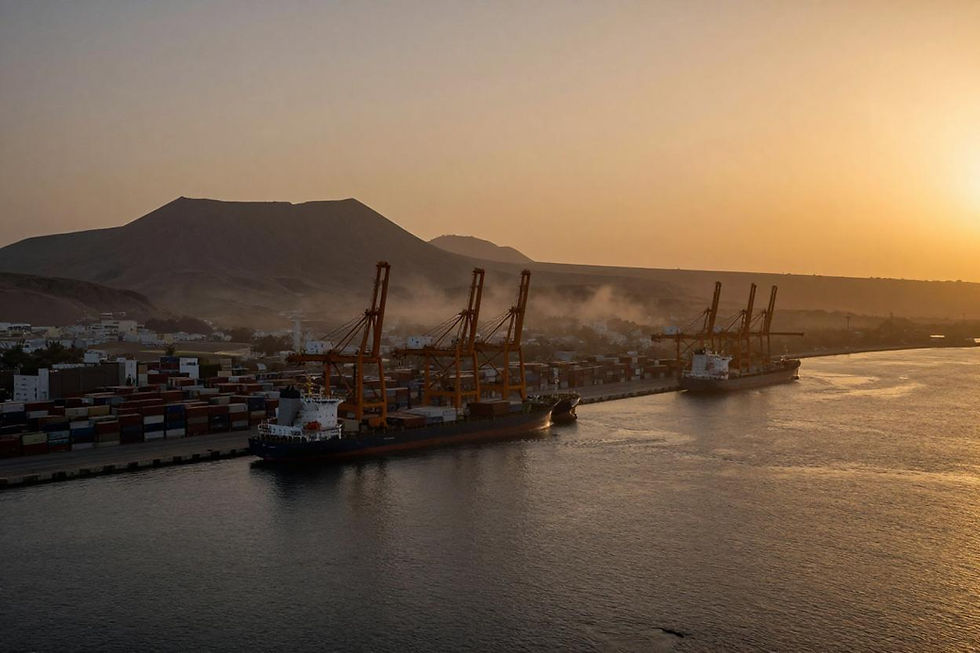
The numbers define the exposure. Since the 1998–2000 Ethio-Eritrean war, Ethiopia has conducted approximately 95% of its foreign trade through this corridor (Institute of Foreign Affairs, cited in Addis Standard, 27 February 2026); 2025 volumes reached 9.5 million tonnes, and port services are estimated to account for as much as 80% of national income (Addis Standard, 27 February 2026). The Doraleh Container Terminal crossed one million TEU for the first time in 2024 with 1,236,769 boxes (African Business, April 2025), against an installed capacity roadmap of two million TEU in 2026 rising toward 3.5 million by 2030 (Mordor Intelligence, July 2026). Half of current container throughput is transshipment rather than Ethiopian gateway cargo — a deliberate diversification the authorities market aggressively (Capital Ethiopia, 7 April 2026).
But the customer has been signalling for two years. The 1 January 2024 memorandum of understanding between Ethiopia and Somaliland — access to a Gulf of Aden port in exchange for stakes in state enterprises — was the first structural bid to break the single-corridor dependency, with consequences we mapped in our Horn of Africa 2026 and Somalia 2026 assessments. The republic's counteroffer was radical in form and revealing in outcome: a 60% equity share in the Port of Tadjoura. DPFZA chairman Aboubakar Omar Hadi disclosed in April 2026 that Ethiopian officials declined — and instead requested a corridor arrangement, potentially including special administrative or transit rights, which stalled the negotiation (Capital Ethiopia, 11 April 2026). Addis does not want to own a piece of the landlord. It wants a highway through the house.
The pricing evidence explains the shopping. British International Investment's December 2025 evaluation of the Berbera corridor puts headline terminal rates at $130 for a 20-foot container and $195 above it — against $133 and $166 at the incumbent hub (BII Infrastructure Study, December 2025). Read carefully, the table does not flatter the challenger: the landlord is cheaper above twenty feet, and its moat is the 753-kilometre electric railway plus corridor gravity, not the tariff. What BII's logistics modelling found instead is that Berbera has become cost-competitive for specific hinterlands — eastern Ethiopia above all, where one logistics firm reported savings of 10–30% depending on cargo type — and that the Somali port's share of the three-port gateway range has already climbed from 9% to 14.3%, with roughly 50,000 TEU of growth since 2017 attributed "almost all" to rerouting from the incumbent corridor (BII, December 2025; Bramston & Associates, May 2026). The precedent for what structural defection looks like already exists: in 2022, Ethiopian utilisation dropped 14.6% in ten months as cargo shifted to Tadjoura (9.2%), Berbera (5%) and Moyale, after the hub slashed free storage from 45 days to eight and imposed $8–10 daily demurrage beyond it (The Reporter Ethiopia, May 2022).
The corridor politics are simultaneously thickening. The DESSU Corridor Authority — linking the port to South Sudan and Uganda via Ethiopia — began operations in early 2026 after a February ministerial accord (TradeMark Africa, 15 February 2026), and the electrified railway to Doraleh Multipurpose Port and the Horizon oil terminal is slated for connection by November 2026 (Capital Ethiopia, 22 February 2026). Yet the same month, reporting confirmed Egypt reached agreements in December 2025 to upgrade both Assab in Eritrea and Doraleh itself (Addis Standard, 27 February 2026) — a pattern of overlapping patrons bidding for the corridor mapped in detail in our Ethiopia 2026 analysis. The paradox is structural: every actor that formalises an interest in the corridor simultaneously establishes a claim on its rerouting.
The slow-moving counterweight is mineral, not containerised. Tadjoura was purpose-built for Danakil Depression potash — 2,000 tonnes per hour of handling capacity, a $90 million facility — while the Ethiopian Railways Corporation's $1.58 billion standard-gauge plan would link the Afar belt to Tadjoura, Assab and Massawa, and Ethiopotash's 486-kilometre lowland export road stands more than 80% complete with an AfDB-funded 230 kV line already energised (Maritime Executive, October 2025; Ethiopotash project disclosures, February 2025). The Kingdom's Red Sea Gateway Terminal projects five million tonnes annually at the port within years — the geometry of the global fertiliser squeeze mapped in our Critical Minerals Trilemma assessment. Potash is the one Ethiopian flow whose growth the landlord earns regardless of Addis's goodwill — and the one that would survive a corridor quarrel.
The financial interest in Ethiopian cargo persists regardless of the geopolitics: 60% of the enclave's 2026 container economics still track Addis's import machine, and DPFZA's own messaging prioritises Ethiopian cargo during surge episodes (Ethiopia Bulletin, 28 July 2026). But priority is not exclusivity. It is likely that by end-2027, at least one competing corridor — Berbera under DP World, Assab under Egyptian finance, or an activated Somaliland arrangement — will move material Ethiopian volume, compressing gateway margins even as total throughput holds; a realistic possibility exists that the loss exceeds 15% of Ethiopian transit within the same window.
For organisations with corridor-dependent supply chains, insurance, or agro-export exposure: model the dependency as a bilateral, not a portfolio. Baseline: 95% corridor share holding through 2027 with erosion beginning at the margin; Tadjoura concession monetisation dependent on an Ethiopian re-engagement that is currently stalled; rail-link delivery by November 2026 on schedule; competition arriving faster in concessions than in actual cargo — monitor actual vessel calls, not announcements.
4. The Moratorium Clock: Exim China, the 2028 Peak, and Borrowed Fiscal Space
The debt narrative that circulates about the country is wrong in an instructive way. The jurisdiction is not in default. It has arranged a suspension of the question.
The stock is manageable, the creditor is singular. Total external debt stood at approximately $3.0 billion in 2024, roughly 70% of GDP (IMF, cited by Rio Times, 4 September 2026); the African Development Bank records public debt easing from 69.6% of GDP in 2024 to approximately 64% in 2025 — still flagged as excessive (AfDB, June 2026). PRC institutions hold over half of the external stock (Congressional Research Service, IF11304, June 2025). After global rate rises pushed servicing costs up, repayments to China's Exim Bank were suspended in late 2022; the resulting moratorium caps interest on the railway and water-pipeline loans at about $20 million annually through 2027 — down from a projected $276 million (IMF, via Rio Times, 4 September 2026).
The IMF's Article IV arithmetic, published in September 2025, sets the timer: total public debt service rises from 2.6% of GDP in 2024 to an average of 4%, peaking at 5% in 2028 upon the moratorium's expiration (IMF Staff Report, 2025 Article IV Consultation). The Fund calls the moratorium what it is — temporary fiscal space — while noting fiscal improvement has been driven by increased military-lease revenues and consolidation, and that the dissolution of the Sovereign Wealth Fund presents an upside fiscal risk through the loss of a consolidated vehicle (IMF, 2025; Coface records the FSD's liquidation in April 2025 amid governance concerns). Meanwhile Exim Bank India has become the creditor holding the largest arrears — a quiet, accumulating second front (IMF, 2025).
The macro wrapper looks deceptively serene. Growth is projected at 6.5% in 2026 and 6.8% in 2027, inflation around 2.4%, fiscal deficit 1.9% of GDP (AfDB, June 2026). But the Fund's debt-sustainability analysis flags vulnerability precisely where the model lives: export and depreciation shocks, with the outlook tied "primarily" to Ethiopian economic prospects — a concentration reviewed in Section 3. Tax-revenue gains are incremental (+0.2% of GDP in 2025, then 0.08 points annually to 2030), which means the 2028 peak must be met by growth, rollover, or renegotiation (IMF, 2025).
The renegotiation question is therefore not whether but on what terms, and against whose leverage. Beijing's willingness to extend relief has been consistent since 2022, but each extension has been priced implicitly in port access, base stability, and alignment — a dependency profile we treat as the Red Sea instance of the wider pattern assessed in our China 2026 risk assessment. Given Ethiopia-bound volumes, tenant cash flows, and Beijing's asset interests in the corridor, it is highly likely that the moratorium is extended or restructured before the 2028 peak bites; it is unlikely that the restructuring occurs without additional asset-side collateral — concessions, operating rights, or pricing arrangements — transferring toward Chinese-linked entities.
For organisations with sovereign-revenue, treaty-linked, or concession exposure: build the 2028 service peak into every maturity beyond 24 months. Baseline: $3.0 billion external stock, ~64–70% of GDP depending on measure; Exim China cap of ~$20 million annual interest through 2027 versus $276 million unmanageable; debt service 2.6% → 5% of GDP by 2028 absent rollover; SOE portfolio review scheduled by the IMF programme for completion in 2026 with retain/restructure/divest decisions pending.
5. The Litigation Long Tail: Doraleh, DP World, and the Sovereign Risk Premium
Every rent economy eventually discovers that expropriation is also a price — and this one has been paying it in instalments since 2018.
The facts are not contested so much as split by tribunal. The state terminated DP World's 50-year Doraleh Container Terminal concession in February 2018, expelled the Emirati operator, and transferred operations to the state-owned SGTD — with the facility sitting adjacent to infrastructure built by China Merchants, which had bought a 23.5% stake in the Port of Djibouti in 2013 and co-launched the $590 million Doraleh Multipurpose Port project in 2015 (Congressional Research Service, IF11304, June 2025). Prior tribunals found the expropriation unlawful, leaving roughly $685–686.5 million in accrued awards, plus interest, unpaid and enforceable against the state (DP World; DredgeWire, 6 October 2025).
The September 2025 ruling cut both ways. On 29 September, arbitrator Maxi Scherer at the London Court of International Arbitration found that Port de Djibouti SA could not be held liable for the 2018 government seizure — a state win that DP World immediately framed as narrow, since the claims against the Republic itself and against China Merchants remain active (African Law & Business, 8 October 2025; Arbitration Monitor, 16 October 2025). A DP World spokesperson cast the stakes expansively: "This case is about more than DP World — it's about whether governments can tear up binding contracts and ignore international law without consequence" (Arbitration Monitor, 16 October 2025). The state's own statement declared the decision "once again reaffirms the legitimate rights of the Republic of Djibouti" (African Law & Business, 8 October 2025). Enforcement litigation continued into 2026, with a High Court of England and Wales judgment entered in February (EWHC 418, 27 February 2026).
The commercial irony is that the terminal prospered regardless — 1.24 million TEU in 2024, profitable every year since opening — while the jurisdiction's risk perception carried the compound interest of the dispute. Coface's country file now lists expropriation risk, corruption allegations, and SOE opacity as standing drags on exactly the private, non-logistics investment the diversification agenda requires; FDI languished at 2.2% of GDP in 2025 (Coface, 2026). The Emirati counteroffensive — backing Berbera and Assab as alternative gateways — is the dispute exported as competition, a dynamic profiled in our UAE 2026 assessment.
The compliance frontier is drifting faster than the legal one. As of the June 2026 plenary, the jurisdiction does not appear on FATF's public lists of high-risk or increased-monitoring countries — but a February 2026 investigation grounded in the mutual-evaluation record alleged that the banking and shipping chain has been routinely abused by sanctions-evasion networks, from Somali piracy-era laundering to Houthi and Hezbollah-linked front companies, describing the national understanding of illicit-finance risk as still at an "embryonic stage" (single-source investigation, February 2026; not corroborated by official FATF statements). The documented warnings nonetheless point the same way: the AfDB and Coface both flag illicit-flow vulnerabilities around the free zones, whose 22% annual company growth operates with limited beneficial-ownership transparency. For compliance teams, the operative fact is not any listing status today — it is that the gap between the gateway's commercial centrality and its supervisory capacity is exactly what grey-listing processes feed on.
The Saudi entry is the strategy's most interesting hedge. The October 2025 thirty-year concession to Red Sea Gateway Terminal International, reportedly involving around $180 million into Tadjoura with operations from 2026, diversifies the operator base away from both the Emirati vacuum and the Chinese concentration — Riyadh gaining a logistics foothold at the chokepoint, the landlord gaining a counterweight (Dabafinance, 10 January 2026). Given the September 2026 Houthi seizures on the Yemeni side of the strait, Saudi strategic interest in the northern shore's stable neighbour is almost certain to deepen through 2027, and it is highly likely that a settlement with DP World — which officials have conspicuously declined to foreclose — arrives within the same window, priced against the diminishing utility of enforcement and the rising value of a unified investor front against the port republic's competitors.
For organisations with concession, arbitration-adjacent, or Gulf-counterparty exposure: treat the legal tail as a discounting question, not a binary. Baseline: ~$686 million in awards accruing interest with active enforcement tracks in multiple jurisdictions; claims against the state and China Merchants unresolved; sovereign positions hardening rhetorically while settlement options remain publicly open; concession regime diversifying (SGTD for containers, RSGTI at Tadjoura, Egyptian interests at Doraleh) faster than legal clarity arrives.
6. The Escalation Premium: Perim Island, the Saudi Blockade, and the War Next Door
In the second week of September, Houthi coastal forces raised their flag on Perim Island — two miles of volcanic rock at the narrowest point of the strait, in sight of every tanker queueing for the Bab el-Mandeb. The war next door had stopped being adjacent. It had acquired real estate.
The sequence that produced September began in February. After the February ceasefire in the Iran war, the Houthis resumed attacks on Israel on 28 March, attacked Saudi Red Sea infrastructure and port facilities on 13 July, and announced a blockade of Saudi ports and shipping effective 20 July (Lloyd's List Intelligence, 23 July 2026). Vessel traffic through Bab el-Mandeb fell 24% in the first weeks of the blockade, then stabilised: 269 transits in the week beginning 20 July, down from 354 the week before — but consistent with levels before the Hormuz disruption had temporarily boosted Red Sea volumes, and by the week ending 23 August movements had recovered to 302, their highest since the Saudi ban (Lloyd's List Intelligence, 6 August and 3 September 2026). Tanker traffic bore the shock; container flows proved stickier than the 2023–2025 crisis had suggested.
Then September delivered the strategic event. Houthi forces seized Perim Island along with Dhubab on the mainland and the Hanish islands, as their coastal offensive overran the port of Mokha (WWD/Sourcing Journal, 14 September 2026; Modern Diplomacy, 19 September 2026). The confrontation displaced more than 112,000 people inside Yemen (Reuters, cited by Modern Diplomacy, 19 September 2026), and Bab el-Mandeb was carrying 8.1 million barrels per day in the second quarter of 2026, nearly double the year-earlier level, as Hormuz disruption pushed Saudi and Gulf flows into the Red Sea (EIA, cited by Modern Diplomacy, 19 September 2026). Reporting suggested the Houthis explored charging transit fees before their coordination centre publicly denied any payment scheme (Al Jazeera, 1 August 2026).
The repricing is documented, not directional. On 3 March 2026, Lloyd's Joint War Committee added Djibouti itself — alongside Bahrain, Kuwait and Qatar — to its Listed Areas under JWLA-033, converting the host state from an observer of war-risk pricing into a named subject of it (JWLA-033; NorthStandard circular, 17 March 2026). By late July, Reuters-reported premiums for southern Red Sea voyages had risen above 1% of hull value from 0.75%, with quotes as high as 3% for Saudi-linked tonnage near Jizan and Al Shuqaiq; Bab el-Mandeb transits carried roughly 0.5% against 0.1% for the western Saudi Red Sea, and Gulf tanker additional premiums, having spiked to 2.5% in early March before easing to around 1% by 30 March, remained up to eight times pre-war levels (Reuters via Insurance Journal, 23 July 2026; Al Jazeera, 23 July 2026; S&P Global via Albany Antree, May 2026). A single high-tension Hormuz transit for a VLCC could price near 10% of hull value (Nautilus Shipping, August 2026).
For the landlord, the effect has been double-entry. On one side: security risk within sight of the anchorage and war-risk repricing across the corridor — dynamics our Yemen 2026 and Bab al-Mandeb blockade analyses treat in depth. On the other: Hormuz-driven rerouting pushed transshipment volumes toward the one large hub still operating normally, with port officials confirming capacity to absorb diverted Persian Gulf cargo while prioritising Ethiopian flows (Ethiopia Bulletin, 28 July 2026). The August Japanese deployment of P-1 patrol aircraft for counter-piracy and Middle East intelligence missions (SCMP, 21 September 2026), the EU's ASPIDES basing agreement of 17 July 2026 (Rio Times, 21 July 2026), and the 30 July formation of a fourteen-nation Multinational Maritime Defence Alliance — including the enclave alongside Saudi Arabia, Turkey, Pakistan, Egypt, and Somalia — to secure freedom of navigation (Al Jazeera, 1 August 2026) all convert the war's persistence into tenant demand. The 2026 re-routing and premium pattern across the full corridor is traced in our Suez Canal 2026 assessment.
The asymmetry that matters for boards: the enclave's downside from a full strait closure is unbounded, while its upside from managed escalation is bounded and already collecting. It is highly likely that elevated threat levels persist through at least mid-2027 given Houthi control of the strait's narrows; it is a realistic possibility that a deliberate strike on the African shore or its approaches occurs during that period, which would convert the escalation premium into an evacuation and duty-of-care event within weeks.
For organisations with maritime, insurance, or war-risk exposure: split the geography from the jurisdiction. Baseline: Bab el-Mandeb transits fluctuating 250–350 weekly; Additional War Risk Premiums at 0.5–1% hull value for corridor transits, spiking toward 3% for Saudi-linked or southern Red Sea calls; the host state itself JWC-listed since March 2026; Gulf premiums at 1–2.5% hull, eight times pre-war; JMIC threat rating Moderate as of May 2026; fourteen-nation coalition operations adding a state-actor deterrent floor beneath commercial traffic without eliminating non-state risk.
7. The Signal Station: SIGINT, Carrier Piers, and the Chinese Upgrade Cycle
In September 2026, analysts at CSIS's Hidden Reach unit overlaid commercial satellite passes over the Chinese base and counted what the untrained eye would miss: reinforced cable trenches, dug in 2025, sized for equipment not yet installed. What the imagery documented was an intelligence platform mid-expansion, not a logistics facility.
Their finding, published on 17 September 2026 by Matthew Funaiole, Brian Hart, Aidan Powers-Riggs, and Douglas Comstock, was that the PLA had upgraded the base with new communications equipment strengthening internal comms and likely enabling signals-intelligence collection. Their assessment was direct: recent Middle East conflicts have sharply increased the intelligence value of Chinese SIGINT capabilities at the site, with more than 20 US warships in the region by July 2026 (CSIS, 17 September 2026). South China Morning Post reporting echoed the finding that the upgrade gives the PLA "a window" on foreign military operations across the Middle East (SCMP, 21 September 2026).
The physical plant deserves the emphasis it rarely receives. Opened on 1 August 2017 at a cost of $590 million, the base spans half a square kilometre with a 400-metre runway, helicopter apron, hospital, and 23,000 square metres of underground space; roughly 1,000–2,000 personnel rotate through, with the Africa Center for Strategic Studies reporting 2,000 troops permanently stationed (Africa Center, June 2026). The pier completed in December 2019 — some 1,120 feet — is assessed by the US Department of Defense as capable of accommodating aircraft carriers, large combatants, and submarines (Congressional Research Service, IF11304, June 2025). General Stephen Townsend, then-AFRICOM commander, told the House Armed Services Committee that Beijing "ultimately plans to construct nine piers with four dedicated to the PLA Navy" (Maritime Executive, 30 April 2021). Whatever the final figure, the trajectory from "logistics facility" to expeditionary node is complete.
The inter-tenant geometry is the story. The Chinese compound sits adjacent to the Chinese-operated Doraleh port, kilometres from Camp Lemonnier and the French, Japanese, and Italian facilities — eight-plus intelligence presences in mutual line of sight, in a state too small to buffer any of them. Italian defence planners are reportedly alarmed by increased Russian activity near their base (HORN Institute, 2026); Russia's rebuffed 2014 approach for a facility here remains the precedent that US pressure can veto a tenancy, while Moscow's February 2025 agreement with Sudan for a Port Sudan base shows the Red Sea appetite persists (BBC, 13 February 2025).
The read for boards is not about a hypothetical battle at the Bab el-Mandeb. It is that the world's most concentrated great-power co-location now includes a dedicated intelligence-collection function pointed at every other occupant — including allied navies conducting strikes from the neighbourhood. In a crisis, this converts any Gulf or Levant escalation into an immediate counterintelligence posture change for every Western unit in the theatre. Given the pace of Chinese investment since 2017 and the 2026 upgrade cycle, it is highly likely that additional sensors and berthing capacity are installed before end-2027, and a realistic possibility exists that the first Chinese carrier call at the facility occurs within the same horizon.
For organisations with classified-workforce, COMSEC, or defence-contracting exposure: treat the entire capital-adjacent zone as a contested electromagnetic environment. Baseline: eight-plus foreign installations within mutual observation range; SIGINT-capable adversary infrastructure operational and expanding per 2026 satellite documentation; Russian probes recurring; carrier-grade pier capacity available to a navy that has not yet exercised it; local counterintelligence environment shaped by a host state balancing all tenants simultaneously.
8. The Megawatt Mirage: Ghoubet Wind, the Khat Line, and the 2035 Renewable Bet
Seventy-six point eight percent. That is the ILO-modelled youth unemployment rate for 2025 — the single number against which every megawatt, free-zone certificate and FDI ribbon-cutting in this section must be scored.
The energy pivot has genuine substance. The Ghoubet wind farm — sixty megawatts, seventeen Siemens Gamesa turbines, $122 million, the country's first independent power producer, delivered by a consortium led by the Africa Finance Corporation with FMO and Climate Fund Managers — began operations in September 2023, with a planned 45-megawatt expansion and an associated desalination plant supplying 7,000 litres of drinking water per hour to nearby villages (Africa Energy Portal, 15 September 2023; AFC, 8 September 2023). The Grand Bara solar project, an initial 25 MW with 10 MW of battery storage, was slated operational by Q1 2026 with a pathway to 100 MW (African Business, 3 April 2025). The stated national objective is 100% renewable electricity by 2035 — first in Africa — with green-hydrogen pre-feasibility work underway by Fortescue Future Industries, AMEA Power, and CWP Global, and geothermal drilling around Lake Assal progressing with Chinese involvement (African Business, 3 April 2025).
The base against which these megawatts are measured is the constraining truth. Domestic installed capacity before Ghoubet was roughly 126 MW, essentially all diesel, less than half operational — with about 95 MW imported from Ethiopia (Africa Energy Portal, 2023). The industrial stack behind the export dream is financed in billions but delivers in megawatts: a $3.8 billion Damerjog buildout spanning thirty square kilometres — a 380,000-cubic-metre tank farm, a 2.5-kilometre oil jetty, twin 60 MW generation and a fourteen-kilometre rail spur — alongside five FDI agreements signed in a single ceremony worth $2.5 billion, and a March 2026 request from Ethiopian Investment Holdings for a 150,000-cubic-metre fuel depot once Horizon Terminals confirmed saturation at five million tonnes against Damerjog's projected 25-million-tonne liquid bulk capacity (papaverAI, May 2026; DPFZA; Fidel Post, March 2026). The data-centre cluster — a 5 MW carrier-neutral facility opening in 2026, roughly $200 million of submarine-cable investment, the conduit whose security economics we assessed in our Seabed Frontier analysis — plugs into the same grid the wind farms must triple (papaverAI, May 2026). The Djibouti International Free Trade Zone reported 513 companies established by March 2026, up 22% year on year, at 70% land utilisation (MarcoPolis, 5 September 2026): demand is arriving faster than electrons.
And the social ledger the megawatts must eventually amortise is the hardest number in this report: youth unemployment of 76.8% in 2025 (ILOSTAT via TheGlobalEconomy), overall unemployment around 26% (Trading Economics, 2026), projected poverty rates of 13.5% on the international line and 33.1% on the lower-middle-income line for 2026 (World Bank via Lloyds Bank Trade Portal, 2026).
The quiet drain running beneath the entire social ledger is botanical. Imports from Ethiopia are dominated by khat — a fresh leaf that loses its psychoactive value within days, flown and trucked daily across the border under a time-critical logistics chain — purchased at origin for around $10 per kilogram and retailing in the range of $25–40 (The Reporter, June 2024). It is Ethiopia's second-most-valuable export after coffee, and Addis demonstrated in April 2022 — when it doubled export prices overnight — that the trade can be weaponised as a foreign-exchange instrument, a decision reversed only after consumer and diplomatic backlash (XCEPT, November 2022). For households here, the leaf functions as a regressive tax on disposable income; for the workforce, as a productivity drag landing hardest on precisely the young male cohort the 76.8% measures; for the state, as an import bill settling in scarce hard currency against a currency board with no printing discretion. The rent economy can price khat's arrival corridor — it cannot tax its compounding costs.
The honest assessment is therefore two-directional. It is likely that installed renewable capacity more than doubles by end-2028 as Ghoubet Phase 2, Grand Bara's later phases, and at least one geothermal or green-hydrogen FID land; it is unlikely, absent a single transformative project, that the energy buildout materially moves the youth-unemployment figure before 2030 — the megawatts price the industrial option, they do not yet buy the social one.
For organisations with energy-intensive industrial, data-infrastructure, or ESG-linked exposure: underwrite the energy transition as a procurement geography governed by treaty-scale counterparties, not a market. Baseline: ~185 MW installed clean-or-imported capacity at end-2026 trending upward; IPP framework proven at Ghoubet and replicable; grid constraint the binding variable between announced and bankable demand; electricity tariffs cheap by regional standards but hostage to a single imported feed from Ethiopia.
9. Djibouti 2026 Geopolitical Risk Assessment — Three Scenarios
This assessment resolves into three scenarios, each defined by a different answer to the tenant question: does the rent hold?
Scenario A — Managed Tenancy and Rented Stability (Probability: ~40-45%)
The baseline persists. Lease renewals continue (France's treaty model becoming the template), the Exim Bank moratorium is extended or softly restructured before the 2028 peak, Red Sea traffic recovers on a 2027 horizon without a full strait closure, and Ethiopian volumes erode at the margin rather than the core. Guelleh completes the transition of the state's day-to-day management toward a designated successor-in-waiting without yielding the presidency. The DIFTZ, Tadjoura, and rail projects deliver cumulative uplift.
This scenario holds unless one or more triggers fire: a Houthi strike on the African shore or a full Bab el-Mandeb closure collapsing transshipment economics; an Ethiopian corridor defection exceeding 15% of gateway volume; a US retrenchment event cutting the anchor tenancy; or a succession shock before institutional transfer. The probability band sits in the low forties because every structural driver of the system — tenant demand, creditor patience, regime intent — currently reinforces continuity; it is capped below half because the drivers are coupled, and the same escalation that fattens the rent erodes the trade beneath it.
Scenario B — Escalation Spillover and the Corridor Squeeze (Probability: ~30-35%)
The war next door arrives. A deliberate or accidental strike on the port complex, anchorage, or a foreign base — Perim-based fires, a misidentified drone over Ambouli, a coalition enforcement action with Houthi retaliation against the African shore — converts the escalation premium into an event. War-risk indices gap higher, transshipment volumes relocate to Salalah and East African alternates for a quarter or more, evacuation and duty-of-care costs activate, and the tenants collectively reinforce rather than depart: the base economy inflates precisely as the trade economy deflates.
This scenario holds unless the fourteen-nation coalition establishes a deterrent floor the Houthis respect, the Suez recovery stalls the war's maritime logic, or diplomacy freezes the Yemeni coastal front through the winter. The probability is elevated by the demonstrated capability and intent of September 2026 — a non-state actor now physically astride the strait's narrows — and reduced only by the observed pattern of mutual cost-avoidance that has characterised every Red Sea escalation cycle since 2023: everyone involved is billing this war, and nobody has yet been willing to close the till.
Scenario C — Anchor Failure: The 2028 Cliff Meets the Succession Vacuum (Probability: ~15-20%)
The two clocks strike together. The moratorium expires into a hard 5%-of-GDP debt-service peak while a succession contest — triggered by incapacity, death, or a palace fracture — splits the elite and puts every lease, concession, and IMF commitment into adjudication. Ethiopia accelerates corridor diversification into the vacuum; an enforcement action against sovereign assets complicates refinancing; the ledger of leases itself becomes the prize of the contest rather than the income of the state.
This scenario holds unless: the creditor restructures early and generously; the succession is pre-managed with tenant consensus — every great power's preferred outcome; or Ethiopian alternatives (Berbera, Assab) remain structurally insufficient for the 9.5-million-tonne habit. The probability is held under a fifth because every tenant has an overriding interest in preventing anchor failure and the levers available to them are considerable; it is not lower because age and debt-service peaks are the only two variables in this system that no one — not the palace, not the creditors, not the tenants — can indefinitely defer.
10. Implications
Maritime and logistics. Split corridor exposure from chokepoint exposure and price them separately. Contract for Red Sea routing with force-majeure language that covers closure episodes of six-to-twelve weeks; verify transshipment alternatives (Salalah, Mombasa, East African feeders) against realistic redirection capacity, not marketing capacity. Reprice war-risk and K&R cover on a 2027 index above the 2025 baseline. Set internal tripwires: any strike within fifty kilometres of the African shore, any deployment of coalition forces into the Bab al-Mandeb narrows, or a sustained sub-200 weekly transit count triggers automatic routing review within seventy-two hours.
Defence, security, and intelligence. Treat the entire capital zone as a contested electromagnetic environment with adversary SIGINT operational since 2026. Apply COMSEC discipline to all communications within two hundred kilometres of Djibouti City regardless of classification level; review contractor and third-country national vetting under an assumption of multi-directional collection. Monitor pier construction tempo and sensor-installation cycles at the Chinese base as standing indicators, with any carrier-group approach or berthing as an early-warning event.
Finance, legal, and compliance. Insert sovereign-litigation screening into every counterparty relationship touching the port chain: the $686 million in unpaid awards and active enforcement tracks make asset-attachment scenarios a documented, not theoretical, tail. Build the 2028 debt-service peak into sovereign-linked receivables, concession cash flows, and any lease-dependent revenue model; stress-test at zero moratorium extension. Apply enhanced due diligence to free-zone counterparties — the DIFTZ's 22% annual company growth includes jurisdictions of convenience, and illicit-flow warnings from both the AfDB and Coface are standing.
Energy and infrastructure. Model grid capacity as a hard constraint on any industrial or data-centre commitment: bankable megawatts trail announced demand by a factor, and the imported Ethiopian feed is a single-point dependency. Require IPP-backed supply in contracts, with the Ghoubet PPA structure — not sovereign guarantees — as the credit anchor.
Political and succession monitoring. Maintain a standing dashboard of six bellwethers: the composition and dynastic placement of the prime-ministerial and cabinet rotation in 2026–2027; any hospitalisation or unplanned absence of the president beyond seventy-two hours; Chinese pier and sensor construction tempo; the creditor posture ahead of the 2027 IMF Article IV; Ethiopian port-allocation announcements versus actual vessel calls at Berbera and Assab; and FATF plenary outcomes (February, June, October), where any movement of the jurisdiction toward increased monitoring converts the compliance paragraph of this assessment from contingency to event — treat listing-inclusion as an immediate correspondent-banking review trigger. Early-warning thresholds: any visible designation of a successor, any moratorium-extension announcement with new concession collateral, and any opposition-figure return from exile — each of which historically precedes elite realignment within twelve months.
Duty of care. Pre-position evacuation planning on the assumption that a Scenario B event compresses departure windows to days, not weeks; the concentration of foreign forces cuts both ways in a crisis, providing lift capacity and jurisdictional friction simultaneously.
11. Core Analytical Judgment
This Djibouti 2026 geopolitical risk assessment maps a system that has solved the oldest problem in small-state strategy by inverting it: instead of seeking security from great powers, it sells security to them — and has convinced eight of them, simultaneously, that the arrangement is their idea.
The system's variables are coupled in ways that defeat linear forecasting. The base economy strengthens with every escalation; the escalation threatens the trade that services the debt; the debt is held by the tenant whose base expansion deters the rivals whose presence justifies the rent. This is not a stable equilibrium — it is a managed oscillation, in which the state collects amplitude as income and calls the arrangement stability. The 2026 election did not change the model; it removed the last procedural constraint on the model's most personalised element, extending the tenure of the sole actor who has ever run the ledger — and thereby concentrating the entire system's continuity risk in one biological variable.
The anchor tenant of the title is, finally, not Washington or Beijing. It is the 78-year-old landlord himself, and every great power in the Gulf of Tadjourah is now, knowingly, subletting from him. The moratorium, the lease, and the succession are the same clock read from three sides. Boards exposed to this jurisdiction are not holding an African frontier position; they are holding a leveraged claim on the continuation of everyone else's rivalry — the most durable, and the least diversifiable, asset class in the Red Sea. The rent is always due before the storm.
---
If your organisation operates in or has exposure to Red Sea and Bab el-Mandeb maritime corridors, East African port and transshipment operations, Ethiopia-bound supply chains, defence contracting and base-support logistics, war-risk insurance and underwriting, sovereign and concession-linked receivables, or compliance-sensitive free-zone trade, CES Intelligence maintains 24/7 situational awareness and can provide bespoke risk assessments, crisis stress-testing, and board-level briefings.
Want more analysis like this?
Bespoke advisory available on request.
Thierry Marquez — Founder & Principal Advisor, CES Intelligence
+33 (0)9 55 16 54 98 →
DISCLAIMER
This analysis is provided for informational and strategic planning purposes only. It is not investment advice, financial advice, or legal advice, and it should not be treated as such. Probability assessments reflect the analyst's calibrated judgment based on available open-source intelligence as of the date of publication and are subject to revision as new information emerges. Some quantitative estimates and reported events are based on regional sourcing that may evolve as additional confirmation becomes available.


