Philippines 2026 Geopolitical Risk Assessment: The Forward Fracture

Updated: 3 days ago

Published: Aug 3, 2026 · Updated: October 1, 2026
Contents
Key Takeaways
Controlled violence is now the operating baseline, and its author is no longer the coast guard alone. The escalation ladder that began with water cannon and lasers has climbed through routine ramming to the first baton strike producing injury (July 2026), deliberate ship-ramming at Sabina Shoal (September 2026), and the first obstruction of a resupply mission by Chinese navy warships acting alongside coast guard cutters (24 September 2026). The 2024 arrangement that had managed tensions at Second Thomas Shoal is almost certainly dead. What has not yet been crossed is the fatality threshold — but the margin narrows with every rung.
The treaty signal is a surge, not a station. Nine EDCA sites, a carrier transit, trilateral exercises and a State Department condemnation constitute a real signal. It remains indexed to a Gulf war Washington does not control, and to an administration that has priced its allies' security as negotiable. Manila's deterrence posture is therefore likely to remain contingent rather than structural through the Iran conflict's duration.
The impeachment has become a conviction machine, assembled in real time. A trial court arrest warrant against the sitting vice president (4 September 2026), a Senate decision lowering the conviction threshold (23 September 2026), and a prosecutor-friendly political arithmetic have materially raised the probability of removal. Her 2028 viability, however, remains resilient across outcomes — which is precisely the instability.
Graft has become the country's fiscal constitution. ₱252 billion stripped from the public works budget, plunder charges against a sitting senator, and a century-long record of zero high-profile convictions mean the corruption scandal is no longer a political story. It is the operating constraint on the state's capacity to respond to any of the other fault lines.
The economy has slipped from deceleration into rupture. Q2 2026 growth of 2.3% — the weakest since 2021 — collided with a central bank hiking into weakness for a third consecutive meeting, a peso at record lows, and inflation expected to breach the 4% ceiling through 2027. The stress-scenario thresholds identified in August have been tripped; the question is now whether deterioration is absorbed or compounds.
The chairmanship is presiding over its own irrelevance. ASEAN's self-imposed 2026 deadline for a South China Sea Code of Conduct will almost certainly pass without a binding instrument, and coercion inside the chair's own exclusive economic zone during its summitry season has settled the question of whether the diplomatic track disciplines the coercive track. It does not.
Modernisation is buying a deterrent for the 2030s against a threat calibrated for 2026. Re-Horizon 3's $35 billion basket — and above all its submarine centrepiece — runs on procurement timelines that cannot match the escalation timeline they are meant to deter.
Portfolio-level. The single most valuable analytical distinction for the next twelve months is between events that confirm the managed-intensification baseline — absorbable, hedged, largely priced — and events that trip the escalation ladder's remaining rungs or the fiscal-political convergence. The former reward patient exposure management; the latter arrive abruptly and reprice simultaneity risk across maritime corridors, sovereign paper and semiconductor supply chains in a single news cycle. Institutions that have not pre-sorted which of their exposures belong to which category will learn the difference from the market, not from their planners.
1. The Baton Threshold: Second Thomas Shoal and the Escalation Ladder
The escalation ladder is not climbing toward a threshold. The threshold has moved.
Until 2023, confrontation at contested features meant water cannon, acoustic devices and laser targeting — coercive but non-contact. In 2024, ramming became routine, capped by the June 2024 skirmish that cost a Navy SEAL his thumb during a blockade of the Sierra Madre resupply run. On 20 July 2026, the ladder moved again: according to the Armed Forces of the Philippines, a China Coast Guard officer deploying from a rigid hull inflatable near the grounded vessel struck a Philippine Navy sailor on the head with a wooden baton — the first exchange of direct physical blows producing injury between the two countries' personnel (AP, 20 July 2026; USNI News, 20 July 2026). The military evaluated the head injury for medical evacuation; Beijing's version held that the crews had "maliciously attacked Chinese law enforcement officers with paddles, long poles and other objects" after ignoring repeated warnings (Newsweek, 20 July 2026). Ambassadors were summoned on both sides the following day (Reuters, 21 July 2026). Two days after the baton strike, a coast guard vessel fired water cannon at a fisheries boat near Scarborough Shoal, closing to within seven metres (CNN, 24 July 2026). This is where Philippines geopolitical risk 2026 concentrates: not in a single battle, but in an escalation ladder whose rungs are climbed quietly.
What has happened since the original publication of this assessment is a two-rung climb that the July incidents only foreshadowed. On 18 September, a China Coast Guard ship executed what Manila's maritime authorities termed "intentional ramming" of a government vessel delivering fuel to fishermen near Sabina Shoal — the second collision in a single month of renewed confrontation (Rappler, 18 September 2026). And on 24 September, the mission that defines the entire dispute — the rotation and resupply of the Sierra Madre — was suspended after coast guard cutters and People's Liberation Army Navy (PLAN) warships acted together to obstruct it, with dangerous manoeuvres threatening a collision with the supply vessel Lapu Lapu (Reuters, 25 September 2026; USNI News, 25 September 2026; Maritime Executive, 25 September 2026). The involvement of PLAN warships in obstructing a resupply mission is without precedent in this dispute's decade-long grey-zone history, and it effectively neutralises the verbal understanding that had governed the shoal since 2024 (EAI Global, 30 September 2026).

The tempo beneath these incidents is industrial, not episodic. Asia Maritime Transparency Initiative data show Beijing doubled its coast guard patrolling presence around Scarborough in 2025, with 2026 on track to double it again; in April, a floating barrier was reinstalled across the shoal's entrance (CNA, 23 September 2026). The air domain has now been opened: armed trainer jets drove away a reconnaissance aircraft over Scarborough in early September (SCMP, 4 September 2026). This operational pattern is consistent with the grey-zone campaign CES Intelligence documented in its July 2026 South China Sea assessment — a state-directed campaign designed to achieve territorial gains below the threshold of armed conflict, timed to a "distraction dividend" created by Washington's absorption in the Gulf. Every baton strike and every warship obstruction is a withdrawal from the account of American credibility. It should be stressed that the correlation between the Gulf conflict and Beijing's maritime acceleration is an analytical inference drawn from timing and strategic context — but the pattern across theatres is now consistent enough to warrant treatment as orchestrated rather than improvised.
The diplomatic overlay has not slowed it. Defence Secretary Gilberto Teodoro, mid-speech at the Seoul Defense Dialogue, received a note passed by the Chinese delegation challenging the country's maritime claims — and answered with the SONA's vernacular weapon: "Have a little shame" (Deccan Herald, 9 September 2026). Taipei, for its part, donated a coast guard vessel to Manila amid the tensions (SCMP, 17 September 2026) — a signal that the forward fracture is widening into a regional alignment line.
Continued coast guard operations at contested features over the next twelve months is no longer a probability estimate; it is the observed operating rhythm. The probability of at least one further incident crossing the fatality threshold within the same period remains a realistic possibility (~40-45%), reflecting the narrowing gap between controlled violence and accidental escalation as naval assets join the coercive mix.
For organisations with maritime, insurance or shipping exposure: treat the 2024 resupply "provisional arrangement" as expired and the PLAN's 24 September debut as the new escalation grammar. Baseline: coast guard presence around contested features on track to quadruple within two years; deliberate ramming now a recurring instrument; obstruction missions previously cutter-only now executed jointly with navy warships; war-risk premia for South China Sea transit to be modelled as a step-function, not a drift.
2. The American Bet: EDCA, Bandwidth, and the Carrier Signal
An alliance is not what the treaty says. It is what the ally can spare.
The Enhanced Defense Cooperation Agreement permits the United States to rotate troops, pre-position equipment and build facilities at nine local bases, after the 2023 expansion added four sites — Camilo Osias Naval Base and Lal-Lo Airport in Cagayan, Camp Melchor Dela Cruz in Isabela, and Balabac Island in Palawan. The geometry is not incidental: the Cagayan sites face Taiwan across the Luzon Strait; Balabac guards the southern approach to the South China Sea. Nikkei Asia characterised the alliance under the current US administration as enjoying a "renaissance" — but one that has "yet to face serious test from regional rival China" (Nikkei Asia, May 2026). US defence financing allocations, reportedly including approximately $200 million under Foreign Military Financing and additional National Security Investment funding, have been directed toward modernisation; Secretary of State Rubio has reaffirmed the 1951 Mutual Defense Treaty's explicit coverage of armed forces, vessels and aircraft anywhere in the South China Sea. The framework, on paper, is sound.
The hardware record is more concrete than the exercise schedule suggests. American anti-ship missile launchers — the Navy-Marine Corps Expeditionary Ship Interdiction System — deployed to the northern provinces near the Luzon Strait for Balikatan 2026, staged across islands within the strait, with Japanese Type 88 launchers and the marines' BrahMos batteries slated to join the drills in live-fire and notional deployments (Naval News, 25 April 2026). Congress is working on a substantial financial appropriation to continue the modernisation effort, and combined live-fire rehearsals have shot down drone formations simulating hostile aircraft off provinces facing the contested waters (Military.com, 10 February 2026).
Its conditionality has hardened on both axes since this report's first publication. Bandwidth first: the United States is simultaneously prosecuting a war against Iran — the ceasefire France 24 described as "ineffective and repeatedly broken" (France 24, 1 August 2026) — managing instability on the Cuban and Venezuelan fronts, sustaining aid to Ukraine, and absorbing a domestic political calendar. Oil's retreat toward $100 late in September came not from victory but from negotiation: American and Iranian officials discussing Hormuz's reopening in New York, with crude easing for a fourth straight session as flows improved (WSJ, 25 September 2026). When Senator Hontiveros warned that "Trump's Iran war is weakening US deterrence in the South China Sea" (PhilStar, March 2026), she was articulating what every regional capital calculates privately. The carrier deployments that followed the July incidents were a credible signal; they were also a surge response to a crisis cycle, not a station.
Political will second: Trump's transactional approach to alliances is documented, and his suggestion that US weapons sales to Taipei could serve as a negotiating lever with Beijing transmitted through every capital in the region. If Taiwan's security guarantee is negotiable, Manila's is not categorically different. The link is direct and structural: our Taiwan 2026 assessment documents the quarantine-window strategy — economic attrition through 72-hour inspection delays rather than kinetic force — with the archipelago as its forward testing ground. Both theatres share the same core variable: Washington's bandwidth deficit as the enabling condition for calibrated escalation. It is highly likely that this deficit persists through the Iran conflict's resolution phase, and a Trump-Xi meeting anticipated by markets for late September may soften rhetoric without altering the underlying arithmetic of distraction.
Trilateral exercises with Japanese and Australian forces conducted in July 2026 showcased the operational dimension — real, repeated, expanding. They remain insufficient to match the frequency and density of coast guard operations conducting daily patrols at features the country claims. An alliance reinforced in hardware and rhetoric, but outrun in daily tempo, is the definition of a signal without a station.
For organisations with alliance-dependent operating assumptions: build the contingency premium into planning horizons now rather than after the next carrier cycle. Baseline: nine EDCA sites with Taiwan-facing geometry; treaty coverage reaffirmed to include coast guard vessels; expeditionary anti-ship missiles and BrahMos-grade strike assets now exercised on Luzon Strait geography; response capacity calibrated to surge cycles that coincide with Gulf flare-ups; a documented pattern of alliance value being priced as a negotiating lever in US-China diplomacy.
3. The Duterte-Marcos Rupture: Impeachment as Political Warfare
The impeachment is not a constitutional proceeding that has become political. It is a political war being fought with constitutional instruments.
The rupture's chronology is by now well established: the Marcos-Duterte alliance of 2022 cracked in late 2023 and is now systemic. The House impeached Vice President Sara Duterte on 11 May 2026 — the first official in the country's history to be impeached twice — over misuse of confidential funds, unexplained wealth and alleged threats against the president's life (Reuters, 11 May 2026; New York Times, 11 May 2026). The Senate trial opened on 6 July under heavy security (BBC, 6 July 2026). A conviction requires two-thirds of senator-judges. The trial is constitutional in form, political in function: Marcos cannot run again, and removing the strongest 2028 rival — or convicting her on charges carrying disqualification — is the most efficient method of eliminating her before the campaign begins. This is a judgment on timing, not on the merits of the charges.
What has changed since the original publication is the removal of two dampeners. First, the criminal track converged on the vice president herself: on 4 September, a Quezon City trial court issued a warrant for her arrest in the grave-threats case involving three counts, setting bail at ₱120,000 per count, with her arraignment deferred (Reuters, 4 September 2026). Second — and strategically decisive — the impeachment court ruled on 23 September to lower the number of votes needed to convict, after four of the 24 senator-judges became unable to participate (Reuters, 23 September 2026). In the assessment of Michael Henry Yusingco, senior research fellow at the Ateneo Policy Center, the lowered threshold represents "the best chance to secure a conviction" (Reuters, 23 September 2026). The defense retains procedural leverage — the threshold debate itself consumed weeks of oral argument (PhilStar, 20 September 2026) — but the structural trend is unmistakable: the conviction machine is being assembled in real time.
The transnational layer compounds it. Rodrigo Duterte, in ICC custody since 2025, made his first public appearance in over a year at The Hague on 16 September, attending a status conference where his fitness for a protracted trial — he is 81 — is now itself a litigation variable (AP, 16 September 2026; The Diplomat, 18 September 2026). Senator Ronald "Bato" dela Rosa, whose arrest attempt dissolved into gunfire in the Senate corridors in May, remains a fugitive five months on; the solicitor general describes him as a "fugitive from justice" (The Diplomat, 18 September 2026), and the justice department has subpoenaed the senator who sheltered him for obstruction (Daily Tribune, 16 September 2026). The Duterte faction reads the ICC track as politically weaponised, and the argument resonates in Mindanao. The risk is not immediate instability; it is a polarisation so deep that governance coherence fails precisely when compounding external and economic pressures demand it.
Against this, the probability of conviction and removal has risen from the moderate band carried in August to likely territory (~45-50%) after the threshold ruling — though appeal dynamics and the Senate's political volatility justify keeping the estimate below the "highly likely" register. Sara Duterte's 2028 viability remains robust regardless of outcome (highly likely to contest unless disqualified), which is exactly the instability: a convicted-but-popular rival, or an acquitted-and-emboldened one, polarises the electorate along Mindanao-Luzon lines through the campaign.
For organisations with political-risk exposure: extend enhanced due-diligence horizons beyond the trial verdict to the post-verdict mobilisation window. Baseline: conviction threshold lowered with 4 of 24 senators excluded; a parallel criminal case with the sitting vice president facing an executed arrest warrant; ICC proceedings advancing on two tracks; regional cleavage deepening; the 2028 campaign de facto underway.
4. The Graft Deadweight: Flood Control and Fiscal Fragility
Corruption here is not a deviation from the budget process. Increasingly, it is the budget process.
The scandal centred on the DPWH flood control programme has metastasised since mid-2025. The Ombudsman filed plunder, bribery and graft charges on 28 May 2026 against Senator Jinggoy Estrada, former DPWH Secretary Manuel Bonoan and several officials over alleged kickbacks from ₱1.4 billion in Bulacan flood control works, with both surrendering on 1 June after the Sandiganbayan issued warrants on non-bailable charges (per Ombudsman filings). In January, former Senator Bong Revilla was charged over a ₱112 million ghost flood control project. By July, the 2026 budget had seen ₱252 billion stripped from locally funded flood control projects (Rappler, July 2026). Marcos's SONA injunction — "Mahiya naman kayo!" — was an attempt to reclaim the anti-corruption narrative (PCIJ, 26 July 2026), delivered against what ABC News called a backdrop of scandal implicating his own allies, his estranged vice president's trial, and the fallout of the Iran war (ABC News, 27 July 2026).
The system's genius is its adaptability. The PCIJ documented that the administration itself introduced a new pork-barrel formula — "allocables" — converting DPWH projects into legislator kickback sources even as the scandal raged (PCIJ, 26 July 2026). Opposition impeachment articles against Marcos himself were dismissed for want of substance, but the asymmetry question now owns the public square, as Senator Cayetano's SONA-week formulation put it: equal justice, or selective? (ABS-CBN, 28 July 2026). The historical record reinforces the scepticism: no high-profile graft case in the country's modern history has produced conviction and imprisonment.
The macroeconomic consequence is not the stolen billions. It is the credibility multiplier applied to everything else: a fiscal stimulus executed by a public works ministry under plunder indictment cannot borrow confidence from a credibility it does not hold. Further revelations within twelve months is almost certain (~70-75% and arguably higher given the DOJ obstruction track now open); genuine reform of the DPWH budget process remains highly unlikely (~15-20%).
For organisations with procurement, infrastructure or public-tender exposure: price the review risk, not the headline risk. Baseline: ₱252 billion already stripped from the 2026 flood control programme; a precedent of zero high-profile convictions offset by a live plunder docket reaching a sitting senator and a former secretary; retroactive procurement investigation risk elevated for all entities tied to DPWH projects; "allocables" logic meaning new political money routes through the same channels as the indicted ones.
5. The Deceleration Rupture: Stimulus Without Credibility
The print landed on 7 August: 2.3% year-on-year, the weakest quarterly performance since 2021 and far below the 2.8% consensus, driven by a construction slump that graft austerity and confidence erosion explain better than any external shock (Reuters, 7 August 2026; Bloomberg, 7 August 2026). A Reuters poll had already flagged war-driven oil prices and weak domestic demand as the twin drags (Reuters, 28 July 2026). The gap between the IMF's July projection — 3.9% growth for 2026, revised down from 4.1%, on the descent from 5.7% in 2024 and 4.4% in 2025 (IMF WEO, July 2026) — and the quarter's actual performance is not statistical noise; it is the measurable cost of the fault lines documented in this report intersecting simultaneously.

The policy response has been to stimulate with the right hand while tightening with the left. The government announced a state-spending ramp-up in May to counter the slowdown, asked Congress in July for tax relief including broader income tax exemptions and removal of the minimum corporate income tax for small businesses (Reuters, 27 July 2026), and has now proposed a $118 billion national budget for 2027 — the stimulus wager carried forward past the electoral horizon (Yahoo Finance, August 2026). Against it, the Bangko Sentral ng Pilipinas, having held at 4.25% in an off-cycle meeting while warning that inflation would breach its 4% ceiling, raised its policy rate to 5.00% in late August — a third consecutive hike, diverging from regional peers, into the fastest inflation in Southeast Asia (WSJ, August 2026; Bloomberg, 27 August 2026). In the assessment of Governor Eli Remolona, "we will tighten as much as we need" (Bloomberg, 27 August 2026). A central bank pre-emptively hiking against a construction-led contraction while the fiscal authority stimulates is not a policy mix; it is a stagflationary squeeze administered by two independent authorities.
The currency seals the picture. The peso slid to 59.38 per dollar in January — the weakest level on record at the time, with officials signalling tolerance for further depreciation (Bloomberg, 12 January 2026) — and has since traded near 62.7 to the dollar (Yahoo Finance, 30 September 2026). For one of Asia's most active sovereign issuers, that is not an inconvenience; it is a borrowing-cost transmission channel running directly into the debt stock. Before the Iran war, the country was reportedly approaching investment-grade upgrade territory; that trajectory is now subordinated to the Gulf, a condition CES Intelligence has documented across emerging-market theatres from Pakistan's IMF lifeline to Egypt's sovereign debt trajectory. A credit outlook revision under sustained $100-plus oil is now a realistic possibility; the upgrade narrative is highly unlikely to be restored within twelve months.
For organisations with sovereign, banking or construction-sector exposure: model the stress case as the base case. Baseline: Q2 print 2.3% against an annual forecast of 3.9%, implying H2 must overperform by more than a full point to meet even the downgraded number; policy rate 5.00% with a hiking bias into weakness; peso at record-low territory; a $118 billion 2027 budget proposed on top of stimulus financed against eroded fiscal credibility, with the executing ministry under plunder indictment.
6. The Energy Trap: Hormuz and the 90% Import Dependency
Energy security, for this economy, is a foreign policy it does not conduct.
The archipelago imports 90-100% of its crude from the Middle East — not a marginal dependency but a total one, and the Asian Development Bank has identified it, alongside Pakistan and Sri Lanka, as among the economies most exposed to Middle East conflict transmission (per ADB reporting). The Iran war's passage through that dependency has been the defining macro shock of 2026, and its current phase is ambivalent by design: Brent traded above $100 through late September — $102.56 on the spot market as of 30 September (Yahoo Finance, 30 September 2026) — even as it eased across four sessions toward that level on improved Hormuz flows and negotiation progress in New York (WSJ, 25 September 2026). Oil above $100 is no longer a scenario; it is the regime the economy is currently operating in, as examined in our Hormuz conflict analysis.
The transmission runs through three channels. Fuel prices first: pump costs are politically sensitive in an economy where transport absorbs a disproportionate share of household income. Electricity second: the generation mix includes significant oil-fired capacity, making tariffs directly responsive to crude. Food third: fertiliser, transport and irrigation pumping are energy-intensive, and food inflation lands on an administration already facing graft-driven legitimacy erosion. Above all three sits the semiconductor and electronics sector — more than half of exports — which is doubly exposed: energy-intensive production and air-cargo-dependent distribution, both hostage to a prolonged Gulf disruption. The sector's competitiveness is indexed to energy-cost stability that the current geopolitical configuration cannot guarantee.
The central bank's own framing completes the circuit: BSP projections show headline inflation breaching the 4% ceiling in both 2026 and 2027 (WSJ, August 2026). An import-dependent economy importing inflation through its entire cost structure, while hiking rates to contain it and stimulating demand to offset it, has exhausted its conventional policy space. It is likely that the oil-price regime above $90 persists through end-2026 absent a negotiated Hormuz settlement — the direction of travel in late September negotiations, but not yet a fact; sustained relief below pre-war levels before 2027 is highly unlikely.
For organisations with energy, manufacturing or consumer-sector exposure: rebuild cost baselines around the regime, not the mean. Baseline: 90-100% Middle East crude dependency; Brent oscillating around $100 with negotiation-driven downside spikes that do not restore pre-war levels; inflation above the 4% ceiling through 2027 per the central bank's own projection; energy-cost scenarios of 30-50% above pre-2026 baselines as the standing stress band, extending to 60-70% under a renewed closure event.
7. The ASEAN Chairmanship: Code of Conduct or Code of Silence
The chairmanship was designed to prove the country could convene the region. It has proved the region cannot protect its convener.
The strategy was sound in theory: chair ASEAN in 2026, inject momentum into the Code of Conduct negotiations that have dragged for over two decades, and convert diplomatic centrality into strategic weight. The Cebu leaders' statement in May pledged to "endeavour to conclude the negotiation of an effective and substantive Code of Conduct in the South China Sea" (AP, 8 May 2026); Foreign Minister Theresa Lazaro reported "positive momentum" and a push to conclude the code within the year (Reuters, 29 January 2026). The self-imposed 2026 deadline was the chair's signature wager.
Events have settled its fate in stages. The July foreign ministers' meeting in Manila opened, per the assembled regional press, with an agenda topped by the resurgent Iran war and "a violent skirmish in the disputed South China Sea" — the baton strike of 20 July, occurring on the summit's doorstep (AP, 21 July 2026). The ministers' joint statement called for an immediate halt to Middle East fighting and the full reopening of Hormuz; on the confrontation occurring outside their windows, the body produced silence. Wang Yi's warning that the chair would "bear the bitter consequences" of provocation, delivered on that meeting's margins, completed the demonstration — documented in our July 2026 South China Sea assessment. By September, cutters and warships were obstructing a resupply mission inside the sitting chair's own exclusive economic zone — and the coercing party's patrol presence around the chair's waters, on AMTI data, doubled in 2025 and is on course to double again in the chairmanship year itself (CNA, 23 September 2026). The code's concluding deadline has passed into the long list of missed anniversaries the negotiation is made of.
The structural obstacle has not moved in twenty years: Beijing insists on bilateral mechanisms it can dominate, while claimant states seek a framework institutionalising collective leverage — and the body operates by consensus that includes Cambodia and Laos, both deeply aligned with the PRC. What the chairmanship has changed is not the deadlock but its visibility: even the sitting chair cannot shield its own vessels from coercion in its own waters. The parallel agenda compounds the strain: Myanmar's civil war grinds on despite the five-point consensus; Lazaro's role as special envoy adds load to a chair already managing a maritime crisis; and the body's bandwidth — like Washington's — is finite. Even Manila's own envoy to Washington has publicly emphasised the need to "cool" the temperature with Beijing to secure its engagement for the code (Reuters, 10 February 2026) — a candid admission that the chairmanship's flagship requires the cooperation of the party coercing it.
A substantively binding code concluded before the 2028 electoral horizon is highly unlikely; a framework document, non-binding and celebratory, at the closing summit is a realistic possibility — which is to say the chairmanship will likely end as it conducted itself, presiding over its own irrelevance with ceremony.
For organisations with regional policy or trade-agreement exposure: do not anchor compliance or corridor planning assumptions to a binding South China Sea instrument. Baseline: a two-decade-old negotiation with a missed 2026 deadline; consensus procedures that make any enforcement mechanism contingent on Beijing's consent; incident-management therefore improvisational, as the September PLAN obstruction demonstrated.
8. The Re-Horizon 3 Gamble: Defence Modernisation Uncertainties
The modernisation programme is a bet on deterrence whose maturity date arrives after the danger it addresses.
Re-Horizon 3, reportedly approved in January 2024, allocates approximately $35 billion over ten years — the most ambitious procurement effort in the country's history, with a centrepiece of diesel-electric submarines, reportedly French-origin Scorpène-class or similar, including funding for purchase, logistics and basing. The ambition is clear; the execution is the constraint. Previous Horizon phases suffered chronic funding shortfalls, the programme's price tag reportedly exceeds the annual defence budget by a factor of about ten, and the funding assumption — sustained appropriations across a decade and across administrations — is one that successive governments have failed to honour for far smaller programmes.
The submarine acquisition illustrates the tension between aspiration and institutional readiness: operating a submarine fleet requires decades of accumulated expertise, specialised training infrastructure and maintenance ecosystems the country does not possess. France's Naval Group has offered training support, but the timeline to operational competence extends well beyond any plausible conflict horizon in the South China Sea — by the time the boats work, the hybrid maritime architecture they were bought to deter will have evolved. The International Institute for Strategic Studies has assessed that "funding issues and vague legislation raise questions as to whether the country can meet these defence ambitions" (IISS). The broader basket — fighters, corvettes, offshore patrol vessels, air defence, cyber — is more realistic and faces the same gap.
Whether the force needs modernising is settled; it manifestly does. The open variable is whether the modernisation timeline can match the escalation timeline documented in Sections 1 and 2. On the available evidence it cannot — and the gap between procurement aspiration and operational reality is precisely where Beijing's advantages compound. A corruption-addled procurement pipeline (Section 4) and a budget under growth-downgrade pressure (Section 5) make the decade-long funding assumption unlikely to hold intact; partial delivery with descoping is the likely median outcome.
For organisations in defence-industrial, naval or aerospace supply chains: approach the opportunity with disciplined patience. Baseline: a $35 billion, ten-year programme priced at roughly ten times the annual defence budget; submarine procurement the most scrutinised contract in the country's defence history with multi-decade competence timelines; fighter, corvette and patrol programmes the executable near-term segment; 2028 as the horizon on which a Duterte presidency would plausibly recalibrate the US relationship and revisit EDCA arrangements — the single largest programmatic risk to any signed contract.
9. Philippines 2026 Geopolitical Risk Assessment — Three Scenarios
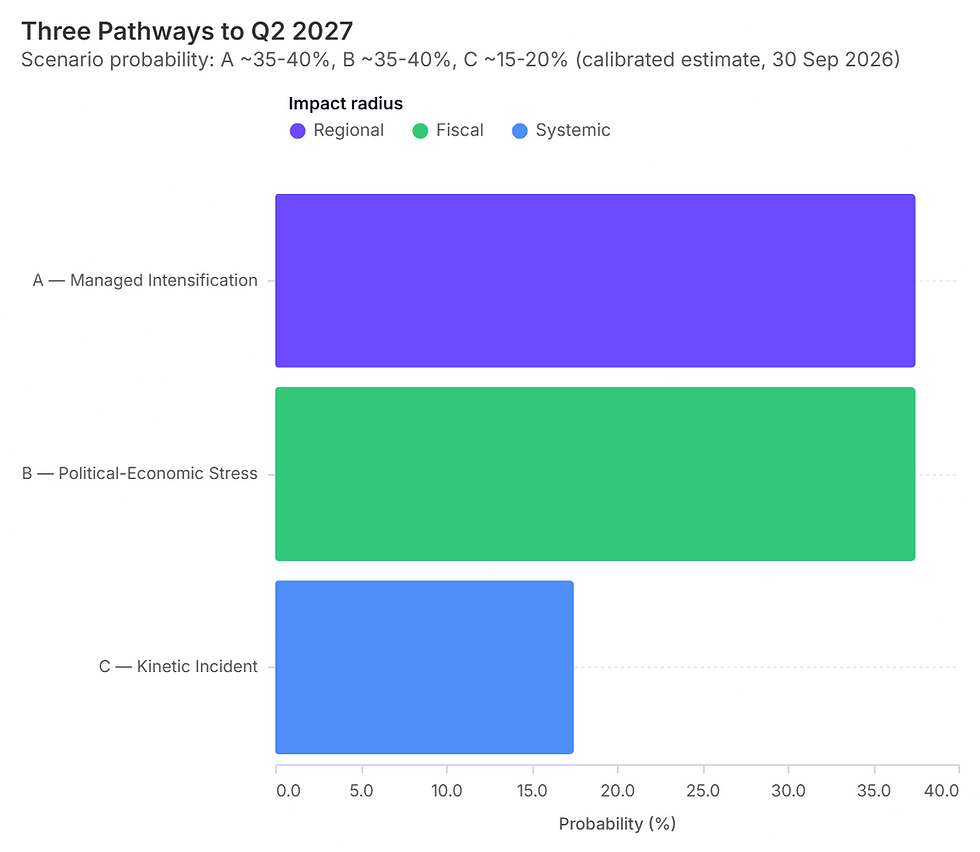
Scenario A — Managed Intensification and Strategic Entrenchment (Probability: ~35-40%)
The current trajectory continues and hardens. Graduated operations at Manila's outposts persist — water cannon, dangerous manoeuvres, intermittent physical confrontation, and now routine PLAN participation in obstruction missions — without crossing the fatality threshold. The US maintains rotational presence through EDCA and periodic carrier deployments without permanent rebasing. The Sara Duterte impeachment concludes with a mixed or split verdict that weakens her without eliminating her 2028 viability. The graft scandal produces no convictions but continues to erode governance credibility. Growth stabilises at the bottom of the 3-4% range as oil moderates with a negotiated Hormuz settlement; the peso finds a level; the BSP pause replaces hikes. ASEAN closes its chairmanship with a non-binding code framework. This scenario holds unless one or more triggers fire: a coast guard or PLAN operation producing a fatality at a Philippine outpost; a US decision reducing EDCA funding or rotational levels under alliance recalibration; an impeachment verdict triggering mass protest in Mindanao; or a renewed Hormuz closure pushing oil above $120/bbl. The probability is held near the top of its band rather than the August figure because the baseline has already degraded — several of its boundary conditions (oil above $100, inflation above ceiling, PLAN participation) have been consumed by reality rather than remaining hypothetical.
Scenario B — Political Crisis and Economic Deterioration (Probability: ~35-40%)
One or more triggers fire: the Iran war persists at sustained tempo, maintaining oil above $100 through 2026-27; inflation accelerates beyond the BSP's tolerance band; the peso depreciates past previous records under sustained pressure; the stimulus fails to generate growth while widening the deficit, triggering a sovereign credit downgrade; the graft scandal expands with additional plunder charges and legislative paralysis; the impeachment becomes a national spectacle polarising the electorate along Mindanao-Luzon lines; Marcos's approval falls below 30%; maritime operations intensify in the political interregnum while the US, absorbed by the Gulf, provides rhetoric without reinforcement. The country enters governance degradation — functional but weakened, diminishing in its capacity to execute either foreign commitments or the economic programme. The probability has been raised to parity with the baseline because the scenario's inflation, growth and exchange-rate triggers have already partially fired (Q2 print of 2.3%, record-low peso, inflation projected above the 4% ceiling through 2027); it is capped below a majority because dampeners remain live — a proactive central bank, negotiating-track oil prices, and an impeachment endgame that may stabilise rather than detonate the political sequence.
Scenario C — Kinetic Incident and Alliance Drag-In (Probability: ~15-20%)
Multiple fault lines rupture in sequence. A local sailor is killed during a coast guard or PLAN confrontation at Second Thomas, Scarborough or Sabina Shoal — or a collision sinks a fisheries boat with fatalities, an outcome the September ramming near-misses have moved measurably closer. The government, under domestic pressure, invokes the Mutual Defense Treaty and demands visible American response. The US deploys additional naval assets while an Iran flare-up splits carrier availability. Beijing calculates Washington will not fight in the Gulf and the South China Sea simultaneously. A blockade of the resupply missions follows; a US escort triggers the first direct US-China naval confrontation. ASEAN issues communiqués without enforcement. Oil spikes above $120 on combined Hormuz and South China Sea risk premiums; the shipping insurance market reprices the transit corridor; supply chains through Subic Bay and Manila — inside the world's second-busiest maritime corridor — are disrupted. The probability band is unchanged despite the PLAN's September debut because the two directional effects offset: the denser and more militarised incident tempo raises the odds of accident, while the late-September US-China negotiation track and the absence of casualties to date pull the other way.
This scenario requires a miscalculation overriding both sides' interest in avoiding direct conflict — a condition that grows more probable as frequency and intensity rise and diplomatic channels narrow, but which remains, on the evidence, resistible by both parties.
10. Implications
Maritime and logistics operators. Model the Sulu Sea and Celebes Sea corridors as the standing contingency for South China Sea routings — 3-5 days of additional transit and 15-25% fuel-cost implications — and pre-build charterparty force-majeure language against obstruction-type events, not just casualty events, after the 24 September mission suspension. Reprice war-risk cover against a step-function: freight-cost scenarios of 30-50% above pre-2026 baselines for Manila-routed cargo through Q4 2026, with the disruption corridor extending to inter-island energy logistics under a renewed Sabina-pattern ramming tempo. Take note of the rerouting signal at infrastructure level: Washington is funding a feasibility study for a Thai subsea cable that bypasses the South China Sea entirely (Fortune, 22 September 2026) — allied capital is already pricing the corridor's degradation into long-lived assets, not just freight schedules.
Political and governance risk operators. Extend enhanced due diligence through the post-verdict window of the impeachment, whatever the verdict, and into the 2028 campaign cycle. Treat the DOJ obstruction track around the dela Rosa flight as an early indicator of a politicised enforcement environment; review every procurement and contract touching DPWH, flood control or locally funded infrastructure against a 24-month review horizon, with retroactive investigation as the planning assumption, not the tail case.
Energy and inflation transmission operators. Rebase energy-cost planning to the post-war oil regime — 30-50% above pre-2026 baselines as the standing band, 60-70% under renewed Hormuz closure — and map exposure through the three transmission channels in priority order: pump prices, oil-fired generation tariffs, then food-input costs. Negotiate labour-cost escalators now; the fiscal stimulus bids up construction and services wages while inflation runs above the central bank's ceiling, and the BSP is tightening into both.
Financial institutions. Stress-test sovereign and bank exposure against the convergence of stimulus, graft-erosion and current-account pressure. Model Scenario B as the base case. Track three indicators as the dashboard: the peso against the dollar (record-low territory and tolerantly managed), the BSP's rate path (5.00% with a hiking bias), and stimulus execution against the fiscal framework. Price a credit outlook revision under sustained $100-plus oil at 40-50% probability through mid-2027, and treat any upgrade talk as narrative, not analysis.
Defence and security firms. Sequence engagement around the executable segment — corvettes, patrol vessels, air defence, cyber — and price political risk into any submarine-related participation: the 2028 election is the programmatic cliff, a Duterte presidency the single largest reversal vector for EDCA-aligned and US-origin contracts alike. Build procurement-timeline assumptions on historical slippage, not programme documents.
Boards assessing regional exposure. Read this assessment jointly with our Taiwan 2026 assessment and The Pacific Compression: the forward fracture documented here is the seaward flank of the same strategic architecture, and a collapse pathway here propagates through the world's second-busiest maritime corridor and through semiconductor value chains before it appears in any sovereign spread. Assign one owner to the South China Sea scenario set at board level; the September PLAN debut removed the last argument for treating it as a country desk's file.
11. Core Analytical Judgment
The fracture defines the analytical problem. The country is externally fortified — a mutual defence treaty with the world's foremost military power, nine EDCA sites, growing interoperability with Japanese and Australian forces, the ASEAN chair. It is internally brittle — a political elite consumed by an impeachment weaponised for 2028, a public works ministry under plunder indictment, growth at its weakest since 2021, an energy security hostage to a Gulf war it cannot influence. This inversion — external fortification without internal cohesion — is the structural condition that makes the Philippines a Category 1 geopolitical risk. A state that appears anchored by treaty alliance but cannot execute domestic governance invites exactly the calibrated coercion it now receives: adversaries exploit the gap between commitment and capacity, allies cannot determine whether the commitment strengthens the partner or subsidises its dysfunction.
Since this assessment was first published, the inversion has tightened on both faces at once. The external fortification acquired its sharpest test case — PLAN warships joining coast guard cutters to obstruct a resupply mission, the first naval participation in the grey-zone campaign against the archipelago — in the same quarter the internal brittleness produced its starkest measurement: 2.3% growth, a record-low peso, a vice president under arrest warrant, and a Senate re-engineering its own arithmetic mid-trial to make conviction possible. These are not separate stories converging by coincidence; as documented across our China, South China Sea, Taiwan and Vietnam assessments, they are one integrated architecture viewed from its most forward-deployed node: Beijing harvesting the distraction dividend in secondary theatres while the ultimate target ripens, and the fiscal-political decay inside the American alliance system doing the coercive work the batons merely punctuate.
The question is not whether Manila stabilises. It is whether stabilisation occurs before or after a structural breach of one or more load-bearing pillars — treaty credibility, impeachment containment, DPWH fiscal integrity, oil-price transmission tolerance. The baton strike of 20 July opened the controlled-violence era; the naval obstruction of 24 September closed the era in which the grey zone had a purely civilian face. The margin between controlled violence and accidental escalation now narrows with every mission Washington does not escort and every quarter the economy does not recover. An alliance substitutes for a state's coherence at exactly the rate the adversary chooses to test it — and the adversary is choosing quarterly.
---
Want deeper analysis?
Bespoke advisory and theatre-level assessments are available on request — scenario planning, country and sector deep dives, crisis stress-testing, and board-level briefings. Engagements are confidential.
Thierry Marquez — Founder & Principal Advisor, CES Intelligence
+33 (0)9 55 16 54 98 →
DISCLAIMER
This analysis is provided for informational and strategic planning purposes only. It is not investment advice, financial advice, or legal advice, and it should not be treated as such. Probability assessments reflect the analyst's calibrated judgment based on available open-source intelligence as of the date of publication and are subject to revision as new information emerges. Some quantitative estimates and reported events are based on regional sourcing that may evolve as additional confirmation becomes available.


