Beijing Orders Around the Nvidia Export Controls, in Bulk

Updated: 2 days ago

CES DAILY SIGNAL — October 21, 2026
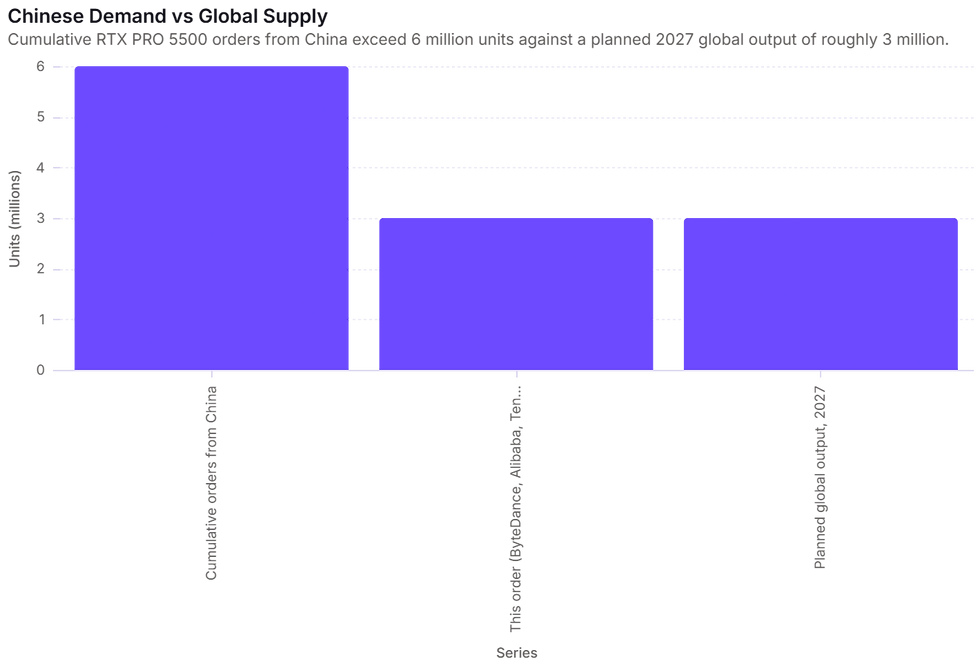
Three of China's largest technology companies walked into the same catalogue on the same day and ordered more than 3 million of the same workstation card — a bill of materials north of $35 billion for hardware Washington never classified as restricted. The vendor, for its part, has told partners it cannot promise delivery: Chinese demand already exceeds planned production, with one of the three sources cited by Reuters putting cumulative orders from China past 6 million units (Reuters, 20 October 2026).
Washington's controls did not close the frontier of compute; they repriced it — and Beijing has just bought at scale exactly where the border was redrawn.
TRAJECTORY
The corridor stays open through the quarter. Early samples reach Chinese customers in December, commercial deliveries begin in the first quarter of 2027, and Beijing's regulators convert tolerance into rationed approval — domestic accelerators riding alongside foreign silicon as a condition of entry. Washington's reaction arrives late and transactionally: a licensing tweak, a tariff, or a stalled bill, none fast enough to unwind contracts already signed. The diplomatic channel survives; the capacity gap does not. Boards exposed to the workstation compute tier should be repricing 2027 procurement assumptions now, not after the Federal Register moves.
SECOND-ORDER EFFECTS
Non-Chinese enterprises — hospitals, manufacturers, media groups running local inference — face likely scarcity and price inflation on the exact category Washington declined to restrict, as allocation politics divert supply and the successor Rubin generation competes for the same TSMC wafers.
The upfront-payment structure converts the order into a counterparty exposure of up to $35 billion in prepaid balances held by Chinese buyers against deliveries the vendor cannot guarantee — a credit-insurance and trade-finance question before it is a technology question, and highly likely to attract scrutiny from lenders on both sides of the Pacific.
Domestic Chinese accelerator vendors gain negotiating leverage: every approved foreign purchase paired with a domestic-quota requirement converts the corridor into an industrial-policy subsidy, accelerating a substitution curve already visible in homegrown revenue growth.
ANALYSIS
How Nvidia Export Controls China — and How They Don't
The RTX PRO 5500 is the mechanism of the bypass, not its beneficiary. A Blackwell-generation workstation card carrying 84 GB of ECC GDDR7 memory and 21,760 CUDA cores on a 600 W envelope, it was quietly listed in mid-September with no press release, no price and no ship date (VideoCardz, 14 September 2026). The specifications matter because of proximity: the flagship RTX PRO 6000 holds only 9.6 percent more cores and 12.5 percent more memory on the same GB202 silicon (VideoCardz, 14 September 2026) — a gap measured in fractions, not generations. It sits below the data-center accelerator category that every successive round of US controls since October 2022 has targeted, which is why Beijing's Ministry of Industry and Information Technology surveyed purchase plans and signalled its intent to approve them (The Information, as reported by Reuters, 27 September 2026). Delivery and absorption into Chinese fleets within ninety days of first shipments is likely; the harder question is whether the capacity trains frontier models at all (see our AI sovereignty and export controls assessment, 2026). The regulator drew the line around rack-scale accelerators — and the catalogue walked around it with a workstation SKU.
The arithmetic outruns the factory
Even if politics permits the purchases, physics prices them. One source puts maximum global output of the card at roughly 3 million units in 2027, against cumulative Chinese orders that two of Reuters' sources place past 6 million — demand at perhaps twice the world's entire planned supply, queued behind a December sample batch and first-quarter 2027 commercial deliveries (Reuters, via The Next Web, 20 October 2026). The supply side compounds: the predecessor RTX 6000D has been discontinued and its Chinese street price has doubled (Reuters, via The Next Web, 20 October 2026), while the pivot toward Rubin competes for the same wafer allocation. Full fulfillment of the three-company order is therefore highly unlikely within the horizon; partial allocation is the operative scenario, and that makes payment terms and allocation politics — not export licences — the binding constraints. A reactive US tightening targeting professional-tier cards remains a realistic possibility, but the sequencing is brutal: any rule written after December addresses shipments already contracted.
Two regulators, one open door
The deeper coupling is that both governments are managing the same leak with opposite instruments. Washington's January framework licensed the H200 to approved Chinese buyers under conditions the Bureau of Industry and Security framed as ensuring Chinese advanced-computing capability "does not exceed the capabilities or supply capacity of the United States," layered with a 25 percent tariff on those sales (Federal Register, via China Briefing, 25 September 2026). Beijing answered with quotas: firms had to pause H200 orders while regulators sized how many domestic chips each buyer must purchase alongside them (Reuters, 8 January 2026). Chinese customers had ordered over 2 million H200 units at roughly $27,000 apiece under those terms — before the workstation corridor opened beneath the whole architecture (Reuters, 31 December 2025). The legislative follow-through exists but lags: the House passed the Remote Access Security Act on 12 January 2026 to close the cloud-rental loophole (China Briefing, 25 September 2026), while Tencent's reported five-year, $7 billion agreement for offshore access to some 100,000 advanced accelerators (Network World, 9 October 2026) shows compute flowing through that gap faster than enforcement closes it. Since our Signal of 12 October, the AI incident channel born of the Trump–Xi summit was absorbing attention while the capacity bypass was being contractualised (see our China geopolitical risk assessment, October 2026). Likely consequence: Beijing institutionalises a two-track approach — sanctioned premium silicon where tolerated, domestic accelerators everywhere else — with domestic suppliers posting four-figure annual revenue growth (Tom's Hardware, 30 September 2026) on the demand this corridor tolerates.
The invoice is denominated in watts
The constraint Washington cannot tariff is the grid on the other side. At the card's published 600 W ceiling, the reported order implies roughly 1.8 GW of aggregate draw — approaching the output of two nuclear units' worth of continuous load to be absorbed somewhere in coastal China, in a market where the electricity appetite of AI facilities is already a documented systemic issue (see our AI data-center energy crisis assessment, October 2026). The memory dimension compounds the physics: 84 GB per card scales to roughly 250 petabytes of GDDR7 on this order alone, drawing on the same module supply that made the Pro lineup feasible in the first place (VideoCardz, 14 September 2026). Beijing's approval calculus is therefore not only about chips — it is about siting, cooling and transmission approvals that no export regime can shortcut. Realistic possibility that MIIT pairing ratios are set as much by available power as by industrial policy; for any operator benchmarking Chinese compute build-out, grid connection queues are the observable that matters.
SIGNALS TO WATCH
Sample shipments reach Chinese buyers in December 2026 — this reading holds unless the Bureau of Industry and Security issues a Federal Register rule covering professional-tier or workstation-category GPUs before commercial deliveries begin in Q1 2027.
A formal MIIT approval publishes domestic-purchase pairing ratios — the quota level, and the power-connection approvals attached to it, set the effective price of the corridor for every subsequent buyer.
Senate movement revives the stalled 30-month statutory ban on advanced China chip sales — legislative traction converts this from a licensing dispute into an alliance-level export regime question.
The vendor's next quarterly filing discloses China backlog and prepaid-order exposure — anything approaching the reported $35 billion in contracted but unfilled orders quantifies the counterparty risk Washington has created on its own side of the wall.
---
Want deeper analysis?
Bespoke advisory and theatre-level assessments are available on request.
Thierry Marquez — Founder & Principal Advisor, CES Intelligence
+33 (0)9 55 16 54 98 →
DISCLAIMER
This CES Daily Signal is provided for informational and strategic planning purposes only. It is not investment advice, financial advice, or legal advice, and it should not be treated as such. Probability assessments reflect the analyst's calibrated judgment based on available open-source intelligence as of the date of publication and are subject to revision as new information emerges.


