The Mecca Defence Pact 2026: Regional Security Reconfiguration or Strategic Theatre?

Updated: Oct 9

Published: 25 August 2026 · Updated: October 1, 2026
Contents
Key Takeaways
The alliance is institutional, not declaratory. The Mecca Joint Defence Agreement, signed at Al-Safa Palace on 7 August 2026 by Saudi Crown Prince Mohammed bin Salman, Turkish President Recep Tayyip Erdoğan, and Pakistani Prime Minister Shehbaz Sharif, creates a collective-defence framework modelled on NATO's Article 5 — an armed attack on one is treated as an attack on all. In the eight weeks since signing, it has acquired institutional substance faster than most precedents: the first Strategic Political and Defence Committee convened in Istanbul on 31 August with all foreign and defence ministers and chiefs of general staff present, a permanent secretariat has been established in Riyadh, and the first secretary-general will be Pakistani. The pact is no longer a photograph; it is a schedule of meetings.
The first test has already happened — and the clause did not fire. Between late August and late September, Houthi forces captured Mocha and Perim Island on the approaches to Bab al-Mandeb, struck the Jazan refinery for at least the third and fourth times since July, forced the shutdown of the East-West pipeline after 11 September attacks, and hit a fuel depot adjacent to Riyadh's King Khalid International Airport. Pakistan's Defence Minister publicly warned that the attacks could activate the alliance; sixty days into its existence, the collective-defence clause has not been formally triggered, and the Kingdom instead sought American military support that Washington declined to provide. The most consequential datum about the pact is now a negative one.
The deterrence value remains asymmetric. The clause is most credible where the Kingdom is the target — both Ankara and Islamabad have demonstrated willingness to deploy forces to Saudi territory — and least credible where Türkiye or Pakistan is the primary target, because Riyadh lacks compelling strategic rationale for direct involvement. The September sequence confirmed the asymmetry operates even within the Saudi case: deployment, yes; joint combat operations under alliance command, not yet.
The defence-industrial dimension is the alliance's most consequential long-term output. Ankara's defence and aerospace sector exported $10.05 billion in 2025, up 48% year-on-year, with $17.8 billion in new contracts; Baykar's 2023 Saudi agreement remains the largest defence export in Turkish history; and the Kızılelma — the first UCAV in history to score a beyond-visual-range air-to-air kill — entered serial delivery to Turkish forces in early 2026. The alliance formalises a procurement pathway outside US Congressional restrictions, aimed at a Saudi localisation target above 50% of military spending by 2030.
The expansion question has cooled, not closed. Erdoğan floated Egyptian accession publicly; Syria and Bangladesh have signalled interest; Qatar is identified by multiple analysts as the most natural Gulf candidate. But Cairo's non-alignment instincts have prevailed so far, and Tehran has formally denied receiving any invitation. It is now unlikely that a fourth member accedes before the alliance's first anniversary.
Portfolio-level: The pact was conceived as a hedge — diversified security provision for Riyadh, strategic depth for Ankara, financial reinforcement for Islamabad — and September demonstrated both what the hedge delivers (institutional coordination, augmented air defence, a standing consultative machinery) and what it does not (collective military action under fire). Organisations should model the alliance as a coordination framework with real industrial content and an untested combat clause, price continued Bab al-Mandeb and southern Red Sea disruption as baseline conditions through at least Q1 2027, and treat formal activation of the collective-defence clause as the single observable event that would reprice Middle East political risk across the board.
1. The Architecture: What the Accord Actually Creates
The agreement establishes three institutional mechanisms, all modelled on NATO precedent: a ministerial-level political committee bringing together Defence and Foreign Ministers, a military committee involving Chiefs of General Staff and Armed Forces Commanders, and a permanent general secretariat headquartered in the Kingdom (Reuters, 7 August 2026). Turkish Foreign Minister Hakan Fidan confirmed the NATO-parallel structure, stating the pact would function with ministerial, political, and military committees alongside the secretariat (The National, August 2026). What existed on paper at signature has since acquired a calendar: the inaugural Strategic Political and Defence Committee met in Istanbul on 31 August, gathering Fidan, Güler and Bayraktaroğlu for Türkiye; Dar, Asif and Field Marshal Munir for Pakistan; Prince Faisal, Prince Khalid and General Al-Ruwaili for the Kingdom — the full ministerial and uniformed leadership of all three signatories (Turkish MFA joint statement, 31 August 2026). The countries formally adopted the name Mecca Defence Alliance, announced the Riyadh secretariat, and confirmed the first secretary-general will be a Pakistani appointee (Al Jazeera, 31 August 2026). As Fidan put it after the talks, the three capitals had taken their "first institutional decisions" (TRT World, 1 September 2026).
The governance design is deliberate. It creates institutional touchpoints at the highest political and military levels without merging national command authorities. The ministerial committee sets strategic direction; the military committee translates that direction into operational coordination; the secretariat manages continuity between meetings. This is a consultative architecture — closer to the early NATO Council model of 1949 than to SHAPE.
The collective-defence clause is the political centrepiece. Modelled on Article 5, it declares that an armed attack against one signatory is regarded as an attack against all three (Reuters, 7 August 2026). Its deterrence value depends on each member believing the others would actually respond. Pakistan's principal security concern is India — absent from Riyadh's and Ankara's threat calculus. Türkiye's primary adversaries are Greece in the Aegean, the PKK across its southern border, and increasingly Israel in the Eastern Mediterranean. The Kingdom's threat environment is Iran and Houthi forces — only partially overlapping with its partners' direct interests (IISS, August 2026). Saudi officials have also moved to define the scope downward, insisting the agreement is focused on conventional military cooperation and rejecting suggestions that Pakistan extends a nuclear umbrella to its partners (War on the Rocks, 9 September 2026; Chatham House, 14 August 2026).
This asymmetry is built-in. The clause is most credible in the scenario where Riyadh is the target — because both Ankara and Islamabad have demonstrated willingness to deploy forces to the Kingdom, and Pakistan had placed roughly 8,000 troops, sixteen JF-17 fighters, two drone squadrons and a Chinese HQ-9 air-defence battery on Saudi soil as early as May 2026, with a confidential provision for escalation to as many as 80,000 troops (Reuters, 18 May 2026). It is least credible where Türkiye or Pakistan is the primary target, because neither Riyadh nor the other signatory has compelling strategic rationale for direct involvement. The accord strengthens Saudi deterrence; it does not symmetrically strengthen that of Ankara or Islamabad. Absent a formal invocation, the alliance's first year is highly likely to remain exactly this: deployments that stabilise, committees that convene, a clause that waits.
For organisations with regional political-risk exposure: track three observable indicators as the operative health metrics of the alliance — the frequency and seniority of committee meetings, the staffing level of the Riyadh secretariat, and, above all, Pakistani force levels in the Kingdom. Deployment counts, not communiqués, are the guarantee metric. Build monitoring dashboards around all three.
2. The Defence-Industrial Integration: A Procurement Pathway Outside Washington
The defence-industrial dimension is where the agreement transitions from symbolic to substantive. The Turkish Defence Ministry's 13 August statement specified that cooperation extends beyond product supply to joint development and production, technology transfer, and sustainable maintenance and logistics support, with priority areas in unmanned and autonomous systems, electronic warfare, and artificial intelligence (Reuters; Al Arabiya, August 2026). This is an integration roadmap, not a procurement catalogue.
The pieces were in motion long before the signature. Türkiye's defence and aviation exports reached $10.05 billion in 2025, up 48% year-on-year, with new contracts growing roughly 80% to $17.8 billion — figures announced by Haluk Görgün, head of the Presidency of Defense Industries (Anadolu Agency, 4 January 2026). Baykar's July 2023 agreement with Riyadh remains the largest defence export in Turkish history, covering Akıncı combat drones, technology transfer, and localised production, with memoranda extending to SAMI for in-Kingdom manufacture and to Aselsan and Roketsan for subsystems (Middle East Eye, 18 July 2023; Anadolu Agency, August 2023). Pakistan and Türkiye already co-manufacture MILGEM-class corvettes and operate joint drone-integration facilities (War on the Rocks, 9 September 2026).
The technological centrepiece is the Bayraktar Kızılelma, the world's first jet-powered unmanned combat aircraft, which destroyed a jet-powered aerial target with an indigenous Gökdoğan beyond-visual-range missile off Sinop on 29 November 2025 — the first air-to-air BVR kill by an unmanned platform in aviation history (Naval News, 30 November 2025). Serial deliveries to the Turkish armed forces began in the first quarter of 2026 — a fleet milestone, with 110 Akıncı platforms already delivered and 120 more expected within the year (Army Recognition, January 2026). In May 2026, Baykar signed its first Kızılelma development cooperation at the SAHA 2026 exhibition, with Indonesia's Republikorp (Airforce Technology, 26 May 2026) — an indication that the platform is being marketed as the flagship of a trilateral-ready industrial ecosystem rather than a national crown jewel.
For Riyadh, the alliance operationalises a decade-long frustration. Negotiations over Saudi participation in Türkiye's KAAN fighter programme had already reached an advanced stage in February 2026, with Erdoğan publicly raising joint investment — a plausible route toward localisation targets of more than 50% of Kingdom-wide military spending on equipment and services by 2030 (Arab Center DC, 11 September 2026). The Kingdom has spent decades buying American weapons at a price, in dependency, that its leadership now wants to escape; on 7 August it signed a deal that makes Ankara's defence industry its primary partner for doing exactly that (Arab Center DC, 11 September 2026). The aggregate effect is a procurement pathway outside US Congressional restrictions — restrictions maintained to preserve Israel's qualitative military edge. If joint R&D produces next-generation missiles, drones, and naval platforms under trilateral ownership, the result is a defence-industrial base that progressively reduces the dependency of the Kingdom on American systems (IISS, August 2026). Initial operational capability for a jointly produced trilateral system within 18–24 months is a realistic possibility; full Kızılelma technology transfer in the same window is highly unlikely — the source code is the crown jewel, and Ankara does not sell crown jewels on schedule.

For organisations in the defence and aerospace supply chain: map exposure along the Baykar–SAMI–Aselsan–Roketsan axis and the KAAN negotiation line. Treat Turkish export-growth data as a leading indicator — commitment shows in production schedules before it appears in alliance communiqués. Contract against an 18–24 month window for initial joint capability, and audit ITAR, technology-transfer and intellectual-property exposure on any contract touching all three signatories.
3. The Drivers: Convergence Born of Insecurity
The pact formalises a realignment that has been building since the Hamas attacks of 7 October 2023 (IISS, August 2026). Three converging insecurity vectors drove the signatories to close ranks — and September sharpened each of them.
The Iran War. The 2026 US-Israel campaign against Iran produced direct strikes on all six GCC states. Bahrain alone reports intercepting 125 missiles and 203 drones. Aramco's 400,000-bpd Jazan refinery was shut down after a Houthi strike on 27 July, struck again on 7–8 September, hit once more on 9–10 September along with fuel depots in Najran and Abha and the King Khalid Air Base at Khamis Mushait — more than 70 people were injured, at least three storage tanks were damaged, and the facility has remained offline (AGSI, 18 September 2026; Financial Times, 8 September 2026; Bloomberg, 13 August 2026). The East-West pipeline, the Kingdom's Hormuz bypass, was shut down after drone attacks on 11 September (Middle East Forum, 13 September 2026). Absent a durable ceasefire, Jazan is highly likely to remain offline into Q4 2026 and further pipeline interruptions are likely before winter, with cascading effects on Red Sea refinery feedstock — the chokepoint dynamics are assessed in our Bab al-Mandeb blockade analysis. The full attrition ledger is assessed in our Saudi Arabia & the Gulf States 2026 report. The war demonstrated that the US security guarantee, while present, was neither comprehensive nor sufficiently rapid; the trilateral accord is Riyadh's answer: diversify the security-provider portfolio.
Israeli Military Reach. Israel has demonstrated willingness to conduct military operations across the region — strikes in Syria, Lebanon, Iran, and a reported operation targeting Hamas leadership in Doha (IISS; Al Jazeera, August 2026). For Riyadh, normalisation remains suspended pending a Palestinian pathway, but Israel's military capability is no longer theoretical. For Ankara, Israel's emergence as a direct competitor in the Eastern Mediterranean and its growing defence partnership with Greece and Cyprus creates a southern-flank concern — one reason Erdoğan has cultivated the role of Israel's primary regional counterweight, a posture that pays diplomatic dividends across the Muslim world while carrying escalation risk (IISS; Al Jazeera, August 2026).
American Strategic Fatigue. The Trump administration's endorsement of the accord suggests either a deliberate strategy of burden-sharing or a recognition that the US cannot maintain a primary security-provider role across the Middle East, the Indo-Pacific, and Europe simultaneously — a tension explored in the assessment framework of our US-Iran war analysis. The trilateral pact extends the logic to the state level: regional allies are being encouraged to build their own security architectures under a loosely supervised American umbrella. In the assessment of the Baker Institute's Kristian Coates Ulrichsen, doubts about the reliability of US security partnerships had developed over more than a decade and were intensified by the 2026 Iran war (Wikipedia compilation of media coverage, September 2026).
The three vectors remain aligned, but the September sequence introduced a fourth driver the original signatories did not anticipate: the need to show the pact working under fire — examined in sections 7 through 8.
For organisations with Gulf energy infrastructure exposure: model continued Houthi strike tempo against southern Saudi facilities as the baseline through Q1 2027. Harden pipeline corridor redundancy now, not upon invasion headlines. Audit Red Sea refinery feedstock dependencies against sustained dual-chokepoint closure.
4. The Israeli Counter-Move: Netanyahu's Hexagon
Israel's response has been diplomatically aggressive and analytically revealing. A senior Israeli official — reflecting the strategic posture assessed in our Israel 2026 analysis — stated flatly: "This alliance is aimed against us," warning that Egypt could eventually join and urging Jerusalem to deepen ties with Greece, Cyprus, India, and the UAE as the Sunni axis grows stronger (Ynetnews, August 2026). Diaspora Affairs Minister Amichai Chikli denounced the accord as "a very dangerous and very troubling development" (Ynetnews, August 2026).
Netanyahu has accelerated his "Axis of Nations" — a hexagonal framework comprising India, Greece, Cyprus, and unnamed Arab, African, and Asian states, positioned against both "the radical Shiite axis" and "the emerging radical Sunni axis" (Middle East Eye; Jerusalem Post, August 2026). The Modi-Netanyahu Jerusalem summit on 26 February 2026 produced a series of economic, security, and diplomatic agreements; Modi addressed the Knesset — the first Indian leader to do so — declaring India stands "firmly with Israel in this moment and beyond," while Netanyahu framed the partnership as an "iron alliance" against "extremist Islam" (Times of Israel; Jerusalem Post, February–August 2026). The Netanyahu-Modi call of 6 August, the day before the signing, was not coincidental (Jerusalem Post, August 2026).
The Israel-India axis is the most significant counter-alignment. India faces Pakistan as a direct nuclear rival and shares with Israel a perception of being threatened by a Türkiye-Pakistan axis backed by Chinese technology; the partnership produces concrete defence-industrial complementarity — Israeli technology, Indian manufacturing scale, and shared intelligence interests across the Indian Ocean–Red Sea–Mediterranean corridor (Jerusalem Post; The Diplomat, August 2026), a dynamic tracked in depth in our India 2026 report.
But the hexagon has inherent limits. It is a coalition of states with divergent threat perceptions — Greece's primary concern is Türkiye in the Aegean; India's is Pakistan and China; Israel's is Iran and its proxies (The Diplomat; IISS, August 2026). The binding agent is shared opposition to the trilateral pact, not shared positive objectives. Coalitions of opposition are easier to assemble than coalitions of action — and the September Houthi escalation, which absorbed the Kingdom's attention and Washington's mediation bandwidth, has temporarily displaced hexagon formalisation on Jerusalem's priority list. Formalisation into a binding mutual-defence treaty before the pact's own credibility question resolves is unlikely — the counter-alignment moves in reaction time, not initiative.
For organisations with India and Israel exposure: monitor Greek-Israeli and Cypriot-Israeli defence agreements as the earliest formalisation signal of the hexagon. Avoid pricing the counter-alignment ahead of the alliance it reacts to — lead times run in months, and the counter-alignment inherits the initiative deficit.
5. The Missing Emirates: GCC Fragmentation and the Red Sea Gap
Riyadh's exclusion of Abu Dhabi is not accidental. The two Gulf powers have drifted apart over divergent Yemen agendas and competing regional ambitions — a rift that deepened through 2026 and became openly strategic when the UAE exited OPEC and OPEC+ in April, a move that brought years of tensions with Riyadh into the open (Reuters, 29 April 2026). The frontline expression of the split has been Yemen: Emirati-supported Southern Transitional Council formations clashed with Saudi-backed forces, and Riyadh struck the UAE-linked port of Mukalla before an uneasy de-escalation (CSIS, 10 March 2026). By late July, officials in both capitals were signalling rapprochement through carefully choreographed photographs — proof, as much of the rift's depth as of the desire to deny it (AFP via Naharnet, 22 July 2026).
The GCC has been militarily ineffectual during the Iran war (IISS, August 2026). The trilateral accord is Riyadh's implicit acknowledgment that the Gulf cooperation model cannot serve as a collective security instrument: by building a framework with Türkiye and Pakistan — neither of them GCC members — the Kingdom signals the organisation is no longer the primary vehicle for Saudi security policy.
The Red Sea dimension compounds this fragmentation — and September made it acute. Türkiye is participating in Jeddah meetings aimed at an international coalition to protect Red Sea shipping (Reuters, August 2026), while Riyadh separately convened a fourteen-nation multinational maritime defence alliance in July, including Egypt, Djibouti, Sudan and Somalia (New Eastern Outlook compilation, 26 September 2026). The UAE, which controls critical port infrastructure along the Red Sea and East African coastlines through DP World facilities in Djibouti, Berbera and elsewhere — roughly 60% of regional port logistics by some assessments (Frontline, February 2026) — is structurally positioned to be a key player. Its exclusion from the trilateral framework creates coordination gaps in exactly the maritime corridor where security is most urgently needed: the chokepoint dynamics are assessed in our Yemen 2026 report. Sanaa's September advance — Mocha, Mayun Island, Perim, and the archipelagos north of Bab al-Mandeb — has meanwhile inflicted what regional analysts describe as fundamental consequences on Abu Dhabi's southern-Yemen position (New Eastern Outlook compilation, 26 September 2026). The market consequence is already measurable: the Joint War Committee has extended its high-risk designation 800 kilometres up the Kingdom's west coast, war-risk claims have topped $2 billion, premiums for Saudi-linked tonnage have reached as high as 10% of hull value in the most exposed quotes, and Bab al-Mandeb crossings fell from 41 to 29 vessels in a single July day — a near-30% contraction (gCaptain, 3 September 2026; S&P Global, 22 July 2026). Unless the Omani channel produces a durable freeze, this repricing is very likely to persist through Q1 2027.

For organisations with exposure to Red Sea logistics, Bab al-Mandeb transit, or East African port operations: model a fragmented security landscape — the trilateral pact, the Jeddah coalition, and bilateral UAE arrangements running in parallel with coordination friction. Budget war-risk premiums of 1–3% of hull value as the operating baseline, audit insurance for war-exclusion language drafted before the JWC extension, and stress-test convoy scheduling against multi-framework deconfliction failures.
6. The Iranian Variable: Invitation or Encirclement?
The reported invitation to Iran is the most analytically complex development — and its evidentiary base has shifted since August. Mehdi Rahimi, head of Iran's parliament's Khaneh Mellat news agency, told Al Mayadeen that Tehran had received an invitation and that the proposal was under review, framing it as part of a "regional security umbrella" favourable to Tehran (Times of India; Jerusalem Post, 23 August 2026). The claim was never confirmed by any signatory. And the day after it surfaced, Iran's Foreign Ministry formally denied receiving any invitation — while confirming that proposals had been made for talks with the three countries on regional security, and adding that Tehran has no reason to believe the agreement is targeted against it (Türkiye Today, 24 August 2026).
The contradiction itself is the signal. Tehran has not opposed the pact's creation — a notable posture given the ongoing war — and its denial was calibrated to preserve the diplomacy while refusing the status of supplicant. Three readings remain plausible, and they are not mutually exclusive:
Co-optation. By dangling Iranian membership, the Kingdom transforms the accord from an anti-Iranian instrument into a regional security framework that includes Tehran. This would reduce its utility as a deterrent against Iran while increasing its utility as a conflict-management mechanism — at the price of hollowing out the collective-defence clause in the one scenario where it matters most.
Encirclement. The invitation is a diplomatic trap. Iran would join a framework where it is outnumbered three-to-one, where its defence-industrial capacity is dwarfed by the Turkish-Pakistani-Saudi combination, and where its room for proxy manoeuvre is constrained by collective obligations. Under this reading, inclusion is more dangerous for Tehran than exclusion.
Hedging. Riyadh is pursuing dual-track diplomacy — building a deterrent framework against Iran while simultaneously offering Tehran a seat at the table, consistent with the maximum-optionality strategy of the Kingdom's wider Gulf posture. The same government that dangled the invitation had halted all trade and financial transactions with Iran on 18 August — eleven days after signature — and had joined US precision strikes on Iranian proxy targets in eastern Iraq on 28 July (Kurdistan 24, 23 August 2026).
The weight of evidence still favours hedging — but the operative fact for planners is the functional outcome: no Iranian accession is under formal negotiation, and Iran's trajectory as war-time adversary to the Kingdom remains intact. MBS has demonstrated a pattern of pursuing apparently contradictory strategies simultaneously — the Abraham Accords alongside OPEC+ cooperation with Russia, normalisation discussions with Israel alongside deepening ties with China. The Iranian gambit is consistent: build the architecture, then decide who occupies it — and Iranian accession before the Iran war concludes is highly unlikely. The war's settlement dynamics, not alliance diplomacy, will set the entry conditions, as assessed in our Iran 2026 report.
For organisations with Iran and Gulf commercial exposure: treat the "invitation" narrative as a de-escalation probe, not an accession track — its analytical value is as a signal of Riyadh's exit-searching, not Tehran's entry-seeking. Plan Gulf-Iran commercial reopening scenarios against the war's conclusion, not against alliance expansion timelines.
7. The American Blessing: Subcontracted Security or Strategic Withdrawal?
President Trump's endorsement on 17 August 2026 — effusive on Truth Social, celebrating the pact as a bold first step and praising the three nations' leadership — remains the single most important external variable (Al Jazeera; Kurdistan 24, August 2026). It raises a question the September sequence has answered only partially: is the United States deliberately subcontracting Middle East security to regional allies, or passively accepting a development that diminishes American leverage?
Arguments for subcontracting. The US faces simultaneous strategic commitments in the Indo-Pacific, Europe, and the Middle East; resources and attention are finite. A regional arrangement led by American partners — Riyadh and Ankara are both US allies; Pakistan is a major non-NATO ally — reduces the direct burden on US forces. The transactional logic is consistent: allies pay more, provide more troops, and assume more risk in exchange for continued American security guarantees.
Arguments for strategic withdrawal. The trilateral accord creates a defence-industrial base that progressively reduces the dependency of the Kingdom on American systems (IISS; Anadolu Agency, 4 January 2026). If Turkish and Pakistani production lines replace American procurement, Congress loses its primary leverage instrument — weapons-sales restrictions. Ankara gains additional bargaining power. Pakistan's nuclear capability enters the regional equation without American mediation. In the assessment of Steven Cook at the Council on Foreign Relations, the agreement demonstrates that US influence in the Middle East has eroded to the point where regional powers now shape their own security order — with proposals circulating to reroute the India-Middle East-Europe rail corridor through Saudi Arabia, Jordan, Syria and Türkiye, bypassing Israel entirely (CFR, 13 August 2026).
Both interpretations remain partially correct — but September tipped the ledger. When the Kingdom asked Washington for direct military support against the Houthi advance, US officials met Houthi representatives at the embassy in Muscat through Omani mediation, extracted assurances that the group would not attack American, Israeli or other commercial vessels, and decided not to intervene to help Riyadh drive back the advance (The Guardian, 16 September 2026). The result was a Saudi two-week ceasefire proposal transmitted via Oman, including direct talks with the Houthi leadership — a proposal the group appears inclined to refuse (Jerusalem Post, 18 September 2026; ISW, 18 September 2026). As Yemen researcher Fatima Alasrar observed, the shift in messaging was significant precisely because Mr Trump had reportedly refused to support the Saudis (The National, 21 September 2026). The cost of the security vacuum is now priced into every cargo: war-risk premiums embed roughly $7–8 on the price of a barrel of crude, and rates for the most exposed Saudi-linked tonnage sit as high as 10% of hull value (gCaptain, 3 September 2026). The subcontractor, at the moment of maximum demand, declined the contract — and told the client to negotiate with its adversary. Absent a reversal in Washington's posture, a European air-defence presence substituting for the American one on Saudi soil becoming semi-permanent by mid-2027 is a realistic possibility — the macro-dynamics of that substitution are assessed in our rearmament and European autonomy analysis.
For organisations dependent on US security commitments in the Gulf: the 16 September Muscat decision — Washington's channel with the Houthis excluding Saudi-linked vessels from its protections — is now the operative precedent. Model American security provision as selective and transactional, treat French reinforcement around Yanbu as a tentative indicator pending verification of force levels and rules of engagement, and assess European substitution demand against contract horizons of two to five years.
8. Mecca Defence Pact 2026 Geopolitical Risk Assessment: Three Scenarios Through Q3 2027
Horizon: through Q3 2027. Probabilities are calibrated against the 25 August publication baseline and rebased following the September escalation sequence — the Houthi advance on Mocha and Perim, the Jazan and East-West pipeline strikes, the Muscat channel, and the untriggered collective-defence clause.
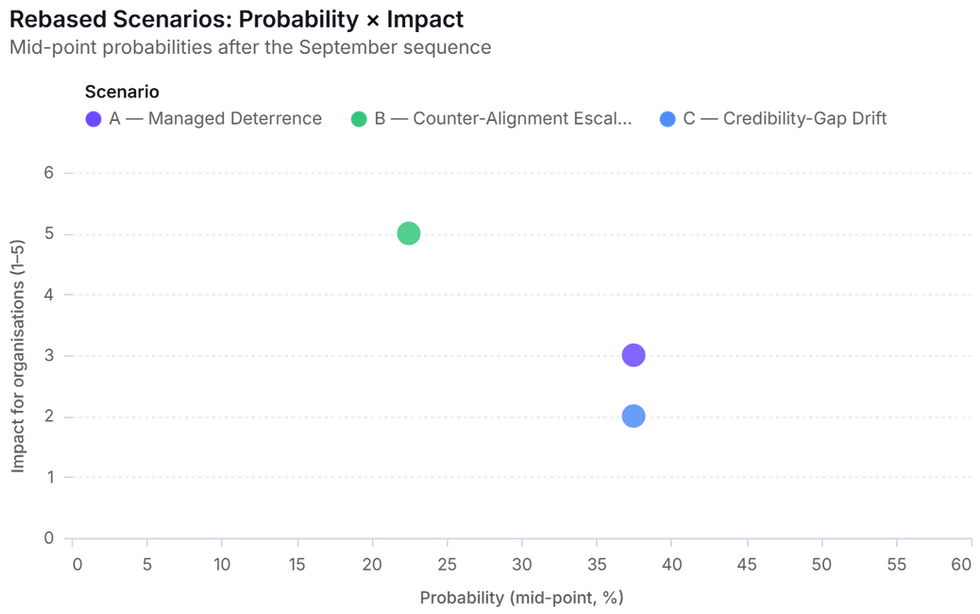
Scenario A — Managed Deterrence Without Rupture (Probability: ~35–40%)
The alliance consolidates as a political-military coordination framework without triggering collective combat operations. The joint coordination centre becomes operational; the Riyadh secretariat staffs up under its Pakistani secretary-general; the committee cadence established at Istanbul holds at quarterly intervals. Defence-industrial cooperation produces initial deliverables — jointly produced Baykar variants, Roketsan munitions components, Aselsan EW kits integrated into Saudi and Pakistani platforms — within 18–24 months. Pakistan's troop deployment stabilises at current levels. Egypt declines formal accession but establishes a liaison relationship. Iran stays out. The Yemen front settles into an armistice-of-exhaustion after the Omani channel produces at least a partial freeze. The US maintains its endorsement while monitoring defence-industrial cooperation for sanctions exposure.
Why not higher: the September sequence has already demonstrated that Riyadh will bypass its partners in extremis, and the Houthi rejection of the two-week ceasefire keeps the activation question alive — every additional Saudi casualty raises the political cost of inaction for Islamabad and Ankara. Why not lower: all three signatories retain structural incentives to keep the framework alive, the institutional machinery is genuinely functioning, and no signatory has repudiated the clause — it has merely gone uninvoked.
Scenario B — Activation and Counter-Alignment Escalation (Probability: ~20–25%)
One or more triggers fire: a mass-casualty Houthi strike on the Kingdom forces formal invocation of the collective-defence consultation mechanism — compelling Pakistan and Türkiye to either honour the clause or expose it; or the hexagon formalises into a binding mutual-defence arrangement with India, Greece, and Cyprus, producing two competing blocs; or Egypt accedes under Gulf financial pressure, adding the Arab world's largest military to the framework. Under this scenario the pact evolves toward a broader security umbrella with five to seven members, the Middle East bifurcates into competing blocs, and maritime corridors — Red Sea, Eastern Mediterranean, Arabian Sea — become zones of competitive military posture.
Why not higher: every prospective expansion candidate has stalled — Cairo's non-alignment instincts have prevailed, Tehran has denied the invitation, and Riyadh itself is negotiating with its adversary rather than invoking its allies. Why not lower: the Houthi campaign continues, Israel's hexagon logic remains reactive but intact, and a single mass-casualty event remains within the plausible distribution.
Scenario C — Credibility-Gap Drift (Probability: ~35–40%)
The September pattern becomes the template. The committee meets, the secretariat functions, joint statements issue — but the alliance does not graduate from consultation to collective action. Parliamentary ratification stalls in Ankara or Islamabad, leaving the pact a leaders' agreement without binding domestic force; prospective members hesitate to accede to a framework whose founders have not themselves bound themselves domestically, as regional analysts have already sketched (Middle East Council on Global Affairs, 9 September 2026). The clause survives unused. The alliance persists as a defence-industrial coordination forum and political signal, while actual Saudi security policy reverts to bilateral channels — Washington, Paris, Muscat — and transactional deals with whoever will fight. As one assessment put it after the September sequence, states honour alliances until the cost of doing so becomes greater than the cost of stepping back (Firstpost opinion analysis, 14 September 2026). The agreement joins the Baghdad Pact (1955) and CENTO in the graveyard of frameworks that looked formidable on paper — with the difference that its industrial wing may outlive its security wing.
Why not higher: the defence-industrial content gives the alliance a commercial raison d'être independent of the clause, and Pakistan's deployment is a sunk commitment that will not be reversed quickly. Why not lower: the first test has already produced a documented bypass — Riyadh turning to Washington before Ankara and Islamabad — and the trend of Saudi exit-searching (ceasefire proposals, French reinforcement) points toward de-escalation outside alliance structures rather than activation through them.
9. Implications
For organisations with exposure to Gulf energy infrastructure: Continue modelling Hormuz and Bab al-Mandeb disruption as baseline conditions through at least Q1 2027. Treat the Jazan outage, the East-West pipeline shutdown of 11 September, and war-risk premiums of 3% of hull value for Saudi-linked tonnage as the current baseline, not tail scenarios — while recognising that baselines recalibrate with each Omani-channel round. Model pipeline corridor redundancy now, not upon invasion headlines. Discount all deterrence-appreciation claims by one full escalation notch: the alliance's cohesion has been tested exactly once, under conditions well short of Article 5 activation, and the result was a Saudi ceasefire proposal.
For defence and aerospace firms: Map exposure along the Baykar–SAMI–Aselsan–Roketsan axis and the KAAN negotiation line; treat Turkish defence export growth — $10.05 billion in 2025, $17.8 billion in new contracts — as the leading indicator of trilateral industrial commitments. Audit ITAR, technology-transfer and intellectual-property exposure on any contract touching all three signatories. Position on either side of the divide created by US restrictions protecting Israel's qualitative military edge: those restrictions now function as a protected market niche for jointly produced trilateral systems.
For financial institutions with Gulf and South Asian sovereign exposures: Treat the 2026 Saudi fiscal ceiling as already breached in substance, whatever the year-end print shows. Stress-test Pakistan's credit profile against the fragility that the April 2026 backstop addresses without resolving, assume upward pressure on combined defence budgets of ~$124.4 billion under any expansion scenario, and treat Pakistani force deployment levels in the Kingdom — not pact statements — as the operative guarantee metric.
For sovereign-credit and capital markets desks: Model Saudi deficit expansion to 6–8% of GDP under sustained attrition and sovereign-credit deterioration under escalation scenarios. Treat PIF as a counterparty whose bond-funded deployment continues while Aramco dividend capacity stays depressed — a widening gap, not a stable position. Monitor CDS levels and the fate of the mooted Saudi state-backed war-risk pool as twin fiscal-strain indicators (Reuters, 25 September 2026). Under Scenario C conditions, stress-test the sovereign stack of all three signatories for a negative rating action before Q3 2027, with Pakistan the most exposed.
For supply chain and logistics operators: Assume the fragmentation of Gulf security cooperation into parallel, partially overlapping frameworks — trilateral pact, Jeddah coalition, UAE bilateral arrangements, French reinforcement around Yanbu — and model coordination friction in every corridor decision. Budget war-risk premiums of 1–3% of hull value for Red Sea exposure as the new baseline, with peak quotes up to 10% for Saudi-linked tonnage; war-risk claims have already topped $2 billion and commercial insurance capacity shows signs of exhaustion (gCaptain, 3 September 2026; Reuters, 25 September 2026). Audit insurance for war-exclusion language drafted before the Joint War Committee extended its high-risk line 800 kilometres up the Saudi west coast.
For organisations with India exposure: Model heightened naval competition in the Arabian Sea between the pact's maritime components and Indian naval operations, elevated under Scenario B. Route contingency planning through the India-Israel counter-alignment axis. Treat any formalisation of the Jerusalem hexagon as a leading indicator of Arabian Sea incident risk.
For security and risk managers: The collective-defence clause means a crisis affecting one signatory can rapidly draw in the other two — expand the geographic scope of crisis protocols accordingly. Maintain hostile-environment postures for personnel in all three signatory states; route medevac protocols on the assumption that a multi-state crisis will close corridors in sequence, not in parallel. Pre-position extraction triggers, not extraction intentions.
10. Core Analytical Judgment
The Mecca Joint Defence Agreement is not a "Muslim NATO," and it is not a diplomatic façade. It is a hedge — designed to give the Kingdom diversified security provision, Türkiye strategic depth, and Pakistan financial reinforcement, without any of the three committing to a level of integration they cannot sustain. What September demonstrated is that hedges, too, get tested. The institutions built after the text are real: a committee that meets, a secretariat that staffs, a name that circulates in other capitals' planning documents. But the September sequence — Mocha and Perim lost, Jazan burning again, the pipeline down, Riyadh on the phone to Washington rather than Ankara — showed the Clause at the centre of the architecture deferring to the Clause at its foundation: when survival was at stake, the Kingdom reached for the guarantee it knows, not the guarantee it built.
The deterrence value was always asymmetric — credible in defending Saudi Arabia, implausible in defending Türkiye or Pakistan — and September revealed a second asymmetry within the first: the signatories will deploy to the Kingdom, but they have not yet fought for it, and Riyadh has not yet demanded that they do. The defence-industrial dimension remains the accord's most consequential long-term output: a procurement pathway outside American restrictions, an industrial base that compounds yearly, and interoperability that, once built, cannot be easily unbuilt. The expansion dynamic — Egypt hesitating, Iran denying, Syria studying — will determine whether this becomes a genuine regional security architecture or a three-member industrial club with a decorative preamble. The coming twelve months will be decided not in committee rooms but on the Yemeni coast.
If the Houthis consolidate around Bab al-Mandeb and Riyadh's Omani channel fails, the Kingdom will face the choice the pact was designed to defer: invoke its allies and discover what the clause is worth, or dissolve into the bilateral marketplace and confirm what the September sequence suggested. Either outcome reprices Middle East political risk; only one of them defines the alliance.
Alliances are proven by the war their architects hope to deter — and the Mecca Pact, in its first quarter of existence, has met the oldest rule of the genre: the paper holds everything except the load.
---
Want deeper analysis?
Bespoke advisory and theatre-level assessments are available on request — scenario planning, country and sector deep dives, crisis stress-testing, and board-level briefings. Engagements are confidential.
Thierry Marquez — Founder & Principal Advisor, CES Intelligence
+33 (0)9 55 16 54 98 →
DISCLAIMER
This analysis is provided for informational and strategic planning purposes only. It is not investment advice, financial advice, or legal advice, and it should not be treated as such. Probability assessments reflect the analyst's calibrated judgment based on available open-source intelligence as of the date of publication and are subject to revision as new information emerges. Some quantitative estimates and reported events are based on regional sourcing that may evolve as additional confirmation becomes available.


