Turkey Sells the Green Transition by the Barrel

CES DAILY SIGNAL — OCTOBER 8, 2026
Bids close on 13 October for the country's 2026 renewable auction round — 2.4 GW of wind and solar offered since July — twenty-seven days before the Antalya Expo Center opens COP31 to the world's climate diplomats (Ministry of Energy and Natural Resources, July 2026). The tender carries an unusual patron: an intergovernmental agreement sealed in Riyadh on 3 February committed Saudi investors to $2 billion and 2 GW of solar at Sivas and Karaman, the first tranche of a 5 GW framework (Reuters, 3 February 2026), with detailed contracts finalized in Istanbul on 20 February (Turkish Minute, 20 February 2026). Energy Minister Alparslan Bayraktar has already announced that the second phase — a further 3 GW — will be signed on the summit's sidelines in Antalya (Renewables Now, 17 August 2026).
Ankara is using the COP31 presidency as collateral for foreign renewable capital while accelerating Black Sea hydrocarbon drilling on a parallel clock — the divergence between the two clocks, not either one alone, is the exposure.
Trajectory
The 13 October round closes substantially subscribed, and Antalya delivers a showcase presidency built on the country's distributed-solar record. The pre-announced 3 GW Saudi phase is signed on the summit's sidelines as scripted, anchoring follow-on tranches to the 5 GW joint pipeline, while a western-basin Black Sea exploration well spuds before the closing plenary. Ankara then presents gas finds and gigawatts as a single national energy-security narrative. After the closing ceremony, auction cadence converges with transmission-grid throughput, which becomes the binding constraint on deployment through the first quarter of 2027, and grid-and-storage packages become the main negotiating currency with Gulf and European financiers.
Second-Order Effects
For European industrial off-takers and grid planners alike, a host country adding solar at this pace — 89 percent of it through unlicensed, self-consumption installations — builds a decarbonised Anatolian cost base under CBAM pressure and cheap cross-border electron potential: renewed southeast-European interconnection interest and competitive pressure on Balkan capacity markets is likely (see our European Energy Security assessment, 2026).
For Gulf sovereign investors, ACWA Power's entry is a realistic possibility template: the Riyadh deal shifts portfolio weight from megaproject overruns into distributed-generation yield assets, with comparable pipelines in Greece and Egypt repriced accordingly.
For incumbent gas suppliers — Azerbaijan above all, then Russia and LNG aggregators — every domestically produced bcm displaces an imported one, and Turkish gas contract renewal cycles falling between 2026 and 2028 land squarely in that window.
Analysis
The presidency as catalogue
The summit deal itself was engineered for exactly this leverage. A deadlock between two rival bidders ended at COP30 with Ankara hosting and holding the COP31 presidency — Environment Minister Murat Kurum presiding, his Australian counterpart Chris Bowen running the formal negotiations (Climate Home News, 11 September 2026; Anadolu Agency, 12 September 2026). What Ankara bought with that compromise is stage time, and the government is already scripting the set: an artificial-intelligence initiative launched on the UN General Assembly's sidelines ahead of the summit (Reuters, 21 September 2026), even as critics flag the awkwardness of a host expanding coal alongside its climate credentials (The Guardian, 5 October 2026). The scale of Turkey renewable energy investment — 120 GW of combined wind and solar targeted by 2035, with at least 2 GW offered annually through auctions until then — converts stage time into capital (Bayraktar statements via Anadolu Agency, February 2026). Given ACWA Power's sovereign anchor already committed, the 13 October round clearing near its offered capacity is highly likely. This is an investment vehicle, not a climate pivot.
Turkey Renewable Energy Investment: Demand Truth, Supply Duality
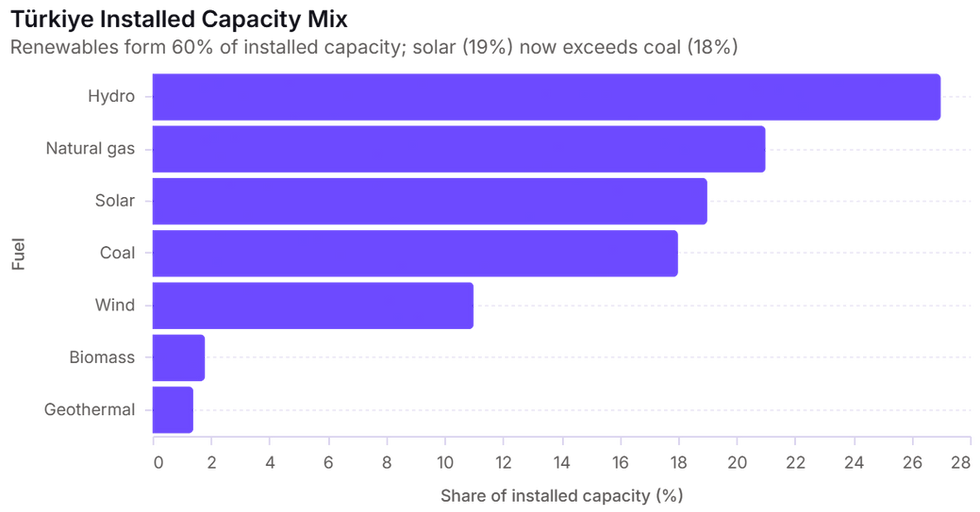
The economic bedrock is real: electricity demand grows nearly 5 percent a year, from 347 TWh generated in 2024 toward at least 510 TWh by 2035 (US International Trade Administration, 2026). Solar is absorbing much of that increment — 10.5 percent of generation in 2025, up from 4.7 percent in 2022 (Ember, April 2026) — but through a striking channel: of 4,694 MW of new solar commissioned in 2025, 4,175 MW came from unlicensed, self-consumption facilities (per TEİAŞ data via IEA-PVPS, 2026). Renewables now sit at 62.1 percent of installed capacity, on a 122.5 GW system (IRENA, March 2026). Yet hydro remains the swing supplier, with the renewable share of monthly generation swinging from 72.3 percent in May to 68.7 percent in June 2026 (TSKB Energy Bulletin, July 2026). The hydrocarbon flank targets the same import bill from the other side: a 75 bcm Black Sea gas find with production slated to double by 2026 and again by 2028 (S&P Global, May 2025), six exploration wells planned across the basin this year (GeoExPro, 2026), inside a national programme of more than 280 wells in 2026 (Türkiye Today, 2026) — a campaign accelerating precisely as Antalya prepares its stage (see our Türkiye 2026 Geopolitical Risk Assessment, 2026). For European industrial off-takers, the unlicensed share of solar additions matters more than the auction round itself: distributed self-consumption is building an Anatolian cost advantage under CBAM pressure before the state auctions ever dispatch. Wind and solar failing to hold financed dispatch is likely without storage procurement, because distributed growth has outrun licensed grid planning — which is precisely why transmission and storage packages, not generation, carry the commercial gravity of the post-summit period for network operators and European financiers, in a global environment where more than 2,500 GW of projects already stall in grid-connection queues (IEA, 2026).
What survives the closing ceremony
Whether Turkey renewable energy investment keeps its cadence after the delegations leave is the durability question, and the domestic context sharpens it: Turkish regulators ordered the liquidation of 131 investment funds managing over $20 billion after redemptions failed, hitting nearly half a million investors hedging a depreciating lira (Reuters, 2 October 2026). A financial sector in contraction does not merely make Gulf sovereign capital more visible in the renewable pipeline — it makes it structuring, shifting deal terms toward hard-currency off-take and inter-governmental tranches. That dependency cuts both ways: follow-on Saudi tranches arriving on schedule at Antalya is likely, but it concentrates sovereign counterparty risk in the very sector Ankara markets as its diversification story. Beyond that, the binding constraint for deployment is transmission and storage, not financing or legitimacy, and the likely post-COP sequence is a negotiation over grid packages with the same Gulf and European institutions attending Antalya as investors. The scenario that breaks the coupling — hydrocarbon setbacks combined with auction under-subscription — is a remote possibility within ninety days, but it would surface early in the signals below rather than in summit communiqués.
Signals to Watch
This reading holds unless the 13 October round closes materially undersubscribed — a weak clearance relative to offered capacity would signal the sovereign anchor, not the summit, is carrying the pipeline.
Drilling escalation becomes visible if a western Black Sea well spuds before the summit opens on 9 November; watch contractor notices through late October.
The closing declaration on 20 November matters less than dated grid and storage procurement commitments — target language without megawatt-month figures is showcase, not policy.
Watch the drawdown schedule of the February $2 billion Saudi tranche in early 2027 disclosures: a deferred schedule would precede any visible slowdown in auction cadence.
---
Want deeper analysis?
Bespoke advisory and theatre-level assessments are available on request.
Thierry Marquez — Founder & Principal Advisor, CES Intelligence
+33 (0)9 55 16 54 98 →
DISCLAIMER
This CES Daily Signal is provided for informational and strategic planning purposes only. It is not investment advice, financial advice, or legal advice, and it should not be treated as such.
Probability assessments reflect the analyst's calibrated judgment based on available open-source intelligence as of the date of publication and are subject to revision as new information emerges.


